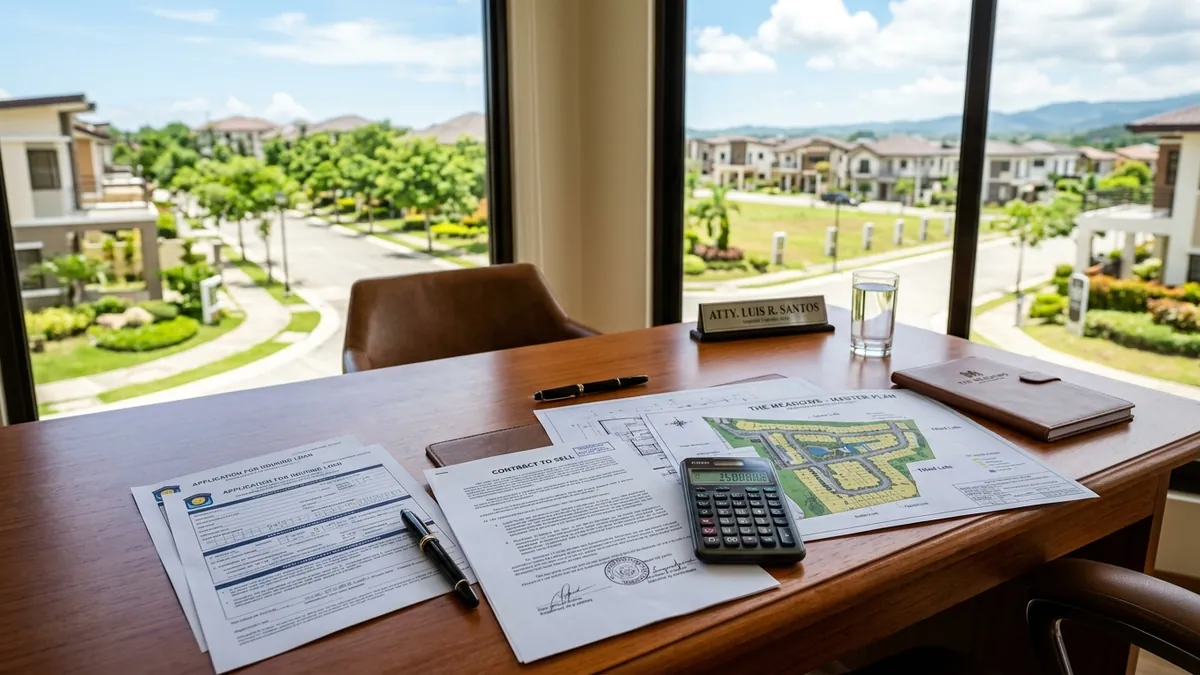
For millions of Overseas Filipino Workers (OFWs), sea-based mariners, and cross-border professionals remitting earnings from the Middle East, Asia-Pacific, Europe, and North America, purchasing a parcel of titled land in the Philippines represents the foundational cornerstone of long-term family security. Yet, a persistent misconception circulates across overseas Filipino communities: many believe that the Pag-IBIG Fund (Home Development Mutual Fund or HDMF) only finances ready-built subdivision houses or urban condominium units, leaving land buyers solely dependent on high-interest personal loans, informal developer in-house financing, or immediate cash outlays.
That assumption is factually incorrect. Under the official guidelines of the Pag-IBIG Fund End-User Home Financing Program, titled residential land acquisition is explicitly recognized as an eligible standalone loan purpose. An OFW can finance the purchase of a residential lot up to 1,000 square meters, or combine lot acquisition with immediate residential construction, backed by government-guaranteed loan terms stretching up to 30 years and competitive fixed interest rates.
However, securing a Pag-IBIG housing loan from overseas is not an automated or casual transaction. It is a rigorous mortgage underwriting procedure governed by statutory administrative issuances, including Pag-IBIG Circular No. 449 and Circular No. 396, Presidential Decree No. 1529 (the Property Registration Decree), the National Internal Revenue Code (NIRC), and cross-border consular protocols established under the 1961 Hague Apostille Convention. Every step requires strict documentary alignment, from verified Migrant Workers Office (MWO) employment contracts and specialized Special Power of Attorney (SPA) mandates to forensic collateral title due diligence and on-site geodetic appraisal inspections.
As a licensed real estate broker, licensed real estate appraiser, and property conveyancing practitioner managing acquisitions, boundary validations, and mortgage releases across Ilocos Sur and Northern Luzon, I have authored this guide to provide overseas Filipinos with an exhaustive, legally grounded blueprint. Whether you are an OFW nurse in London, an IT consultant in Singapore, an engineer in Dubai, or a chief engineer aboard an international container vessel, this guide details statutory loan purposes, cross-border documentary dockets, mathematical borrowing capacity calculations, bank versus Pag-IBIG comparisons, post-approval Registry of Deeds mortgage registration, and a complete financial closing model for provincial titled land.
Financing a Titled Lot in the Philippines from Abroad?
LandMaster Realty provides end-to-end mortgage coordination, forensic title verification, geodetic boundary surveys, and Registry of Deeds mortgage registration for Overseas Filipino Workers (OFWs). We represent overseas buyers on the ground in Ilocos Sur and Northern Luzon, ensuring that your Pag-IBIG or commercial bank loan is approved and disbursed without costly delays or legal vulnerabilities.
1. Statutory Framework: Pag-IBIG Circular No. 449 and Residential Lot Purchase Rules
To navigate the Pag-IBIG housing loan program successfully, overseas buyers must understand the statutory foundation that empowers the agency to finance real estate. The Home Development Mutual Fund was created under Presidential Decree No. 1752 and substantially strengthened by Republic Act No. 9679, known as the Home Development Mutual Fund Law of 2009. Under RA 9679, Pag-IBIG is mandated to administer a nationwide provident savings program and provide affordable housing financing for Filipino workers, including mandatory coverage for overseas workers registered with the Philippine Overseas Employment Administration (POEA), now integrated into the Department of Migrant Workers (DMW).
The operational rules governing retail mortgage loans are codified in Pag-IBIG Fund Circular No. 449 (Amended Guidelines on the Pag-IBIG Fund End-User Home Financing Program) and its companion issuance, Circular No. 396. These administrative issuances establish the exact categories of real estate that the Fund is legally authorized to finance.
Eligible Standalone Loan Purposes vs Combined Programs
Under Circular No. 449, the Fund classifies land and home financing into distinct, mutually exclusive loan purposes. For an OFW acquiring real property, three primary options exist:
- Purchase of Residential Lot (Standalone): The borrower obtains financing strictly to acquire ownership of an unimproved, titled parcel of residential land. The borrower is under no immediate regulatory obligation to begin house construction within a specified timeframe, provided the property meets all collateral title requirements.
- Purchase of Residential Lot and Construction of House: The borrower applies for a single consolidated loan package that covers both the acquisition of the vacant residential lot and the simultaneous construction of a residential dwelling on that lot. Loan disbursements for the construction component are released in tranches based on verified progress of works.
- House Construction on an Owned Lot: If the OFW already owns a titled residential parcel (whether acquired through inheritance, cash purchase, or prior loan settlement), they can apply for financing dedicated entirely to erecting a residential structure according to approved architectural plans and building permits.
The 1,000 Square Meter Maximum Lot Area Ceiling
A critical statutory limitation that frequently catches overseas buyers unprepared is the area ceiling imposed on standalone lot purchases. Under Pag-IBIG underwriting guidelines, the maximum allowable land area for a standalone residential lot purchase is strictly 1,000 square meters.
This cap is deliberate. The statutory purpose of Pag-IBIG Fund is to provide shelter and residential stability for Filipino families, not to subsidize commercial land speculation, real estate hoarding, or large-scale agricultural operations. If an OFW identifies a desirable provincial property measuring 1,500 square meters or 2,500 square meters under a single title, Pag-IBIG will automatically decline the standalone lot application, unless the parcel is formally subdivided into separate Torrens titles through an approved geodetic subdivision plan, allowing a qualifying 1,000 square meter portion to serve as the collateral.
Ineligible Land Classifications: Agricultural, Commercial, and Untitled Land
Under Pag-IBIG Circular No. 449, the Fund maintains strict exclusionary rules regarding property classification. The following types of land are strictly disqualified from Pag-IBIG financing:
- Agricultural Land Subject to Agrarian Reform: Lands classified as agricultural under the Comprehensive Agrarian Reform Program (CARP / Republic Act No. 6657) or covered by Certificates of Land Ownership Award (CLOA) and Emancipation Patents (EP) cannot be financed through Pag-IBIG. The Fund only accepts lands zoned for residential use.
- Commercial and Industrial Lots: Properties designated exclusively for commercial establishments, warehouses, or industrial plants cannot be financed under the residential home financing window.
- Untitled Properties (Tax Declarations Only): Properties that lack a Torrens title and are evidenced solely by a municipal tax declaration are categorically ineligible. Pag-IBIG requires an indefeasible Torrens title registered under the Torrens system.
- Properties Without Permanent Road Access: Any parcel that lacks a legal, permanent, and physical right-of-way connecting to a public road is automatically rejected during on-site appraisal inspection.
| Financing Parameter | Standalone Lot Purchase | Lot Purchase + House Construction | House Construction on Owned Lot |
|---|---|---|---|
| Maximum Land Area | Strictly up to 1,000 square meters | Up to 1,000 square meters | No statutory land cap (Appraisal based on structure) |
| Maximum Loan Amount | Up to 6,000,000 PHP (Subject to capacity and LTV) | Up to 6,000,000 PHP (Combined lot and structure) | Up to 6,000,000 PHP (Based on bill of materials) |
| Standard Retail LTV Ratio | 80% to 85% of Pag-IBIG Appraised Value | 85% to 90% of Total Appraised Value | Up to 90% of Appraised Construction Cost |
| Maximum Repayment Tenor | Up to 30 years (Cannot exceed age 70 at maturity) | Up to 30 years (Cannot exceed age 70 at maturity) | Up to 30 years (Cannot exceed age 70 at maturity) |
| Disbursement Mechanism | Single lump-sum check to seller after title transfer | Lump sum for lot, staged tranches for construction | Staged progress tranches based on ocular inspection |
| Zoning Requirement | Strictly Residential (TCT/OCT must be clean) | Strictly Residential with building permit | Residential zoning with local building permit |
2. OFW Eligibility and Borrowing Capacity Calculations
Before selecting a prospective parcel of land, an OFW must verify their legal eligibility and calculate their actual borrowing capacity under Pag-IBIG underwriting standards. In retail mortgage lending, loan approval is determined not by personal enthusiasm or verbal seller agreements, but by mathematical underwriting formulas that evaluate the borrower’s risk profile.
Fundamental Membership Qualifications
To qualify for a Pag-IBIG retail housing loan to purchase land, an overseas worker must satisfy the following core criteria:
- Active Membership and 24-Month Contribution Rule: The member must have remitted at least 24 monthly membership savings (contributions) at the time of application. An OFW who has not completed 24 months of continuous savings is permitted under Pag-IBIG rules to make a lump-sum payment of the required balance to fulfill the 24-month requirement immediately. Both regular mandatory HDMF savings and voluntary Modified Pag-IBIG II (MP2) savings contribute toward establishing active member standing.
- Age Limits: The borrower must be no more than 65 years old at the date of loan application and must not exceed 70 years old at the date of loan maturity. For an OFW seeking a maximum 30-year loan term, the application must be filed before their 40th birthday. A 55-year-old OFW applicant is eligible for a maximum loan repayment tenor of 15 years (70 minus 55).
- Legal Capacity: The applicant must possess full legal capacity to acquire, own, and encumber real property under Philippine civil law.
- Satisfactory Credit History: The borrower must pass Pag-IBIG’s credit background check, which cross-references default records across the Credit Information Corporation (CIC), banking databases, and existing Pag-IBIG short-term or multi-purpose loans.
- No Existing Defaulted Housing Loans: The borrower must not have an outstanding Pag-IBIG housing loan that is currently delinquent or in default, whether as a principal borrower or as a co-borrower.
The Threefold Borrowing Capacity Formula
Under Pag-IBIG Circular No. 449, the approved loan amount is determined by taking the lowest figure among three independent parameters:
- The Actual Loan Amount Applied For: The specific financial figure requested by the borrower in their application form.
- The Borrower’s Capacity to Pay (Debt-Service Ratio): The loan amount derived from the borrower’s verified net disposable income. For housing loans up to 1,250,000 PHP, the monthly amortization must not exceed 35% of the borrower’s gross monthly income. For retail loans exceeding 1,250,000 PHP, underwriting guidelines cap the monthly amortization between 30% and 35% of gross monthly income, depending on regional income brackets and total living liabilities.
- The Loan-to-Value (LTV) Ratio of the Collateral: The maximum loan percentage permitted against the Pag-IBIG Appraised Value of the land. For retail lot purchases from private individual sellers, the loan-to-value ceiling is typically 80% to 85% of the appraised value determined by Pag-IBIG’s licensed appraisal personnel.
| Gross Monthly OFW Income | Max Monthly Amortization (35%) | Estimated Max Loan (20-Yr Term @ 6.25%) | Estimated Max Loan (30-Yr Term @ 6.25%) |
|---|---|---|---|
| 50,000 PHP (~890 USD) | 17,500 PHP | ~2,390,000 PHP | ~2,840,000 PHP |
| 80,000 PHP (~1,425 USD) | 28,000 PHP | ~3,830,000 PHP | ~4,550,000 PHP |
| 120,000 PHP (~2,140 USD) | 42,000 PHP | ~5,750,000 PHP | 6,000,000 PHP (Program Cap) |
| 150,000+ PHP (~2,675+ USD) | 52,500 PHP | 6,000,000 PHP (Program Cap) | 6,000,000 PHP (Program Cap) |
Note: Amortization figures are calculated using a baseline indicative interest rate of 6.25% per annum fixed for 3 years, excluding mandatory monthly premiums for Mortgage Redemption Insurance (MRI) and Fire Insurance.
The Critical Appraised Value vs Selling Price Reality
The single most frequent shock experienced by overseas Filipino buyers is the gap between the seller’s asking price and Pag-IBIG’s appraised valuation. A private landowner in a developing municipality may demand 2,000,000 PHP for a 300 square meter residential lot. However, when Pag-IBIG’s appraiser inspects the location and cross-references recent comparable sales and municipal tax data, the Fund may appraise the property at 1,600,000 PHP.
If the approved LTV is 85%, Pag-IBIG will lend 85% of 1,600,000 PHP, which equals 1,360,000 PHP. The OFW borrower is legally responsible for funding the remaining 640,000 PHP difference (2,000,000 PHP selling price minus 1,360,000 PHP loan release) directly to the seller as cash equity. Understanding this dynamic is essential to prevent liquidity shortfalls during transaction closing.
3. The Complete Cross-Border Documentary Docket for OFWs
Because an Overseas Filipino Worker resides outside the Philippines while applying for a mortgage loan, standard domestic documentation protocols are insufficient. Cross-border loan underwriting requires strict verification of foreign employment legitimacy, consular authentication of legal representation, and civil status documentation under Philippine law.
Pag-IBIG Housing Loan Application Forms and Virtual Submission
The loan application begins with the completion of the standard Pag-IBIG Housing Loan Application (PHLA / Form HQP-HLF-068 or HQP-HLF-069). Today, an OFW can initiate the pre-qualification phase digitally through the Virtual Pag-IBIG for Members online portal. The digital system generates a tracking reference number and an initial documentary requirement checklist based on the member’s profile.
Special Power of Attorney (SPA) and the 2019 Hague Apostille Protocol
Because the OFW cannot personally attend title signings, BIR assessments, and loan closings in the Philippines, appointing an Attorney-in-Fact through a specialized Special Power of Attorney is mandatory. Under Article 1878 of the Civil Code of the Philippines, an agent must have an express, written, and notarized Special Power of Attorney to enter into any contract by which the ownership of an immovable is transmitted or encumbered, or to create or convey real rights over immovable property.
Crucially, Pag-IBIG provides its own standard Special Power of Attorney template (specifically customized for housing loan transactions). Using a generic, broadly phrased SPA template downloaded from the internet will result in immediate rejection by Pag-IBIG legal reviewers. The SPA must contain explicit authority allowing the representative to:
- Sign the Pag-IBIG Housing Loan Application and all associated mortgage agreements.
- Execute the Real Estate Mortgage (REM) over the specific parcel of land, identifying the property by its precise Transfer Certificate of Title (TCT) number, lot number, block number, and registered location.
- Receive the Notice of Approval (NOA), Letter of Guaranty (LOG), and loan proceeds checks on behalf of the principal borrower.
- Represent the buyer before the Bureau of Internal Revenue (BIR) for electronic Certificate Authorizing Registration (eCAR) issuance, the City or Municipal Treasurer, and the Registry of Deeds.
The execution of the SPA depends on the country where the OFW is currently stationed:
- Apostille Member Countries: If the OFW resides in a country that is a party to the 1961 Hague Apostille Convention (such as the United States, Canada, the United Kingdom, Australia, Japan, Singapore, New Zealand, or European Union member nations), the OFW signs the Pag-IBIG SPA before a local foreign public notary. The notarized document is then submitted to the designated competent foreign government authority (such as the Secretary of State in the US, the Foreign, Commonwealth & Development Office in the UK, or the Ministry of Foreign Affairs in Singapore) to receive an official Apostille Certificate. Once apostilled, the document is legally valid in the Philippines without requiring authentication by the Philippine Embassy or Consulate.
- Non-Apostille Countries: If the OFW works in a country that has not acceded to the Hague Apostille Convention (such as the United Arab Emirates, Qatar, Saudi Arabia, Kuwait, or Oman), the SPA must be executed before a local foreign notary, authenticated by the foreign country’s Ministry of Foreign Affairs (MOFA), and subsequently legalized by the Philippine Embassy or Consulate General through consular authentication.
Proof of Overseas Income Docket
To substantiate borrowing capacity, the OFW must present verified evidence of overseas earnings. Under Pag-IBIG underwriting standards, the income docket requires three layers of verification:
- Verified Employment Contract: For land-based OFWs, an active employment contract verified by the Migrant Workers Office (MWO), formerly known as the Philippine Overseas Labor Office (POLO), or a standard employment contract authenticated by the Department of Migrant Workers (DMW / POEA). For domestic or corporate professionals exempted from MWO verification, an apostilled foreign employment contract accompanied by employer certification is required.
- Certificate of Employment and Compensation (CEC): An original employer certification issued within the last six months, stating the OFW’s exact position, employment tenure, gross monthly basic salary, regular allowances, and tax withholding status. For documents written in a foreign language (such as Arabic, German, or Japanese), an official English translation authenticated by an authorized embassy translator is mandatory.
- Recent Payslips and Remittance Bank Statements: Certified copies of consecutive monthly payslips for the last three to six months, paired with three to six months of bank statements showing salary credits or formal overseas remittance slips (e.g., Western Union, bank wire transfers) remitted to Philippine bank accounts.
- Seafarer-Specific Requirements: For sea-based mariners, the docket must include the latest POEA-approved Seafarer Employment Contract, a Certificate of Sea Service from the local crewing agency, the official Crew List, and recent monthly allotment slips reflecting remittances to a designated Philippine bank account.
Civil Status and Identification Documents
Under the Philippine Family Code (Executive Order No. 209), the property relations of Filipino spouses are governed by the system of Absolute Community of Property (for marriages celebrated on or after August 3, 1988) unless a valid prenuptial agreement was executed before marriage. Consequently, if the OFW applicant is married, spousal consent is legally mandatory. Both spouses must sign the mortgage documents, or the overseas spouse must execute an apostilled marital consent SPA.
The applicant must submit:
- Philippine Statistics Authority (PSA) authenticated Certificate of Marriage (issued within the last six months).
- For single applicants: PSA Certificate of No Marriage Record (CENOMAR).
- Two valid government-issued photo identifications of the OFW borrower (Philippine Passport and overseas resident ID or work permit).
- Two valid government-issued photo identifications of the designated Attorney-in-Fact in the Philippines.
- Tax Identification Number (TIN) verification for both borrower and spouse.
4. Collateral Title Due Diligence: What Pag-IBIG Inspects Before Approval
When an OFW applies for a housing loan to buy land, the property itself serves as the underlying security for the financial exposure through a registered Real Estate Mortgage (REM). Consequently, Pag-IBIG conducts an exhaustive collateral investigation. If the target parcel has technical defects, encumbrances, or boundary disputes, the loan application will be frozen or rejected regardless of how high the borrower’s overseas salary may be.
As a licensed appraiser, I routinely observe loan applications collapse because buyers failed to verify title cleanliness before submitting their papers. An OFW must conduct rigorous due diligence across four key dimensions before committing to a parcel:
1. Torrens Title Verification at the Registry of Deeds (TCT/OCT)
The seller must provide an original Certified True Copy of the Transfer Certificate of Title (TCT) or Original Certificate of Title (OCT) issued by the Registry of Deeds responsible for the municipality where the land is located. Under Pag-IBIG rules, the Certified True Copy must have been issued within the last 30 to 90 days.
The memorandum of encumbrances on the back of the title must be scrutinized for adverse annotations. A clean title must be free of:
- Existing unresolved real estate mortgages or chattel mortgages.
- Notices of Lis Pendens indicating pending court litigation over ownership.
- Adverse claims filed by third-party claimants under Section 70 of Presidential Decree No. 1529.
- Uncancelled attachments, tax liens, or court execution orders.
- Unsettled estate liens under Section 4 Rule 74 of the Rules of Court (applicable to properties inherited within the past two years).
2. Certified Tax Declarations and Municipal Tax Clearance
The collateral docket requires an updated Certified True Copy of the Tax Declaration for Land issued by the Municipal Assessor’s Office. If the property is being purchased as a vacant lot, the Assessor must also issue a formal Certificate of No Improvement, confirming that no unassessed residential buildings or commercial structures exist on the parcel.
Additionally, the seller must provide the official receipts for the latest Real Property Tax (amilyar) payments and a formal Municipal Tax Clearance issued by the Municipal Treasurer, verifying that all property taxes are paid up to date with zero accumulated delinquency surcharges.
3. Geodetic Vicinity Map, Subdivision Plan, and Road Right-of-Way
Pag-IBIG appraising engineers require technical surveying documentation to locate and validate the parcel in relation to public infrastructure. The seller or borrower must submit:
- An approved Subdivision Plan or Cadastral Map showing the exact configuration of the lot, lot numbers, and adjoining boundary lines.
- A certified Vicinity/Location Map prepared and signed by a licensed Geodetic Engineer, providing precise driving directions, prominent landmarks, and geographic coordinates.
- Verified Permanent Road Right-of-Way (RROW): Under Pag-IBIG property standards, the target lot must have direct, physical, and legally recognized access to an existing public road (national, provincial, municipal, or barangay road). If the parcel is located inside an informal private subdivision or interior development, the access road must be deeded as an open road right-of-way or registered as a perpetual easement of right-of-way on the titles of servient estates under Civil Code Articles 649 to 657. Landlocked properties without verified legal road access are disqualified from Pag-IBIG financing.
4. Physical On-Site Property Appraisal
Once the documentary docket passes initial scrutiny, Pag-IBIG dispatches an appraiser to conduct an on-site property inspection. The appraiser verifies:
- Physical Boundary Verification: Ensuring that physical boundary markers (mojones) correspond accurately with the technical descriptions in the title.
- Terrain and Environmental Hazards: Assessing flood risk, ground instability, proximity to high-voltage transmission lines, and riverbank easements.
- Neighborhood Development: Evaluating the presence of basic utilities (electricity grid connection, municipal water supply, road paving, and drainage systems).
- Market Comparables: Examining verified recent arm’s-length sales of similar residential lots within the immediate barangay to determine the fair market appraisal value.
5. Pag-IBIG Fund vs Commercial Bank Financing for OFW Land Purchase
Overseas Filipino Workers often debate whether to finance their land purchase through the Pag-IBIG Fund or via commercial bank home mortgage loans (such as BDO Unibank, Bank of the Philippine Islands / BPI, Metrobank, Security Bank, or China Bank). Both institutional financing channels provide viable pathways to property acquisition, but they cater to fundamentally different borrower profiles, equity budgets, and risk appetites.
Interest Rates and Multi-Year Fixing Periods
Pag-IBIG Fund offers exceptionally competitive fixed interest rates structured across diverse fixing terms:
- 1-Year Fixing: 5.75% per annum.
- 3-Year Fixing: 6.25% per annum.
- 5-Year Fixing: 6.50% per annum.
- 10-Year Fixing: 7.125% per annum.
- 30-Year Full-Term Fixed: 9.75% to 10.00% per annum.
Commercial banks frequently advertise lower promotional entry rates (such as 6.00% to 6.25% fixed for 1 to 3 years). However, commercial bank loans are subject to mandatory periodic interest repricing. Once the initial fixing window expires, the bank adjusts the interest rate based on prevailing Philippine market benchmark yields and Bangko Sentral ng Pilipinas (BSP) policy rates. In an inflationary economic climate, an OFW borrowing from a commercial bank faces variable interest rate risks that can substantially increase monthly amortization payments.
Loan Tenor Differences: 30 Years vs 15-to-20-Year Bank Caps
The most decisive advantage of Pag-IBIG Fund for land financing is loan tenor. Pag-IBIG permits mortgage repayment terms of up to 30 years for qualifying residential properties. This extended repayment horizon significantly depresses the required monthly amortization, enabling an OFW to preserve liquid cash reserves while maintaining manageable debt obligations.
In contrast, commercial banks enforce much stricter repayment ceilings on vacant land. While banks may offer 20 to 25-year terms for completed house-and-lot units, they almost universally restrict vacant residential lot financing to a maximum of 10 to 15 years (occasionally stretching to 20 years for premium tier clients). A shorter repayment term dramatically elevates the required monthly amortization, restricting borrowing capacity for middle-income OFWs.
Down Payment Equity Requirements
Down payment obligations represent another major point of divergence. Under Pag-IBIG retail lot guidelines, qualified borrowers can access loan-to-value ratios of up to 80% to 85% of appraised value, meaning the required baseline equity is 15% to 20%.
Commercial banks enforce much stricter collateral risk buffers for raw land. Banks generally cap their loan-to-value ratio on vacant residential lots at 70% to 80% of bank appraisal, demanding an upfront cash equity down payment of 20% to 30%. Furthermore, bank internal appraisals are notoriously conservative, often appraising provincial land at 70% to 80% of actual market asking prices, thereby expanding the required cash-to-close for the OFW.
Underwriting Rigor and Foreign Income Verification Friction
Commercial banks maintain stringent credit evaluation protocols. Most private commercial banks require overseas applicants to maintain an existing domestic bank account with substantial average daily balances (ADB) or require an overseas income conversion haircut (where foreign earnings are discounted by 20% to 30% to account for currency volatility). Furthermore, banks often insist that the Attorney-in-Fact be a direct first-degree compulsory heir (parent, spouse, or adult child).
Pag-IBIG Fund, by contrast, operates under a statutory mandate to promote universal housing access. Its evaluation focuses on continuous membership savings, MWO/POLO verified contracts, and consistent foreign salary remittances, providing broader flexibility for overseas contract workers, domestic staff, and seafaring personnel.
| Feature / Criteria | Pag-IBIG Fund (HDMF) | Commercial Bank Financing |
|---|---|---|
| Maximum Loan Tenor for Land | Up to 30 years (Age up to 70 at maturity) | 10 to 15 years (Max 20 years for select banks) |
| Maximum Land Area Limit | Capped at 1,000 square meters for standalone lots | Flexible (Can finance 1,500 to 3,000+ sqm lots) |
| Maximum Loan-to-Value (LTV) | 80% to 85% of Pag-IBIG Appraised Value | 70% to 80% of Bank Appraised Value |
| Required Cash Equity Down Payment | 15% to 20% of Appraised Value + Equity Gap | 20% to 30% of Appraised Value + Equity Gap |
| Interest Rate Stability | Government-guaranteed multi-year fixed options | Market-pegged with annual or 3-year repricing |
| Processing Timeline | 60 to 90 days from complete submission to release | 30 to 45 days for complete dockets |
| Overseas Contract Worker Accessibility | High (Mandated universal social program) | Moderate to Strict (Stringent credit scoring) |
6. The 6-Stage Remote Loan Application to Proceeds Release Pipeline
Executing a Pag-IBIG housing loan while stationed abroad requires meticulous operational sequencing. Because multiple government agencies and private stakeholders are involved (Pag-IBIG Fund, the Bureau of Internal Revenue, the Municipal Assessor and Treasurer, the Registry of Deeds, and the private seller), any breakdown in the procedural pipeline can stall the transaction for months.

Stage 1: Virtual Pag-IBIG Pre-Qualification and Eligibility Verification
The OFW logs into their Virtual Pag-IBIG account to verify their continuous 24-month contribution history. If contribution gaps exist, the member remits the catch-up payments online. The member then uses the online housing loan eligibility calculator to generate a preliminary borrowing capacity assessment based on monthly income and preferred fixing terms, producing a formal digital application endorsement.
Stage 2: Cross-Border Document Assembly, MWO Verification, and Apostille SPA
The overseas borrower collates their foreign employment docket. For land-based workers, the employment contract is submitted to the nearest Migrant Workers Office (MWO / POLO) for official verification. Concurrently, the OFW downloads the official Pag-IBIG Special Power of Attorney template, signs it before a local notary public in their host country, and obtains an official Hague Apostille Certificate (or Consular Authentication if residing in a non-Apostille country). The apostilled SPA and verified employment contracts are dispatched via international courier to the designated Attorney-in-Fact in the Philippines.
Stage 3: Property Appraisal, Credit Evaluation, and Notice of Approval (NOA)
The Attorney-in-Fact submits the complete documentary packet alongside the seller’s title documents (Certified True Copy of TCT, Tax Declaration, Tax Clearance, and Vicinity Map) to the Pag-IBIG Housing Business Center covering the property jurisdiction. Pag-IBIG charges an upfront, non-refundable appraisal fee of 1,000 PHP (with an additional 1,000 PHP processing fee collected upon filing). Pag-IBIG inspectors conduct an on-site ocular appraisal. Upon passing credit and technical review, Pag-IBIG issues the official Notice of Approval (NOA) and Letter of Guaranty (LOG), detailing the approved loan amount, monthly amortization, and required pre-release conditions. The NOA carries a strict validity window (typically 90 calendar days) within which all transfer formalities must be completed.
Stage 4: Execution of Loan and Mortgage Agreement and Conditional Deed of Sale
With the NOA in hand, the Attorney-in-Fact and the seller execute the formal conveyancing documents. The parties sign the Pag-IBIG Loan and Mortgage Agreement (LMA), the Promissory Note, and the Deed of Absolute Sale. The seller receives the official Letter of Guaranty issued by Pag-IBIG, which legally guarantees that the Fund will release the approved loan proceeds directly to the seller once the land title is successfully registered in the buyer’s name with the Pag-IBIG mortgage lien annotated.
Stage 5: BIR ONETT eCAR Issuance, Transfer Tax, and Registry of Deeds Mortgage Annotation
This stage represents the critical tax and title conveyancing bridge. The Attorney-in-Fact presents the signed Deed of Absolute Sale, title copies, and tax declarations to the Bureau of Internal Revenue (BIR) Revenue District Office (RDO) handling the municipality. Under the National Internal Revenue Code, the applicable taxes must be settled:
- Capital Gains Tax (6% of gross selling price or zonal value, whichever is higher), typically settled from the seller’s proceeds or factored into net transaction pricing.
- Documentary Stamp Tax on the Deed of Absolute Sale (1.5% of transaction value).
- Documentary Stamp Tax on the Real Estate Mortgage Agreement (0.4% to 0.75% of loan value).
Upon tax clearance, the BIR issues the electronic Certificate Authorizing Registration (eCAR). The Attorney-in-Fact pays the local government Transfer Tax (0.50% to 0.75%) at the Municipal Treasurer’s Office and submits the entire docket to the Registry of Deeds. The Registry cancels the seller’s title, issues a brand-new Transfer Certificate of Title in the name of the OFW buyer, and immediately inscribes the Pag-IBIG Real Estate Mortgage (REM) as a primary encumbrance on the title’s Memorandum of Encumbrances.
Stage 6: Final Document Surrender and Loan Proceeds Release to Landowner
The Attorney-in-Fact brings the newly issued Transfer Certificate of Title (registered in the OFW’s name with the Pag-IBIG mortgage lien inscribed), the updated Tax Declaration from the Municipal Assessor, and the Municipal Tax Clearance to Pag-IBIG. Upon administrative verification, Pag-IBIG releases the loan proceeds check (or executes an automated electronic fund transfer) directly to the seller or their authorized bank account, formally concluding the land acquisition.
7. Worked Financial Closing Model: 2.5M PHP Residential Lot in Ilocos Sur
To provide overseas buyers with concrete financial clarity, let us examine a realistic practitioner scenario based on an actual provincial land acquisition in Metro Vigan / Bantay, Ilocos Sur. This model deconstructs every expense line item, contrasting contract purchase prices with appraised values and illustrating the required out-of-pocket cash to close.
Case Scenario Profile
- Buyer: OFW Senior Staff Nurse working in London, United Kingdom.
- Gross Monthly Salary: 2,800 GBP (~200,000 PHP per month).
- Target Property: 250 square meter titled residential lot in an established residential community in Metro Vigan.
- Contract Selling Price: 2,500,000 PHP (10,000 PHP per square meter).
- Pag-IBIG Appraised Value: 2,300,000 PHP (9,200 PHP per square meter).
- Approved Loan-to-Value (LTV): 85% of Appraised Value = 1,955,000 PHP.
- Financing Channel: Pag-IBIG Retail Housing Loan, 30-Year Repayment Term, 3-Year Fixed Rate at 6.25% per annum.
| Financial Closing Component | Computation Basis / Rate | Amount (PHP) | Responsible Party |
|---|---|---|---|
| Agreed Contract Selling Price | 250 sqm @ 10,000 PHP/sqm | 2,500,000 PHP | Total Land Consideration |
| Pag-IBIG Approved Loan Proceeds | 85% of 2,300,000 PHP Appraisal | (1,955,000 PHP) | Funded by Pag-IBIG to Seller |
| Mandatory Cash Equity Down Payment | Selling Price minus Approved Loan | 545,000 PHP | OFW Cash Outlay to Seller |
| Pag-IBIG Processing and Appraisal Fees | 1,000 PHP filing + 2,000 PHP processing | 3,000 PHP | OFW Borrower |
| Advance Insurance Premiums (1 Year) | Mortgage Redemption Insurance (MRI) | ~7,800 PHP | OFW Borrower (Deducted or paid) |
| BIR Documentary Stamp Tax on Sale | 1.5% of Contract Selling Price | 37,500 PHP | Standard Buyer Conveyance Cost |
| BIR Documentary Stamp Tax on Mortgage | Sec. 196 NIRC on 1,955,000 PHP loan | ~10,200 PHP | OFW Borrower |
| LGU Local Transfer Tax (Ilocos Sur) | 0.50% of Contract Selling Price | 12,500 PHP | Standard Buyer Conveyance Cost |
| LRA Registration and Mortgage Annotation | Graduated schedule on sale and loan | ~18,400 PHP | Standard Buyer Conveyance Cost |
| Notarial, Hague Apostille, and Courier | UK Notary + FCDO Apostille + DHL | ~16,000 PHP | OFW Cross-Border Legalization |
| Total Upfront Cash-to-Close Required | Equity + All Taxes, Fees & Logistics | 650,400 PHP | Total OFW Liquid Capital Outlay |
Statutory Note: The 6% BIR Capital Gains Tax (150,000 PHP) is legally the statutory obligation of the seller under Section 24(D) of the National Internal Revenue Code and is deducted from the seller’s final proceeds check, unless the parties execute an explicit net pricing agreement transferring that burden to the buyer.
Monthly Amortization Comparison Across Loan Terms
Once the loan is disbursed, the OFW begins monthly amortization payments. Below is the comparative monthly amortization schedule for the 1,955,000 PHP principal loan at a 6.25% fixed interest rate across 15, 20, and 30-year repayment tenors:
| Repayment Term | Principal & Interest | Est. Monthly MRI Premium | Total Monthly Payment | Required Gross Monthly Income |
|---|---|---|---|---|
| 15-Year Tenor (180 Mos) | 16,778 PHP | ~650 PHP | 17,428 PHP | ~49,800 PHP (~890 USD) |
| 20-Year Tenor (240 Mos) | 14,302 PHP | ~650 PHP | 14,952 PHP | ~42,720 PHP (~765 USD) |
| 30-Year Tenor (360 Mos) | 12,045 PHP | ~650 PHP | 12,695 PHP | ~36,270 PHP (~650 USD) |
Because the UK-based nurse in our case study earns 200,000 PHP per month, the required 30-year monthly amortization of 12,695 PHP represents a mere 6.35% of their gross monthly salary, comfortably well below Pag-IBIG’s 35% statutory debt-service ceiling. This demonstrates how accessible titled land ownership can be for overseas workers when leveraged properly through government institutional financing.
8. Five Critical Pitfalls for Overseas Buyers to Avoid
In my real estate brokerage and appraisal practice across Northern Luzon, I regularly counsel overseas clients who encountered severe financial distress because they bypassed procedural safeguards. To protect your hard-earned remittances, avoid these five common errors:
Pitfall 1: Handing Over Non-Refundable Cash Advances Before Pag-IBIG Title Appraisal
Many private landowners insist on receiving a 10% to 20% cash “earnest money” or “reservation deposit” before agreeing to release title photocopies for a loan application. If you surrender non-refundable cash to the seller and Pag-IBIG subsequently rejects the property (due to title encumbrances, road right-of-way deficiencies, or an unacceptable appraisal valuation), recovering that cash from the seller often proves extraordinarily difficult. Always insert an express conditional clause in your preliminary Contract to Sell stating that the reservation is 100% refundable if the property fails to secure Pag-IBIG mortgage approval.
Pitfall 2: Purchasing Landlocked Parcels or Informal Easements
Never rely on a seller’s verbal assurance that “our family owns the neighboring lot, so you can always pass through.” Pag-IBIG appraising engineers inspect property boundaries with strict adherence to public access regulations. If the road right-of-way is not permanently annotated on the servient titles or established as an open public roadway on an approved subdivision plan, the property appraisal will be immediately disapproved.
Pitfall 3: Executing a Generic Consular SPA Instead of the Mandated Pag-IBIG Template
Consular offices frequently provide standard, generic Special Power of Attorney templates that grant broad authority to “buy, sell, or manage real property.” While suitable for casual administrative tasks, Pag-IBIG’s legal mortgage underwriting division requires its exact, standardized SPA wording (Form HQP-HLF-068/069) containing explicit references to the Real Estate Mortgage, Promissory Note, and Fund authorization clauses. Submitting a non-compliant SPA results in immediate underwriting rejection, forcing you to repeat the entire notarization and apostille cycle overseas.
Pitfall 4: Miscalculating the Equity Gap Between Selling Price and Appraisal Value
As illustrated in our worked financial model, Pag-IBIG does not lend against the seller’s asking price. It lends strictly against its own independent appraisal valuation. If you budget only for the standard 15% equity down payment without maintaining a supplementary cash buffer for the appraisal gap and closing taxes, you risk defaulting on the purchase agreement after the loan is approved.
Pitfall 5: Missing the 90-Day Notice of Approval (NOA) Expiration Window
When Pag-IBIG issues the Notice of Approval, the clock begins ticking. The borrower and their Attorney-in-Fact typically have exactly 90 calendar days to complete the Deed of Absolute Sale, secure the BIR eCAR, pay local transfer taxes, register the deed at the Registry of Deeds, and submit the new title with mortgage annotation back to Pag-IBIG. In provincial jurisdictions where municipal assessor or BIR processing experiences seasonal backlogs, delays can easily cause the NOA to expire, requiring a formal revalidation process and additional fees.
9. Frequently Asked Questions About Pag-IBIG Housing Loans for OFWs
Can an OFW use a Pag-IBIG housing loan to buy raw agricultural land or farm lots?
No. Under Pag-IBIG Circular No. 449, the Fund strictly finances titled residential land. Agricultural land covered by the Comprehensive Agrarian Reform Program (CARP), raw farm acreage, or properties classified as agricultural on their tax declarations and titles are legally ineligible. If you wish to purchase farmland, you must explore private agricultural land acquisition protocols or commercial agricultural banking facilities.
What is the maximum land area an OFW can finance through Pag-IBIG?
The maximum allowable land area for a standalone residential lot purchase is strictly 1,000 square meters. If the parcel exceeds 1,000 square meters, the owner must formally subdivide the property through an approved geodetic subdivision plan, allowing a qualifying 1,000 square meter portion to be titled and mortgaged to Pag-IBIG.
Can an OFW apply for a Pag-IBIG lot loan without returning to the Philippines?
Yes. The entire transaction can be completed remotely from abroad. The OFW initiates the application via the Virtual Pag-IBIG online portal, collates verified overseas income documents, and executes a specialized Pag-IBIG Special Power of Attorney (SPA) legalized via the 1961 Hague Apostille Convention (or Philippine Consular Authentication). The designated Attorney-in-Fact handles on-site appraisal coordination, BIR tax settlement, and Registry of Deeds title registration in the Philippines.
What happens if the Pag-IBIG appraised value is lower than the seller’s asking price?
Pag-IBIG calculates its loan-to-value (LTV) ratio (typically 80% to 85%) strictly against its official appraised value, never the seller’s contract price. The borrower is legally responsible for funding the remaining difference (the equity gap) directly to the seller in cash. If the appraisal gap is unmanageable, the buyer can renegotiate the selling price with the landowner or cancel the contract under a financing contingency clause.
Can a seafarer or sea-based OFW apply for a 30-year Pag-IBIG lot loan?
Yes, provided the seafarer meets the age criteria (the loan term cannot extend past age 70). Sea-based OFWs must submit their POEA-approved Seafarer Employment Contract, Certificate of Sea Service from their manning agency, and official monthly allotment slips proving continuous remittance to a Philippine bank account.
Can dual citizens and former Filipino citizens use Pag-IBIG housing loans to buy land?
Dual citizens who have reacquired Philippine citizenship under Republic Act No. 9225 enjoy full freehold property rights identical to natural-born citizens and can access Pag-IBIG housing loans by presenting their Bureau of Immigration Identification Certificate and maintaining active HDMF savings. Former Filipino citizens who hold foreign passports without reacquiring Philippine citizenship cannot access Pag-IBIG housing loans, although they can purchase limited land areas using cash or commercial bank financing under Batas Pambansa Blg. 185.
Which is better for an OFW buying land: Pag-IBIG Fund or commercial bank financing?
Pag-IBIG Fund is superior for buyers seeking maximum repayment terms (up to 30 years), lower monthly amortizations, smaller equity down payments (15% to 20%), and stable government-guaranteed interest rates. Commercial bank financing is better suited for high-income buyers acquiring larger land parcels (over 1,000 square meters) who can afford shorter 10 to 15-year tenors and larger 20% to 30% upfront cash equity down payments.
10. Professional Mortgage Assistance and Land Due Diligence in Northern Luzon
Purchasing titled land in the Philippines while working overseas should be an empowering milestone, not a stressful ordeal characterized by legal pitfalls and bureaucratic delays. When you leverage institutional financing through the Pag-IBIG Fund, you benefit from a structured regulatory framework that protects both your capital and your family’s future.
However, the difference between a smooth transaction and an abandoned application lies in on-the-ground operational execution. At LandMaster Realty, we specialize in bridging the distance between overseas Filipinos and provincial real estate in Ilocos Sur and Northern Luzon. As licensed real estate brokers and appraisers, our team handles forensic title investigations at the Registry of Deeds, geodetic boundary verifications, Pag-IBIG documentary coordination, BIR ONETT tax clearance, and final title conveyancing.
Secure Your Titled Land in Ilocos Sur with Professional Guidance
Whether you need assistance pre-qualifying for a Pag-IBIG retail lot loan, conducting title due diligence on a prospective property, or navigating Registry of Deeds mortgage registration from abroad, LandMaster Realty provides authoritative representation every step of the way.