For millions of Overseas Filipino Workers (OFWs), sea-based mariners, and Filipino expatriates residing across North America, the Middle East, Europe, and Asia-Pacific, investing hard-earned foreign remittances into Philippine real estate represents the ultimate milestone of financial security. However, acquiring titled provincial land in the Philippines while physically living thousands of miles away introduces complex legal, operational, and financial risks that cannot be navigated through casual family favors or informal verbal agreements.
Under Philippine property law, an overseas buyer cannot simply send money through a remittance center and hope that a relative registers the land correctly. Real estate conveyancing is governed by strict statutory formalities under the Civil Code of the Philippines, the Property Registration Decree (Presidential Decree No. 1529), the 1961 Hague Apostille Convention, and the National Internal Revenue Code (NIRC). A single procedural misstep, such as utilizing a defective General Power of Attorney, failing to verify the seller’s title with the Land Registration Authority (LRA), or remitting purchase funds into a personal savings account, can lead to catastrophic capital loss, severe family litigation, or void property transactions.
As a licensed real estate broker, licensed real estate appraiser, and property conveyance practitioner managing land acquisition and title verification across Ilocos Sur and Northern Luzon, I have structured this comprehensive guide to provide overseas Filipinos with an institutional-grade roadmap for remote property acquisition. Whether you are purchasing an ancestral parcel, a residential subdivision lot, or a productive agricultural tract, this guide deconstructs the legal agency requirements, consular apostille protocols, banking remittance safeguards, Bureau of Internal Revenue (BIR) One-Time Transaction (ONETT) tax clearances, and worked financial closing models required to protect your overseas capital.
Purchasing Land in the Philippines While Based Abroad?
LandMaster Realty provides end-to-end remote acquisition representation, title due diligence, boundary verification, and BIR eCAR processing for Overseas Filipino Workers (OFWs) and expatriates. We serve as your fiduciary on the ground in Ilocos Sur and Northern Luzon, ensuring that every contract, tax clearance, and title transfer strictly complies with Philippine law.
1. The Legal Foundation of Remote Property Agency: Civil Code Mandates
When an overseas buyer purchases real estate without being physically present in the Philippines, the entire transaction hinges upon the legal doctrine of agency. In Philippine jurisprudence, agency is a fiduciary contract whereby one person (the agent or Attorney-in-Fact) binds themselves to render some service or to do something in representation or on behalf of another (the principal), with the consent or authority of the latter.
Because real property represents a high-value asset, the Civil Code of the Philippines imposes extraordinary statutory safeguards on transactions involving land. Overseas buyers must understand three fundamental statutory provisions before authorizing any representative in the Philippines:
Article 1874 of the Civil Code: Why Verbal Authority Is Void
The most dangerous misconception among overseas Filipinos is believing that a phone call, email, chat message, or video call gives a sibling, parent, or trusted friend the legal right to purchase or sell real estate on their behalf. Article 1874 of the Civil Code of the Philippines explicitly provides:
“When a sale of a piece of land or any interest therein is through an agent, the authority of the latter shall be in writing; otherwise, the sale shall be void.”
The statutory language is absolute. The law does not say that the sale is merely voidable or unenforceable; it declares the transaction completely void from the beginning (void ab initio). If your representative signs a contract or delivers earnest money without written authority executed under legal formalities, no legal rights are transferred, the seller can repudiate the transaction at will, and your funds remain completely unprotected under Philippine law.
Article 1878 of the Civil Code: Mandatory Special Power of Attorney
While Article 1874 mandates written authority, Article 1878 specifies the exact type of authority required. Under Article 1878, a General Power of Attorney (GPA), which grants general administrative authority over business affairs, is completely invalid for real estate transactions. Article 1878 enumerates the specific acts that strictly require a Special Power of Attorney (SPA):
- Article 1878, Paragraph 5: To enter into any contract by which the ownership of an immovable is transmitted or acquired either gratuitously or for a valuable consideration.
- Article 1878, Paragraph 12: To create or convey real rights over immovable property, including mortgages, easements, and leases exceeding one year.
- Article 1878, Paragraph 15: Any other act of strict dominion, including compromising claims, waiving rights, or executing deeds before government registries.
Under long-standing Supreme Court jurisprudence, including Cosmic Lumber Corporation v. Court of Appeals (G.R. No. 114311) and City-Lite Realty Corporation v. Court of Appeals (G.R. No. 138639), the authority of an agent to execute an act of strict dominion must be clear, unequivocal, and strictly construed. If an SPA grants authority to “negotiate and inquire” about land, that language does not empower the agent to sign a binding Deed of Absolute Sale or obligate the buyer to pay the balance.
Article 1879: Construction of Authority to Sell or Purchase
Article 1879 of the Civil Code adds a crucial operational boundary: “A special power to sell excludes the power to mortgage; and a special power to mortgage does not include the power to sell.” Similarly, a special power to buy does not empower an agent to encumber, mortgage, or subdivide the land after acquisition. Every specific legal act that your Attorney-in-Fact must perform, from signing the Contract to Sell to appearing before the Bureau of Internal Revenue, must be explicitly itemized within the instrument.
Drafting Precision: Identifying Property Details and Price Ceilings
A well-drafted property acquisition SPA must never be a generic template downloaded from the internet. To prevent fraud and abuse, the SPA executed by an overseas Filipino must incorporate precise identifiers:
- Exact Description of Property: Transfer Certificate of Title (TCT) or Original Certificate of Title (OCT) number, registered lot and block numbers, registered cadastral survey number, and exact land area in square meters.
- Location Boundaries: Barangay, municipality or city, and province where the real estate is situated.
- Maximum Purchase Price: An express financial ceiling stating the maximum price per square meter or total acquisition amount the agent is authorized to commit.
- Government Agency Representation: Specific authority to transact with the Bureau of Internal Revenue (BIR) for Tax Identification Number (TIN) issuance, electronic Certificate Authorizing Registration (eCAR) collection, City or Municipal Assessor for Tax Declaration transfer, and Registry of Deeds for title issuance.
- Title Ownership Clause: A mandatory declaration that the Transfer Certificate of Title must be registered solely in the name of the overseas principal (and spouse, if applicable), strictly prohibiting the agent from inserting their own name on public land records.
2. Executing Legal Documents from Abroad: The Hague Apostille vs Consular Legalization
For an SPA, sworn statement, or contractual instrument executed outside the Philippines to be legally admissible in Philippine courts, acceptable to the Registry of Deeds, and recognized by the Bureau of Internal Revenue, it must undergo formal cross-border authentication.
Many overseas Filipinos still operate under outdated procedures, mistakenly believing they must obtain a “red ribbon” authentication from the Department of Foreign Affairs (DFA). This process was permanently changed when the Philippines formally acceded to the 1961 Hague Convention Abolishing the Requirement of Legalisation for Foreign Public Documents (Apostille Convention), which took effect for the Philippines on May 14, 2019.
The 2019 Hague Apostille Protocol: Streamlined Document Execution
Under the Hague Apostille Convention, the cumbersome multi-layered legalization process (involving local notarization, state certification, foreign ministry authentication, and Philippine consular red-ribboning) has been replaced by a single, standardized certificate known as an Apostille.
If you reside in any of the 126+ member states or territories of the Apostille Convention, including the United States, Canada, the United Kingdom, Australia, Japan, South Korea, Singapore, New Zealand, Saudi Arabia, the United Arab Emirates, and all European Union member countries, you no longer need to visit a Philippine Embassy or Consulate to authenticate your SPA. Once your document is apostilled by the designated competent authority of the country where you reside, it is automatically valid and legally effective in the Philippines without any further authentication by the DFA or Philippine consular officers.
| Country of Residence | Convention Status | Competent Apostille Authority | Execution Procedure |
|---|---|---|---|
| United States | Hague Apostille Member | Secretary of State of the state where notarized | Sign before US Notary Public; submit to Secretary of State for Apostille Certificate |
| Canada | Hague Apostille Member (Effective Jan 2024) | Global Affairs Canada or Provincial Ministry | Sign before Canadian Notary; submit to designated provincial/federal authority |
| United Kingdom | Hague Apostille Member | Foreign, Commonwealth & Development Office (FCDO) | Sign before UK Notary Public or Solicitor; submit to FCDO Legalisation Office |
| Australia | Hague Apostille Member | Department of Foreign Affairs and Trade (DFAT) | Sign before Australian Public Notary; submit to DFAT Passport Office for Apostille |
| Saudi Arabia & UAE | Hague Apostille Members | Ministry of Foreign Affairs (MOFA) Apostille Office | Sign before licensed local notary; submit to MOFA for Apostille; or consularize at Embassy |
| Non-Apostille Countries (e.g., Qatar, Kuwait) | Non-Member State | Philippine Embassy or Philippine Consulate General | Book appointment at Philippine Embassy/Consulate; execute document in consular presence |
Step-by-Step Execution Workflow in Apostille Jurisdictions
For overseas Filipinos residing in Apostille member countries, the remote document execution pipeline follows four precise steps:
- Drafting the Instrument: Prepare the Special Power of Attorney in standard Philippine legal format, adhering to Philippine legal nomenclature. Ensure the principal and agent information matches their Philippine government-issued identification cards.
- Local Notarization: Personally appear before a licensed Notary Public in your city of residence. Bring your valid Philippine passport or foreign government ID. Sign the SPA in the physical presence of the notary, who will execute the notarial jurat or acknowledgment and affix their official stamp and seal.
- Submitting to the Apostille Issuing Authority: Submit the notarized document to the designated state or federal department authorized to issue Apostilles (e.g., the Secretary of State in US states, the FCDO in the UK, or DFAT in Australia). Pay the statutory certification fee (typically 10 to 30 USD). The agency will attach the official square Apostille Certificate, binding it to your notarized document with an official grommet, seal, or digital verification stamp.
- International Courier Dispatch: Ship the physical original apostilled document to your Attorney-in-Fact in the Philippines via secure international courier (DHL, FedEx, or UPS) with active tracking. Scanned copies or PDF printouts are strictly rejected by the Registry of Deeds and the BIR. The physical paper original bearing the wet ink signature, embossed notarial seal, and official apostille certificate must be submitted.
Consular Legalization in Non-Apostille Jurisdictions
If you reside in a country that has not acceded to the Hague Apostille Convention (such as Qatar, Kuwait, Egypt, or Nigeria), the traditional consular acknowledgment procedure remains mandatory:
- Book a consular services appointment through the official portal of the nearest Philippine Embassy or Consulate General.
- Present the unsigned SPA, your valid Philippine passport, and two government-issued identification cards.
- Sign the document directly in the presence of the Philippine Consular Officer.
- Pay the consular acknowledgment fee (typically 25 USD or local equivalent).
- The Philippine Embassy will attach the official consular certificate bearing the seal of the Republic of the Philippines. Once dispatched to the Philippines, this document is immediately usable without DFA intervention.
For an exhaustive breakdown of required SPA clauses and downloadable legal formats, consult our dedicated guide on Special Power of Attorney for OFW property transfers.
3. The 6-Stage Remote Land Acquisition Pipeline
Successfully acquiring titled land from abroad requires a disciplined, sequential execution framework. Attempting to skip steps, such as disbursing purchase funds before receiving a certified true copy of the land title or signing deeds before completing a boundary relocation survey, is the single most frequent cause of property disputes and financial loss among overseas Filipinos.
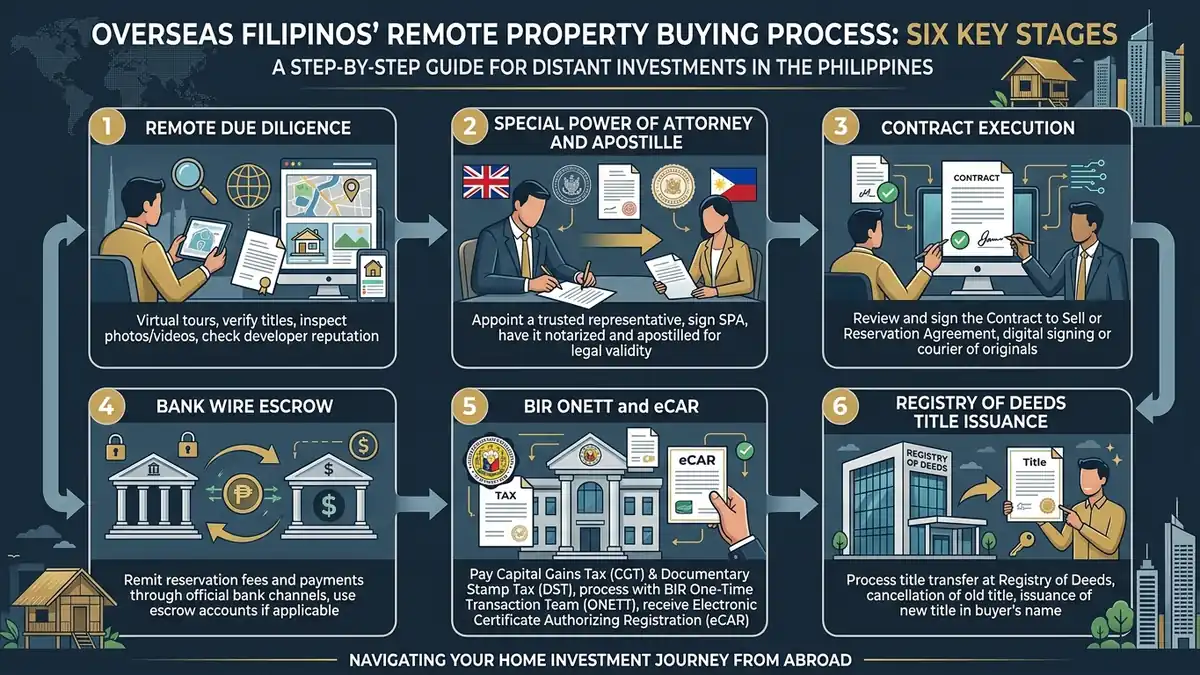
The following six-stage pipeline outlines the end-to-end conveyancing workflow required to secure titled provincial land in the Philippines while residing overseas:
Stage 1: Remote Due Diligence and Title Search
Before negotiating purchase terms or releasing any earnest money deposit, the buyer must commission independent title due diligence through a licensed broker or conveyance practitioner. Never rely on photocopies provided by the seller or real estate marketing agents.
Your representative must obtain a fresh Certified True Copy (CTC) of the Transfer Certificate of Title directly from the Registry of Deeds where the land is located, utilizing the LRA Philippine Land Registration Information System (PhilRIS). This document reveals the true registered owner of record, active liens, mortgages, lis pendens notices, or adverse claims annotated on the back of the title under the Memorandum of Encumbrances.
Stage 2: Physical Verification, Boundary Survey, and Zoning Inspection
A titled property that appears flawless on paper may harbor severe physical or zoning defects on the ground. During Stage 2, your on-ground representative coordinates two non-negotiable physical inspections:
- Cadastral Relocation Survey: A licensed Geodetic Engineer is commissioned to conduct a boundary relocation survey, physically locating the concrete boundary monuments (mojons) embedded in the ground, verifying that the actual lot area matches the square meterage declared in the technical description of the TCT, and confirming zero boundary encroachments by neighboring structures.
- Zoning and Municipal Verification: Verification with the City or Municipal Planning and Development Office (MPDO) to ensure the lot conforms to the local Comprehensive Land Use Plan (CLUP), possesses an approved access road, and is not traversed by future public infrastructure, flood easements, or highway widening projects.
Stage 3: Drafting the Contract to Sell and Executing the Remote SPA
Once due diligence confirms that the property is clean and unencumbered, the parties enter into a bilateral Contract to Sell. This contract explicitly establishes the purchase price, payment schedule, seller obligations to clear real property taxes, and buyer rights to inspect documents.
Simultaneously, the overseas buyer drafts and executes the property-specific Special Power of Attorney appointing their trusted representative in the Philippines. The SPA is notarized and apostilled in the buyer’s country of residence, then shipped via express courier to the Philippines.
Stage 4: Secure Fund Remittance and Execution of Deed of Absolute Sale
Upon receipt of the original apostilled SPA and fulfillment of all closing preconditions stipulated in the Contract to Sell, the transaction transitions to formal closing. The parties execute the final Deed of Absolute Sale (DOAS) before a Philippine Notary Public. Your Attorney-in-Fact signs the deed strictly on your behalf, appending the original apostilled SPA as an integral annex.
Simultaneously, the purchase consideration is released through secure institutional banking channels (such as bank manager checks drawn against escrow or direct telegraphic wire transfers to verified seller accounts), as detailed in Section 5 below.
Stage 5: BIR ONETT Tax Assessment and eCAR Issuance
Under the National Internal Revenue Code, the transfer of real property triggers mandatory national internal revenue taxes that must be paid within strict statutory deadlines. Your Attorney-in-Fact presents the complete closing docket to the BIR Revenue District Office (RDO) having jurisdiction over the property:
- Securing an official Tax Identification Number (TIN) for the overseas buyer via BIR Form 1904 under Executive Order No. 98.
- Filing BIR Form 1706 and paying the 6% Capital Gains Tax (CGT) within thirty (30) days from notarial execution of the Deed of Absolute Sale.
- Filing BIR Form 2000-OT and paying the 1.5% Documentary Stamp Tax (DST) on or before the fifth (5th) day of the month following the notarial execution of the deed.
- Submitting the tax returns, official receipts, and property clearances to the BIR One-Time Transaction (ONETT) team for processing and release of the electronic Certificate Authorizing Registration (eCAR).
Stage 6: Registry of Deeds Title Transfer and Municipal Assessor Tax Declaration
With the BIR eCAR in hand, the Attorney-in-Fact completes the final leg of conveyancing:
- Local Transfer Tax: Paying the Local Transfer Tax (0.50% to 0.75% of purchase price or zonal value) at the City or Municipal Treasurer’s Office and securing the official Transfer Tax Receipt and Tax Clearance.
- Registry of Deeds Registration: Submitting the original Owner’s Duplicate Copy of the TCT, original Deed of Absolute Sale, original apostilled SPA, BIR eCAR, and Transfer Tax receipt to the Registry of Deeds under Presidential Decree No. 1529. The Registry cancels the seller’s title and issues a brand-new Transfer Certificate of Title in the sole name of the overseas buyer.
- Municipal Assessor Declaration: Submitting the newly issued TCT to the City or Municipal Assessor’s Office to cancel the seller’s Tax Declaration and issue a new Tax Declaration for land (and improvements) under the buyer’s name.
4. Critical Remote Due Diligence: Protecting Overseas Capital from Distance
Due diligence is the paramount shield protecting an overseas buyer from property fraud. When you are residing outside the Philippines, you cannot physically visit the municipal hall, interrogate the village chief (Barangay Captain), or walk the lot boundaries. Therefore, your verification protocols must be systematic, rigorous, and documentary.
Every remote land acquisition conducted through LandMaster Realty enforces seven mandatory due diligence checks:
1. Owner of Record Verification vs Purported Heirs
A staggering percentage of real estate disputes in the Philippines arise because overseas buyers purchase land from persons who do not possess legal authority to sell. Commonly, an overseas buyer deals with a cousin, uncle, or sibling of a deceased registered owner who claims, “We all agreed to sell this land.”
In Philippine law, verbal agreements among heirs have zero legal force against registered titles. If the person named on the front face of the Transfer Certificate of Title is deceased, the land cannot be sold directly via a standard Deed of Absolute Sale. The heirs must first execute a formal Extrajudicial Settlement of Estate, settle all accrued estate taxes under Republic Act No. 11956, secure a BIR eCAR for the estate, and either partition the property or execute an Extrajudicial Settlement with Simultaneous Absolute Sale. If you disburse funds before these estate proceedings are fully finalized, you are purchasing an unresolved hereditary lawsuit.
2. Certified True Copy Title Inspection via PhilRIS
Never rely on a printed title presented by the seller. The seller could possess a genuine owner’s duplicate title that has been canceled by court order, or worse, a sophisticated counterfeit title printed on simulated Bangko Sentral ng Pilipinas (BSP) security paper.
Your representative must obtain a fresh Certified True Copy (CTC) directly from the Registry of Deeds via the LRA PhilRIS system. Once obtained, inspect three critical elements:
- Serial Numbers and Watermarks: Check the judicial form serial number and verify that the security fibres and barcoded tracking numbers match official Land Registration Authority records.
- Registered Owner Details: Confirm the exact legal name, citizenship, and civil status of the seller. If the seller is indicated as “married to,” the spouse must sign the deed or execute a concurrent apostilled marital consent.
- Memorandum of Encumbrances: Read every single entry annotated on the reverse side of the title. Look for mortages to rural banks, notices of adverse claims (Section 70, PD 1529), notices of lis pendens (pending court litigation, Section 76, PD 1529), attachments or levies by court sheriffs, and Section 4, Rule 74 two-year statutory liens for estate settlements. For a detailed guide on interpreting these annotations, read our practitioner manual on how to read a title memorandum of encumbrances.
3. Cadastral Boundary Relocation Surveys and Mojon Verification
One of the most frequent traps in provincial land purchases is purchasing a “paper lot.” An overseas buyer sends money for an 800-square-meter titled parcel, only to discover years later that a neighbor has constructed a concrete perimeter fence enclosing 200 square meters of the property, or that a public access road encroaches upon the lot.
Always hire an independent licensed Geodetic Engineer to conduct a boundary relocation survey. The engineer must cross-reference the cadastral survey plan approved by the Department of Environment and Natural Resources (DENR) Land Management Bureau with the bearings and distances stated in the technical description of the TCT. The engineer must locate all concrete boundary monuments (mojons), flag any boundary overlaps, verify that the terrain is buildable, and issue a formal signed Survey Plan and Relocation Report.
4. Agrarian Reform (DAR CARP) and Retention Limits for Provincial Land
If you are purchasing provincial land classified as agricultural or rural, you must navigate the Comprehensive Agrarian Reform Law (Republic Act No. 6657 as amended by RA 9700). Under CARP:
- Retention Limit: No individual landowner may hold more than five (5) hectares of agricultural land anywhere in the Philippines. An overseas Filipino who already owns agricultural parcels must ensure that the new acquisition does not breach this mandatory cap.
- DAR Clearance: Any sale or transfer of agricultural land exceeding certain thresholds requires a formal DAR Clearance from the Department of Agrarian Reform Provincial Agrarian Reform Office (PARO). Without this clearance, the Registry of Deeds will reject the registration of the Deed of Absolute Sale.
- Tenancy Verification: Your representative must secure a Certification from the Barangay Agrarian Reform Committee (BARC) or Municipal Agrarian Reform Officer (MARO) certifying that the agricultural lot is untenanted and free from agricultural leasehold beneficiaries. For full procedural steps, see our specialized guide on buying agricultural land in the Philippines under CARP.
5. Real Property Tax and Municipal Assessor Verification
A land title may be completely valid at the Registry of Deeds, but if the previous owner neglected to pay municipal real property taxes (RPT) for a decade, the local government unit (LGU) may have initiated tax delinquency proceedings or public auction notices against the parcel under the Local Government Code of 1991 (Republic Act No. 7160).
Your on-ground representative must visit the City or Municipal Assessor’s Office and the City or Municipal Treasurer’s Office to obtain:
- A fresh Certified True Copy of the current Tax Declaration for Land (and a Certificate of No Improvement if the lot is vacant).
- A formal Tax Clearance Certificate issued by the Local Treasurer certifying that all basic real property taxes and Special Education Fund (SEF) levies are fully paid up to the current calendar year.
5. Wire Transfers, Banking, and Remittance Safeguards for Overseas Buyers
Handling financial disbursements across international borders is fraught with danger. Far too many overseas Filipinos save money for years, only to lose their savings because they wired funds casually through non-commercial channels or personal bank accounts.
The Fatal Mistake: Remitting Property Funds to Relatives
The single greatest operational hazard in overseas land purchases is wiring purchase funds directly into the personal savings account of a relative, sibling, or family friend in the Philippines with instructions to “pay the seller.”
This practice creates three devastating liabilities:
- Anti-Money Laundering Act (AMLA) Freezes: Under Republic Act No. 9160 (The Anti-Money Laundering Act of 2001, as amended), Philippine commercial banks are legally mandated to flag sudden, large cash inflows entering personal retail savings accounts. A sudden remittance of 2,000,000 PHP to 5,000,000 PHP into an ordinary savings account will trigger an immediate bank hold, requiring extensive proof of source of income, tax filings, and transaction justification. If the relative cannot satisfy bank compliance officers immediately, the account is frozen, stalling the property transaction and incurring contract default penalties.
- Commingling and Diversion of Funds: Once funds enter a third party’s personal bank account, they become legally commingled with that individual’s personal estate. If your relative encounters an emergency, faces hospital expenses, suffers business debts, or undergoes marital separation, your property funds can be drawn upon, garnished by creditors, or frozen by courts without your knowledge or consent.
- Tax Implication Risks: Large unclassified fund transfers between individuals can be audited by the BIR as undeclared loans, hidden compensation, or taxable donations subject to 6% Donor’s Tax under Section 99 of the NIRC.
The Professional Alternative: Direct Telegraphic Transfers and Bank Escrow
To ensure 100% financial security, overseas buyers must utilize structured institutional payment mechanisms:
- Direct Telegraphic Wire Transfer to Seller: Wire funds directly from your overseas bank account to the verified Philippine bank account of the registered property owner. The remittance slip must clearly cite the transaction purpose in the memo field (e.g., “Payment for TCT No. 123456 Lot 12 Block 3 Vigan City as per Contract to Sell dated [Date]”). This provides an immutable cross-border financial trail proving that consideration was paid directly to the title holder.
- Bank Manager Checks via Attorney-in-Fact: If the seller insists on payment via Manager’s Check upon simultaneous signing of the Deed of Absolute Sale, wire the funds directly to a dedicated, newly opened escrow or trust account under strict written instructions. The Attorney-in-Fact presents a Manager’s Check payable strictly to the seller’s legal name. Never issue cash payments or personal checks.
- Formal Escrow Agreements: For premium commercial or provincial land transactions, engage the Trust and Asset Management department of a major Philippine commercial bank (such as BDO, BPI, or Metrobank) or a licensed title brokerage firm to serve as an independent escrow agent. The escrow agent holds the purchase funds and only releases them to the seller upon verified delivery of the owner’s duplicate title, tax clearances, and signed Deed of Absolute Sale.
Milestone-Based Payment Architecture
Never pay 100% of the purchase price upfront. Structure your purchase agreement around verifiable legal milestones:
| Milestone Stage | Payment Percentage | Preconditions Required for Fund Release |
|---|---|---|
| Earnest Money / Reservation | 2% to 5% of Total Price | Execution of formal Reservation Agreement; seller grants 30 to 45 days exclusive due diligence period; money forms part of the purchase price. |
| Contract to Sell Signing | 20% to 30% Down Payment | Receipt of clean LRA PhilRIS Certified True Copy; completion of boundary relocation survey; confirmation of zero municipal tax delinquency. |
| Deed of Absolute Sale Execution | 50% to 60% Substantial Payment | Simultaneous execution and notarization of Deed of Absolute Sale; physical turnover of original Owner’s Duplicate TCT, tax declarations, and tax clearances. |
| Final Closing Escrow Holdback | 10% Final Retention | Released only after the BIR issues the official electronic Certificate Authorizing Registration (eCAR) confirming full payment of Capital Gains Tax and Documentary Stamp Tax. |
6. BIR ONETT Representation: Securing the eCAR Without Returning Home
In Philippine property conveyancing, signing the Deed of Absolute Sale is only half the battle. A buyer does not become the legally registered owner on public land records until the transaction is cleared by the Bureau of Internal Revenue (BIR) and a new Transfer Certificate of Title is issued by the Registry of Deeds.
Every land sale triggers a mandatory administrative process handled by the BIR One-Time Transaction (ONETT) team at the Revenue District Office (RDO) having jurisdiction over the location of the land. For overseas Filipinos, managing this process remotely requires strict adherence to tax documentation rules:
Securing an OFW Tax Identification Number (BIR Form 1904 under EO 98)
To acquire titled land in the Philippines, every buyer must have a registered Philippine Tax Identification Number (TIN). Many overseas Filipinos who left the country years ago either never obtained a TIN, forgot their number, or let their registration lapse.
Under Executive Order No. 98, non-resident citizens, OFWs, and foreign nationals are legally authorized to secure a TIN specifically to transact with government agencies (including the Registry of Deeds and LRA). Your Attorney-in-Fact can secure your TIN from the RDO by submitting:
- Duly accomplished BIR Form 1904 (Application for Registration for One-Time Taxpayer and Persons Registering Under E.O. 98).
- Copy of the overseas buyer’s valid Philippine passport with photograph and signature.
- Copy of the original apostilled Special Power of Attorney authorizing the representative to secure a TIN on your behalf.
- Official government ID of the Attorney-in-Fact.
Statutory Taxes: Deadlines and Penalties
The National Internal Revenue Code imposes two primary national transfer taxes on the sale of real property classified as a capital asset:
- Capital Gains Tax (CGT): Governed by Section 24(D) of the NIRC, CGT is levied at a flat rate of six percent (6%) of the gross selling price or the current fair market value, whichever is higher. By legal presumption and standard conveyancing practice, CGT is the statutory liability of the seller. It must be filed and paid using BIR Form 1706 within thirty (30) calendar days from the date of notarization of the Deed of Absolute Sale.
- Documentary Stamp Tax (DST): Governed by Section 196 of the NIRC (as amended by the TRAIN Act, Republic Act No. 10963), DST is levied at a rate of 1.5% (15 PHP for every 1,000 PHP or fractional part thereof) of the gross selling price or fair market value. By standard contractual custom, DST is paid by the buyer. It must be filed and paid using BIR Form 2000-OT on or before the fifth (5th) day of the month following the date of notarial execution.
Warning on Missed Deadlines: If your representative fails to file these returns and remit payments within the strict statutory windows, the BIR automatically imposes severe statutory surcharges: a mandatory 25% surcharge on the basic tax due, an annual deficiency interest of 12% per annum, and compromise penalties ranging from 1,000 PHP to 50,000 PHP. For an overseas buyer, these penalties can add tens of thousands of pesos in unexpected costs.
The Electronic Certificate Authorizing Registration (eCAR)
Once all taxes, surcharges (if any), and certification fees are paid, the BIR ONETT team examines the complete documentary docket:
- Original notarized Deed of Absolute Sale (with apostilled SPA attached).
- Certified True Copy of the Transfer Certificate of Title issued by the Registry of Deeds.
- Certified True Copy of the current Tax Declaration for Land and Improvements.
- Certificate of No Improvement issued by the City or Municipal Assessor (if applicable).
- Official receipts and validated tax returns for BIR Form 1706 and BIR Form 2000-OT.
- Vicinity map and sworn statement of seller and buyer.
Upon satisfactory audit, the BIR issues the electronic Certificate Authorizing Registration (eCAR). The eCAR contains a secure 2D barcode, a unique system-generated eCAR Number, and an electronic security code that is transmitted directly into the LRA computer system. Under Section 58 of Presidential Decree No. 1529, the Register of Deeds is strictly prohibited from registering any deed of transfer or issuing a new land title without an authentic eCAR. For full requirements, see our guide on BIR eCAR requirements and processing.
7. Worked Financial Closing Model: Purchasing a 3.5M PHP Provincial Lot in Northern Luzon
To provide overseas buyers with complete financial clarity, the following worked case study illustrates the exact line-by-line closing costs for purchasing a titled provincial residential parcel in Northern Luzon. This realistic financial simulation models an Overseas Filipino Worker residing in Dubai, UAE, acquiring an 800-square-meter titled residential lot in Metro Vigan, Ilocos Sur.
Transaction Parameters
- Property Type: Titled Residential Lot (Transfer Certificate of Title)
- Location: Metro Vigan, Ilocos Sur
- Total Land Area: 800 square meters
- Agreed Contract Purchase Price: 3,500,000 PHP (4,375 PHP per square meter)
- BIR Zonal Value: 3,800 PHP per square meter (Total Zonal Valuation: 3,040,000 PHP)
- LGU Assessed Market Value: 2,400,000 PHP
- Tax Base for Statutory Calculation: 3,500,000 PHP (The gross selling price is higher than both the BIR zonal value and municipal assessed value, establishing the legal tax base under NIRC Section 24(D)).
| Expense Item | Governing Rate / Statutory Basis | Statutory Responsible Party | Amount (PHP) |
|---|---|---|---|
| Gross Contract Purchase Price | Agreed bilateral consideration | Buyer Outlay | 3,500,000.00 |
| Capital Gains Tax (CGT) | 6.0% of Tax Base (NIRC Section 24D) | Seller Responsibility | 210,000.00 |
| Documentary Stamp Tax (DST) | 1.5% of Tax Base (NIRC Section 196) | Buyer Responsibility | 52,500.00 |
| Local Transfer Tax | 0.50% of Tax Base (Ilocos Sur Provincial Tax Code) | Buyer Responsibility | 17,500.00 |
| Registry of Deeds Registration Fee | LRA Graduated Registration Fee Schedule | Buyer Responsibility | 19,456.00 |
| Legal Notarization of Deed of Sale | Standard Notarial Fee (approx. 1.0% negotiated) | Buyer Responsibility | 25,000.00 |
| Geodetic Relocation Survey | Mojon relocation and cadastral verification report | Buyer Responsibility (Due Diligence) | 15,000.00 |
| Consular Apostille & Courier Fees | UAE MOFA Apostille + DHL Express to Philippines | Buyer Direct Outlay | 8,500.00 |
| LRA PhilRIS Certified True Copies & Clearances | LRA title search, tax clearance, DAR certifications | Buyer Due Diligence Outlay | 4,500.00 |
| Professional Title Conveyancing & Processing | End-to-end representation: BIR, LGU, Registry | Buyer Professional Fee | 35,000.00 |
| TOTAL CASH OUTLAY FOR BUYER (Purchase Price + All Closing Expenses) | 3,677,456.00 | ||
Financial Takeaways for Overseas Buyers:
- Total Incidental Closing Costs: For the buyer, total closing taxes, registration fees, surveys, and professional processing amount to 177,456.00 PHP, which represents approximately 5.07% of the gross purchase price. As a prudent rule of thumb, an overseas buyer should budget between 5% and 6% above the purchase price to cover all legal conveyancing and titling expenses.
- Seller Net Proceeds: Assuming the seller covers their statutory Capital Gains Tax obligation of 210,000.00 PHP and pays the standard real estate brokerage commission (5%, or 175,000.00 PHP), the seller receives net cash proceeds of 3,115,000.00 PHP.
- Full Transparency: By establishing this itemized schedule upfront in the Contract to Sell, neither party is surprised by hidden municipal fees or registration costs during closing. For a broader analysis of title transfer costs across the Philippines, see our complete breakdown on transfer of title costs in the Philippines.
8. Five Fatal Mistakes OFWs Make When Buying Land Remotely
Throughout two decades of real estate practice in Northern Luzon, our team has been consulted by dozens of overseas Filipinos seeking to unravel failed property transactions. In almost every case, the financial loss could have been prevented by adhering to proper legal standards. Here are the five most frequent traps:
1. Purchasing “Rights” or “Tax Declaration Only” Parcels
Unscrupulous individuals often market unregistered provincial land to overseas Filipinos at enticingly low prices, describing the transaction as “buying the rights” or purchasing “titled by tax declaration.”
In Philippine property jurisprudence, a Tax Declaration is strictly a fiscal assessment tool for municipal taxation. A Tax Declaration does not prove ownership of land. It does not confer title, nor is it conclusive evidence of ownership against an adverse registered claimant holding a Torrens title. Purchasing “rights” means you are acquiring possessory claims that may be subject to overlapping ancestral claims, government public domain status, or protracted judicial confirmation proceedings under Republic Act No. 11573. Unless you are an experienced institutional investor prepared for years of judicial land titling, never purchase real estate that does not carry an authentic Torrens Transfer Certificate of Title (TCT). Review our authoritative comparison on Tax Declaration vs Land Title.
2. Executing an Overly Broad General Power of Attorney
Many overseas Filipinos sign a pre-printed General Power of Attorney giving their relative complete blanket authority to “manage, sell, transfer, mortgage, and dispose” of any property they acquire. If the relationship with that relative deteriorates, or if the relative becomes financially desperate, an open-ended GPA enables them to take out high-interest loans against your land, lease the property without your consent, or even execute conveyances to third parties. Always execute a Special Power of Attorney strictly limited to purchasing the specific parcel, and explicitly revoke the SPA in writing the moment the new title is issued in your name.
3. Registering the Land in a Relative’s Name Under an Informal Promise
Because processing an apostilled SPA takes a few weeks, overseas buyers are often persuaded by family members: “Just put the title under my name first so we can close the deal quickly, and I will transfer it to your name when you come home next year.”
This is the single most common cause of permanent capital loss among overseas workers. Once a land title is registered in your relative’s name, Philippine law presumes that person to be the absolute legal owner. If that relative passes away, the property automatically becomes part of their estate, subject to the claims of their legal spouse, legitimate children, illegitimate children, and creditors. Even if the relative is willing to transfer the land back to you later, doing so triggers a second round of complete transfer taxes (either another 6% Capital Gains Tax or 6% Donor’s Tax, plus 1.5% Documentary Stamp Tax, Local Transfer Tax, and registration fees). Never allow your land to be titled in anyone else’s name.
4. Skipping the Cadastral Relocation Survey
Relying on a video call showing an empty grassy field is not a boundary inspection. Without a formal cadastral relocation survey by a licensed Geodetic Engineer, an overseas buyer cannot know whether the seller is showing them the correct parcel, whether the access road is public or privately owned, or whether adjacent owners have encroached across the boundaries. Investing 15,000 PHP to 25,000 PHP in an official boundary survey before closing protects millions of pesos in land value.
5. Accepting Simulated Paper Receipts Without Electronic Verification
When an Attorney-in-Fact handles the BIR ONETT process, the overseas buyer must independently verify that the taxes were actually remitted to the government. Dishonest fixers and unmonitored representatives have been caught forging BIR rubber stamps and printing fake Certificates Authorizing Registration on commercial paper while pocketing the tax money. When the buyer later tries to register the deed, the Registry of Deeds discovers the fraud, rejects the transfer, and the BIR assesses substantial back taxes and fraud penalties. Always demand the official electronic eCAR barcode verification number and verify it directly through the BIR national eCAR database before releasing final funds.
9. Frequently Asked Questions About Buying Land in the Philippines from Abroad
Can an Overseas Filipino Worker (OFW) buy land in the Philippines without traveling home?
Yes. Under Philippine law, an OFW or expatriate Filipino can complete 100% of a land purchase remotely by executing a Special Power of Attorney (SPA) abroad under the 1961 Hague Apostille Convention or through a Philippine Embassy. The appointed Attorney-in-Fact signs the contracts, pays statutory taxes at the BIR, and receives the new title in the buyer’s sole name.
Does an SPA executed abroad still need a “red ribbon” from the Philippine Embassy?
No, provided you reside in one of the 126+ member countries of the Hague Apostille Convention (such as the United States, Canada, UK, Australia, Saudi Arabia, UAE, or Japan). In these jurisdictions, you simply notarize the document locally and obtain an official Apostille Certificate from the host government. The traditional red ribbon was abolished when the Philippines acceded to the Apostille Convention on May 14, 2019.
Can a dual citizen buy land in the Philippines while living overseas?
Yes. Dual citizens who have reacquired or retained Philippine citizenship under Republic Act No. 9225 enjoy 100% unlimited property ownership rights under the 1987 Philippine Constitution, exactly identical to natural-born Filipino citizens living in the country. For procedural details, consult our guide on buying land as a dual citizen under RA 9225.
What happens if an OFW does not have a Philippine Tax Identification Number (TIN)?
An OFW can obtain a Philippine TIN without traveling home. Under Executive Order No. 98, your appointed Attorney-in-Fact submits BIR Form 1904, a copy of your passport, and your apostilled SPA to the Revenue District Office having jurisdiction over the property to generate a verified TIN for land registration.
Who is responsible for paying Capital Gains Tax and Documentary Stamp Tax?
By standard legal presumption, the seller is statutory liable for the 6% Capital Gains Tax (BIR Form 1706), while the buyer pays the 1.5% Documentary Stamp Tax (BIR Form 2000-OT). However, the parties can contractually agree otherwise in the Contract to Sell. Both taxes must be fully remitted before the BIR releases the electronic Certificate Authorizing Registration (eCAR).
How long does the remote land acquisition process take from start to finish?
A standard remote land purchase takes approximately 60 to 90 days. Drafting and receiving the apostilled SPA from abroad takes 2 to 3 weeks. Due diligence and survey take 1 to 2 weeks. BIR ONETT audit and eCAR issuance typically requires 30 to 45 days. Registry of Deeds cancellation and new title issuance requires 15 to 30 days depending on local LRA backlog.
Can an OFW buy agricultural land or farm lots in the province?
Yes, provided the OFW does not exceed the mandatory five-hectare (5 ha) landholding retention limit under the Comprehensive Agrarian Reform Law (RA 6657). The sale requires a Department of Agrarian Reform (DAR) Clearance and a BARC/MARO certification confirming the parcel is untenanted before the Registry of Deeds will register the transfer.
10. Institutional Acquisition Representation for Overseas Filipinos
Purchasing land in the Philippines while living abroad should be an empowering investment in your family’s future, not an endless source of anxiety and family disputes. Navigating cross-border real estate requires experienced professionals on the ground who act as your fiduciary, verifying every technical document, inspecting every physical monument, and auditing every tax clearance with uncompromising diligence.
At LandMaster Realty, we specialize in representing Overseas Filipino Workers, dual citizens, and expatriates acquiring titled property across Ilocos Sur, Metro Vigan, and Northern Luzon. Our team of licensed real estate brokers, licensed real estate appraisers, and legal conveyance specialists ensures that your property is purchased cleanly, securely, and strictly in accordance with Philippine law.
Protect Your Overseas Property Investment Today
Do not gamble your overseas earnings on informal promises or unverified land titles. Contact LandMaster Realty today for professional title searches, geodetic boundary surveys, BIR eCAR processing, and full remote acquisition representation in Ilocos Sur and Northern Luzon.