When buying, selling, inheriting, or paying annual taxes on real estate in the Philippines, property owners inevitably encounter three conflicting valuation numbers for the exact same parcel of land. Your municipal tax declaration displays an Assessor Market Value and an Assessed Value; the Bureau of Internal Revenue (BIR) computes taxes against a Zonal Value; and commercial real estate appraisers or bank loan officers quote an open-market Fair Market Value that is frequently twice or three times higher than either government schedule. Confusing these three distinct benchmarks leads to severe financial and legal blunders, ranging from undercalculating transactional taxes at the BIR to disputing municipal property tax bills or suffering unexpected loan collateral rejections.
In our daily real estate brokerage and appraisal practice at LandMaster Realty in Ilocos Sur, we regularly sit down with property owners, buyers, and estate heirs who are stunned to discover that a lot purchased for PHP 4,000,000 has an official taxable assessed value of only PHP 480,000 on its municipal tax declaration, while the BIR insists on computing transfer taxes based on a statutory zonal value floor of PHP 3,200,000. Understanding how these valuations are established, which government agency controls each schedule, and how newly enacted national legislation harmonizes the entire system is essential for every landowner in the Philippines.
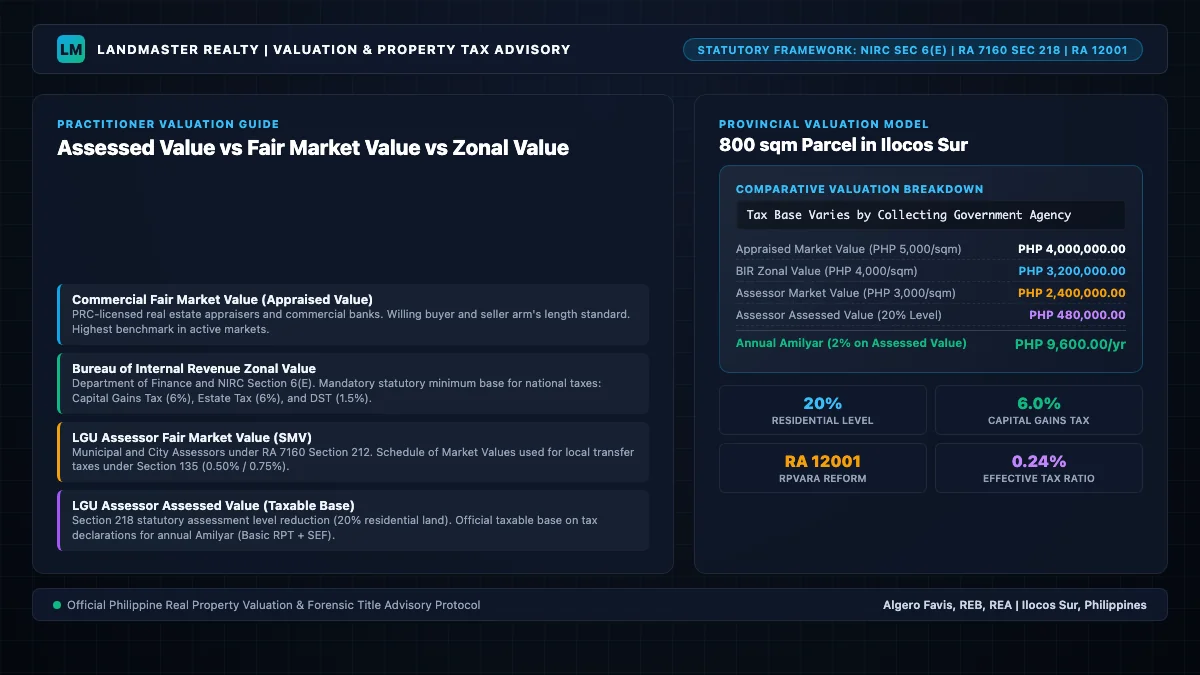
Comparative Philippine real property valuation review examining BIR zonal value schedules, municipal tax declarations, and commercial bank appraisals in Ilocos Sur, Philippines.
Quick Answer: What Is the Difference Between Assessed Value, Fair Market Value, and Zonal Value in the Philippines?
To immediately grasp how Philippine property valuations function and where each number applies, examine these core practitioner realities:
- Commercial Fair Market Value (Open-Market Appraised Value): This is the true economic price negotiated between a willing buyer and a willing seller in an arm’s length, unforced open-market transaction. It is determined by Professional Regulation Commission (PRC) licensed real estate appraisers and commercial banks based on actual comparable sales, replacement construction costs, and income potential. This figure represents the highest benchmark in active real estate markets and governs private sale negotiations and bank mortgage loan collateral limits.
- Bureau of Internal Revenue (BIR) Zonal Value: This is an administrative valuation floor prescribed by the Department of Finance under Section 6(E) of the National Internal Revenue Code (NIRC). It serves as the statutory minimum tax base for national internal revenue taxes, including Capital Gains Tax (6%), Estate Tax (6%), Donor’s Tax (6%), and Documentary Stamp Tax (1.5%). By law, national taxes are computed on whichever is highest among the gross selling price, the BIR zonal value, or the assessor market value.
- Local Government Unit (LGU) Assessor Fair Market Value: This is the municipal or city valuation established in the local Schedule of Market Values (SMV) enacted by the Sangguniang Panlalawigan or Sangguniang Panlungsod under Section 212 of Republic Act No. 7160 (Local Government Code of 1991). It serves as the statutory benchmark for the local Provincial or City Transfer Tax under Section 135 (0.50% in provinces, 0.75% in cities).
- LGU Assessor Assessed Value (Taxable Assessment Roll): This is the final taxable amount printed on your official Tax Declaration. It is derived by multiplying the Assessor Fair Market Value by the statutory assessment level percentage mandated under Section 218 of RA 7160 (such as 20% for residential land or 40% for agricultural land). Annual property tax (amilyar), consisting of the Basic Real Property Tax and the Special Education Fund (SEF), is calculated strictly against this reduced Assessed Value.
- The RPVARA Revolution (Republic Act No. 12001): Signed into law in June 2024, the Real Property Valuation and Assessment Reform Act replaces fragmented, multi-agency valuation schedules with a single, digital Real Property Information System (RPIS). It adopts unified Schedule of Market Values for both national and local taxes, establishes mandatory 3-year valuation updating cycles under the Bureau of Local Government Finance (BLGF), and provides a 2-year statutory tax amnesty granting full condonation of accumulated real property tax penalties and interest.
Whether you are calculating transaction expenses for an upcoming conveyance or checking your annual municipal tax ledger, LandMaster Realty provides licensed, end-to-end guidance. Review our comprehensive Real Property Tax Payment and Municipal Compliance Services and our dedicated Land Title Transfer and Registration Services to ensure all property valuations and tax bases are precisely calculated before you sign documents or disburse funds.
The Tripartite Philippine Valuation System: Why Three Different Values Exist for the Same Land
A recurring source of frustration among property buyers, sellers, and heirs is the realization that the Philippine government does not operate a single property valuation registry. If you purchase an 800-square-meter residential lot in Bantay or Vigan City, Ilocos Sur, you will receive documents bearing three completely different valuations. This divergence is not an administrative clerical error; it is the structural consequence of three separate institutions fulfilling three fundamentally distinct statutory mandates.
Historically, property valuation in the Philippines developed along separate tracks because national taxation authorities, local municipal treasuries, and commercial lending institutions pursue contrasting legal and operational objectives.
1. National Tax Authority: Bureau of Internal Revenue (Department of Finance)
The Bureau of Internal Revenue operates under the national Department of Finance. Its primary institutional responsibility under the National Internal Revenue Code (Republic Act No. 8424, as amended) is the collection of national internal revenue taxes to fund national government operations. To prevent taxpayers from colluding to report artificially suppressed contract prices on deeds of sale, Section 6(E) of the Tax Code empowered the Commissioner of Internal Revenue to divide the country into zones and prescribe mandatory minimum property values, universally referred to as BIR Zonal Values.
The BIR does not use zonal value to evaluate mortgage safety or determine local public service assessments. Instead, zonal value functions as an unyielding statutory tax floor. Even if a seller agrees to sell family land to a relative at a deep discount, the BIR calculates Capital Gains Tax (6%) and Documentary Stamp Tax (1.5%) against the prescribed zonal value schedule, ensuring that national treasury receipts remain protected against under-declaration.
2. Local Government Units: City and Municipal Assessors (RA 7160)
Under Republic Act No. 7160, commonly known as the Local Government Code of 1991, administrative governance and fiscal autonomy were devolved to Local Government Units (provinces, chartered cities, and municipalities). Local assessors are municipal or provincial officials tasked with discovering, listing, classifying, and appraising all real properties within their territorial jurisdiction under Sections 198 through 225 of the Code.
Local assessors maintain their own independent valuation metric known as the Schedule of Market Values (SMV). The purpose of the assessor valuation is not to assess national conveyance taxes, but to establish an equitable, uniform tax base for local ad valorem taxation, specifically the annual real property tax (popularly called amilyar) and the local transfer tax under Section 135. Furthermore, to protect residential homeowners and agricultural farmers from excessive annual taxation, the Local Government Code mandates that the Assessor Market Value must be drastically scaled down using statutory assessment level percentages before the annual tax rate is applied. This scaled-down figure is the Assessed Value.
3. Private Commercial Market: Licensed Appraisers and Commercial Banks
Completely outside government tax offices sits the private commercial market. Commercial Fair Market Value reflects the economic reality of the open market. It is established through empirical valuation studies conducted by real estate appraisers licensed by the Professional Regulation Commission (PRC) under Republic Act No. 9646 (the Real Estate Service Act) and the internal appraisal departments of commercial universal banks.
Commercial appraisers do not consult outdated municipal tax rolls or rigid BIR zonal tables to determine what a property is worth. Instead, they apply globally accepted valuation methodologies, such as the Market Data Approach, analyzing recent arm’s length transactions of comparable lots in the immediate neighborhood, examining physical topography, evaluating road frontage, verifying zoning compliance, and calculating economic capitalization rates. When a buyer secures a loan from a commercial bank (such as BDO, BPI, or Metrobank), the bank’s approved loan-to-value ratio is anchored strictly to this independent appraised commercial value.
Practitioner Insight: Because the three valuation benchmarks are established by different entities for different purposes, they almost never match. In prime residential and commercial corridors, commercial market value is almost always highest, BIR zonal value occupies the middle ground, and municipal assessor assessed value is the lowest. Conflating these three values when drafting contracts or budgeting transaction expenses is one of the most common causes of transaction delays and tax penalties in the Philippines.
BIR Zonal Value Deconstructed: Statutory Purpose Under NIRC Section 6(E), Tax Applications, and Revision Cycles
To safely navigate any land sale, extrajudicial estate settlement, or property donation, one must understand how the Bureau of Internal Revenue establishes and applies Zonal Values under Philippine tax law.
1. Statutory Authority Under Section 6(E) of the Tax Code
The authority to prescribe zonal values is codified under Section 6, Subsection (E) of the National Internal Revenue Code of 1997 (Republic Act No. 8424), as amended by the TRAIN Act (Republic Act No. 10963). The law explicitly provides that the Commissioner of Internal Revenue is authorized to divide the Philippines into different zones or areas and shall, upon mandatory consultation with competent appraisers both from the private and public sectors, determine the fair market value of real properties in each zone.
The statute establishes an unbending rule for national tax assessment: whenever the fair market value of real property is required to be determined for internal revenue tax purposes, the tax base shall be whichever is the higher of:
- The fair market value as determined by the Commissioner (the prescribed BIR Zonal Value); or
- The fair market value as shown in the schedule of values of the Provincial and City Assessors (the Assessor Market Value); or
- The gross selling price or actual consideration stated in the notarized deed of conveyance.
This statutory formula is known among real estate practitioners as the Highest Value Rule. If a contract of sale states a purchase price of PHP 2,000,000, but the BIR zonal value for the parcel is PHP 3,000,000 and the municipal tax declaration states an assessor market value of PHP 1,800,000, the BIR will automatically discard the selling price and compute all national taxes based on the PHP 3,000,000 zonal valuation floor.
2. National Internal Revenue Taxes Governed by Zonal Value
Zonal value directly dictates the computation of four major national internal revenue taxes administered by the BIR:
- Capital Gains Tax (CGT): Under Section 24(D)(1) of the Tax Code, a final tax of six percent (6%) is imposed on the gross selling price or the current fair market value determined pursuant to Section 6(E) (the zonal value), whichever is higher, upon the sale, exchange, or disposition of real property classified as a capital asset.
- Documentary Stamp Tax (DST): Under Section 196 of the Tax Code, deeds of sale and conveyances of real property are subject to a documentary stamp tax of 1.5% (specifically PHP 15.00 for every PHP 1,000.00 or fractional part thereof) based on the actual consideration or the fair market value determined under Section 6(E), whichever is higher.
- Estate Tax: Under Section 84 of the Tax Code, as amended by the TRAIN Act, an estate tax rate of six percent (6%) is levied on the net estate of a deceased property owner. Under Section 88, properties included in the gross estate must be valued at their fair market value as of the date of death, which is defined as the higher between the BIR zonal value and the assessor market value.
- Donor’s Tax: Under Section 99 of the Tax Code, real property transferred through voluntary donation without consideration is subject to a six percent (6%) donor’s tax computed on the total net gifts exceeding the statutory PHP 250,000 annual exemption, anchored to the higher of the zonal value or the assessor market value under Section 102.
- Creditable Withholding Tax (CWT) and Value Added Tax (VAT): In commercial land sales involving real estate developers or corporations where the land is an ordinary asset, withholding taxes ranging from 1.5% to 6% and 12% VAT are assessed on the gross selling price or the BIR zonal value, whichever is higher.
3. Revenue District Office (RDO) Classifications and Zonal Revision Cycles
BIR zonal values are organized by Revenue District Offices (RDOs) across the country. In Northern Luzon, for instance, properties in Ilocos Sur fall under the jurisdiction of BIR Revenue District Office No. 2, located in Vigan City. Within each RDO schedule, properties are categorized by municipality or city, then subdivided by barangay, street name, and specific vicinity code.
Furthermore, the BIR applies strict property classification codes that determine the applicable value per square meter:
- RR: Residential Regular (standard residential subdivisions and urban village lots).
- CR: Commercial Regular (commercial strip properties, downtown retail corridors, and business districts).
- A: Agricultural (farmland, rice land, corn land, and fishponds, often further subdivided by classification such as Riceland Irrigated or Unirrigated).
- I: Industrial (manufacturing, warehousing, and logistics zones).
- GL: Government Land (institutional land owned by public entities).
- X: Institutional (hospitals, universities, and religious sites).
Historically, BIR zonal value revisions were published periodically through Department Orders signed by the Secretary of Finance. Although the Tax Code contemplated revisions every three years, in practice many provincial RDO schedules remained untouched for eight to fifteen years. As economic development, infrastructure projects (such as expressways and bypass roads), and commercial growth outpaced government updates, a massive chasm emerged between static government zonal values and dynamic open-market prices. This chronic stagnation was one of the primary catalysts for the passage of the Real Property Valuation and Assessment Reform Act (RPVARA).
Important Note on BIR Electronic Certificates (eCAR): You cannot secure an Electronic Certificate Authorizing Registration (eCAR) from the BIR without submitting certified copies of the current municipal tax declaration. The BIR assessment officer cross-references the tax declaration market value against the official zonal schedule. If the assessor valuation is higher than the zonal value, the BIR will compute Capital Gains Tax against the assessor figure. Review our comprehensive guide to BIR eCAR Requirements and Processing to understand how valuation discrepancies affect title transfers.
Assessor Market Value and Assessed Value: How LGUs Compute Ad Valorem Taxes Under RA 7160 Section 218
While the BIR focuses on national conveyance taxes, your local City Hall or Municipal Hall relies on an entirely different valuation architecture. Every owner of titled or untitled land in the Philippines receives a municipal Tax Declaration (for owners holding untitled parcels and seeking to transition into registered status, review our step-by-step practitioner guide on how to apply for a land title in the Philippines). When reading this document, many owners become confused because it contains two distinct figures: Fair Market Value and Assessed Value.
1. Assessor Fair Market Value (The Municipal SMV)
Under Section 212 of Republic Act No. 7160, the provincial, city, or municipal assessor is mandated to prepare a Schedule of Fair Market Values (SMV) for the different classes of real property situated within the LGU. This schedule is submitted to the local Sanggunian (the provincial board or city council), which enacts it into law through a formal tax ordinance.
The Assessor Fair Market Value represents the local government’s baseline estimation of what a property is worth per square meter prior to taxation. It is calculated simply as:
The Assessor Market Value serves two primary statutory purposes:
- Local Transfer Tax Floor (Section 135): When a property is sold or transferred, the province or chartered city levies a local transfer tax (typically 0.50% in provinces like Ilocos Sur, and up to 0.75% in chartered cities). Under Section 135 of RA 7160, this tax is levied on the total consideration or the fair market value of the property, whichever is higher. Here, fair market value refers specifically to the assessor market value on the tax declaration.
- Pre-Assessment Base: It serves as the gross numerical base to which statutory assessment levels are applied to determine the taxable assessed value.
2. The Section 218 Statutory Assessment Levels
The Philippine tax system recognizes that if homeowners, farmers, and small businesses were taxed annually on the full commercial or market value of their land, the tax burden would be crushing and lead to widespread property forfeitures. To prevent this, Section 218 of the Local Government Code establishes mandatory statutory assessment levels. An assessment level is a legally defined percentage applied to the Fair Market Value to derive the taxable Assessed Value.
Section 218 establishes explicit statutory ceilings for land assessment levels:
| Property Classification | Statutory Assessment Level Ceiling (RA 7160 Sec. 218) | Standard LGU Assessment Level Applied |
|---|---|---|
| Residential Land | Maximum 20% | 20% (Standard across provinces and cities) |
| Agricultural Land | Maximum 40% | 20% to 40% (Varies by provincial ordinance) |
| Commercial Land | Maximum 50% | 40% to 50% |
| Industrial Land | Maximum 50% | 40% to 50% |
| Mineral Land | Maximum 50% | 50% |
| Special Classes (Cultural, Scientific, Hospital, Local Water Districts) | Maximum 10% to 15% | 10% (Hospital/Scientific) to 15% |
For buildings, residential structures, and physical improvements, Section 218 establishes a graduated, tiered assessment scale ranging from 0% for modest dwellings up to 60% for luxury homes, and up to 80% for high-value commercial buildings. For example, residential houses with a fair market value below PHP 175,000 enjoy a 0% assessment level, meaning they pay zero annual property tax on the structure, while homes valued above PHP 10,000,000 are assessed at 60%.
3. Mathematical Derivation of Assessed Value
The mathematical computation that appears on every Philippine tax declaration is straightforward:
For example, if a residential parcel in Ilocos Sur has an Assessor Market Value of PHP 2,400,000.00, and the local residential assessment level is 20%, the taxable Assessed Value is:
4. Annual Amilyar Computation (Basic RPT + SEF)
Annual real property tax is calculated strictly on the Assessed Value, never on the gross Market Value or the BIR Zonal Value. Under Section 233 and Section 235 of RA 7160, local governments levy two separate annual property tax components:
- Basic Real Property Tax (Section 233): Up to one percent (1%) of the assessed value in provinces, and up to two percent (2%) of the assessed value in chartered cities and Metro Manila municipalities.
- Special Education Fund (SEF, Section 235): A mandatory uniform national levy of one percent (1%) of the assessed value, dedicated exclusively to the financing of local public school facilities.
Thus, in a province like Ilocos Sur, the combined annual property tax levy is 2.0% (1% Basic RPT + 1% SEF) applied to the Assessed Value. On a residential lot with an assessed value of PHP 480,000.00, the annual amilyar is:
Because the taxable base was reduced from the PHP 2,400,000 market value to the PHP 480,000 assessed value, the property owner pays only PHP 9,600.00 annually, representing an effective tax rate of just 0.24% against the property’s true commercial value. For step-by-step guidance on paying local taxes and capturing prompt-payment discounts, review our guide on How to Pay Real Property Tax Online and at LGU Treasurers.
Commercial Fair Market Value and Bank Appraisals: Open Market Valuation Standards
While government tax authorities operate with fixed formulas and administrative schedules, the open real estate marketplace operates on pure economic supply and demand. Commercial Fair Market Value (frequently referred to by real estate practitioners simply as Market Value or Appraised Value) is the benchmark that governs real estate transactions, investment feasibility, and commercial bank financing.
1. Professional Appraisal Standards and the Real Estate Service Act
Under Republic Act No. 9646 (RESA), the valuation of real property for commercial purposes is legally restricted to licensed Real Estate Appraisers (REA) who have passed the PRC licensure examination and adhere to the Philippine Valuation Standards (PVS), which mirror the International Valuation Standards (IVS).
Under professional appraisal standards, Fair Market Value is formally defined as:
“The estimated amount for which an asset or liability should exchange on the valuation date between a willing buyer and a willing seller in an arm’s length transaction, after proper marketing and where the parties had each acted knowledgeably, prudently, and without compulsion.”
Unlike local assessors who perform mass appraisals on whole neighborhoods using uniform tables, an independent real estate appraiser conducts a forensic investigation of the specific property. Professional appraisers utilize three primary valuation approaches:
- Sales Comparison Approach (Market Data Approach): The appraiser identifies recent, verified sales and active offerings of comparable properties in the immediate vicinity. Adjustments are made for differences in land area, road frontage, shape, elevation, proximity to commercial centers, and market timing. This is the primary method used for residential subdivision lots and commercial land.
- Cost Approach (Depreciated Replacement Cost): Used extensively for structures and building improvements, this method calculates the current construction cost required to replicate the building new, and then deducts physical depreciation, functional obsolescence, and economic obsolescence.
- Income Capitalization Approach: Applied to commercial income-generating assets (such as commercial retail plazas, office buildings, rental apartments, and warehouses), this method converts expected net operating income (NOI) into present capital value using a localized capitalization rate.
2. Bank Appraisals and Loan-to-Value (LTV) Mechanics
A frequent shock for borrowers in the Philippines occurs when they apply for a bank loan or real estate mortgage. Borrowers frequently assume that if a seller asks PHP 5,000,000 for a property, the bank will lend 80% of that purchase price. Alternatively, borrowers look at their tax declaration, see an assessed value of PHP 600,000, and worry that the bank will lend almost nothing.
In practice, commercial banks dispatch their own licensed appraisal officers or accredit third-party appraisal firms (such as Cuervo Appraisers, Asian Appraisal, or accredited independent brokers) to determine two distinct valuation metrics:
- Fair Market Value (FMV): The bank’s independent estimate of what the property would sell for under normal market conditions.
- Sound Value / Forced Sale Value (Liquidation Value): A conservative discounted value reflecting what the property would fetch in an expedited public auction if the borrower defaults on the loan. Bank liquidation values typically apply a 20% to 30% discount to fair market value.
Furthermore, under Bangko Sentral ng Pilipinas (BSP) prudential banking regulations, commercial banks enforce strict Loan-to-Value (LTV) ceilings. Most Philippine universal banks cap real estate mortgage loans at 60% to 70% of the bank’s appraised market value (or sound value), rather than the contract selling price. If a bank’s appraisal determines that a parcel has a market value of PHP 4,000,000, a 70% LTV loan will yield a maximum borrowing capacity of PHP 2,800,000, regardless of the purchase price negotiated between buyer and seller.
Due Diligence Reminder: If you are buying land that requires bank financing, always insert an appraisal and financing contingency clause in your preliminary agreement. If the bank appraisal comes in lower than the agreed contract price, you will be required to cover the shortfall in cash as additional equity. Review our comprehensive guide to Real Estate Due Diligence in the Philippines to avoid financing shortfalls.
The RPVARA Revolution: How Republic Act No. 12001 Harmonizes National and Local Property Values
For decades, the existence of multiple, conflicting government valuation schedules was recognized as one of the greatest structural bottlenecks in the Philippine economy. Outdated municipal tax declarations deprived local governments of vital revenues, while unpredictable, fragmented BIR zonal revisions created disputes, protracted tax audits, and widespread corruption during property conveyances.
In June 2024, the Philippine government enacted a landmark legislative overhaul: Republic Act No. 12001, officially titled the Real Property Valuation and Assessment Reform Act (RPVARA). This legislation represents the most comprehensive reform of Philippine real property valuation since the enactment of the Local Government Code in 1991.
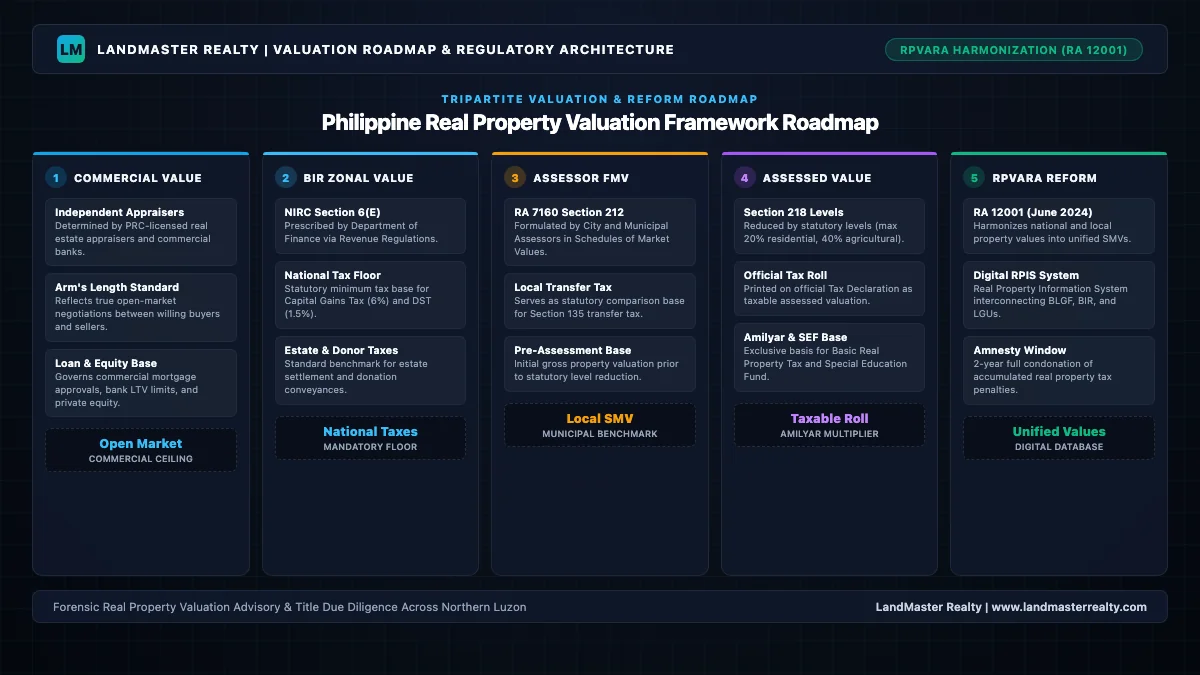
Philippine real property valuation framework roadmap detailing national BIR zonal values, municipal assessor market and assessed values under RA 7160, commercial appraisal standards, and RA 12001 harmonization.
1. The 5 Core Pillars of Republic Act No. 12001 (RPVARA)
RPVARA structurally reorganizes the Philippine property valuation landscape through five transformative mechanisms:
Pillar 1: Harmonization and Unified Schedules of Market Values (SMVs)
Under Section 5 of RA 12001, the government mandates the establishment of a single, uniform valuation base across the country. Local assessors will continue to draft Schedules of Market Values, but these schedules must now adhere to uniform, standardized valuation methodologies formulated by the Bureau of Local Government Finance (BLGF). Most crucially, once the Secretary of Finance approves these unified SMVs, they become the mandatory valuation basis for both local real property taxes and national internal revenue taxes, effectively phasing out the independent, duplicate BIR zonal valuation schedules.
Pillar 2: The Real Property Information System (RPIS)
RPVARA establishes a centralized digital registry known as the Real Property Information System (RPIS). This electronic database interconnects the BLGF, the Bureau of Internal Revenue, the Land Registration Authority (LRA), Registries of Deeds nationwide, and all local assessor offices. The RPIS maintains an electronic record of all real property transactions, certified deed prices, land classifications, and mapping boundaries. This transparency eliminates the historic practice of submitting undervalued deeds of sale to tax authorities while maintaining separate commercial contracts.
Pillar 3: Mandatory 3-Year Valuation Revaluation Cycles
Under previous laws, local government units frequently delayed revaluations for political reasons, with some municipalities maintaining 15-year-old property schedules. RPVARA establishes a strict statutory mandate requiring all provincial, city, and municipal assessors to update their Schedules of Market Values every three (3) years. Failure by local assessors to comply without valid justification constitutes grounds for administrative sanctions under civil service rules.
Pillar 4: Professionalization and Centralized BLGF Oversight
Under RA 12001, the Bureau of Local Government Finance (BLGF) is granted expanded regulatory, technical, and administrative oversight over all local assessors. Local assessment personnel must undergo continuous professional development, meet standardized educational qualifications, and align local property assessments with International Valuation Standards.
Pillar 5: The Statutory 2-Year Real Property Tax Amnesty Window
Recognizing that updating decades-old valuation rolls will result in significant increases in assessed property values, Congress embedded an extraordinary relief mechanism in Section 29 of RA 12001: a nationwide Real Property Tax Amnesty. Under this provision, property owners with accumulated delinquent real property taxes are granted a two-year transition window from the effectivity of the law during which all accumulated interest, penalties, and surcharges on delinquent amilyar are 100% condoned upon payment of the basic tax. To understand how to take advantage of this national amnesty, read our detailed analysis on Real Property Tax Delinquency Penalties and Amnesty.
2. What Property Owners Must Expect During the Transition
While RPVARA modernizes the valuation system, property owners must prepare for its practical consequences:
- Increases in Municipal Market Values: When your municipality updates its Schedule of Market Values under BLGF oversight, the market value printed on your tax declaration will rise significantly toward commercial reality.
- Legislative Tax Relief Safeguards: To prevent sudden tax shocks, RPVARA authorizes local Sanggunians to adjust local assessment level percentages downward and caps initial tax increase impacts to ensure that annual amilyar remains manageable for homeowners.
- Streamlined Title Conveyancing: Once unified SMVs are fully operational in the RPIS, buyers and sellers will no longer have to reconcile conflicting BIR and Assessor valuations when securing an eCAR and transferring tax declarations.
Financial Arithmetic Case Study: Comparing All Three Values on an 800 sqm Ilocos Sur Parcel
To fully appreciate how these valuation benchmarks operate in practice, let us examine a real-world financial case study from our brokerage and valuation practice in Northern Luzon. This case study details the numbers for an 800-square-meter titled residential lot located in an established residential barangay in Bantay, immediately adjacent to the heritage city of Vigan, Ilocos Sur.
1. The Valuation Profile of the Property
On the date of evaluation, the 800-square-meter parcel displays the following distinct valuations across private, national, and local records:
- Appraised Commercial Fair Market Value: A PRC-licensed real estate appraiser conducts a sales comparison study of recent subdivision lot sales in the neighborhood and values the land at PHP 5,000.00 per square meter, yielding a total market value of PHP 4,000,000.00.
- BIR Zonal Value: Under the active Department Order for BIR RDO No. 2 (Ilocos Sur), the parcel is classified as Residential Regular (RR) with an official zonal valuation of PHP 4,000.00 per square meter, yielding an aggregate zonal valuation floor of PHP 3,200,000.00.
- Assessor Fair Market Value: Under the provincial Schedule of Market Values enacted by the Province of Ilocos Sur, the base unit market value for this residential zone is PHP 3,000.00 per square meter, producing a total assessor market value on the tax declaration of PHP 2,400,000.00.
- Assessor Assessed Value: Under Section 218 of RA 7160, the statutory residential land assessment level of 20% is applied to the assessor market value (PHP 2,400,000.00 x 20%), establishing an official taxable assessed value on the tax declaration of PHP 480,000.00 (equivalent to PHP 600.00 per square meter).
2. Transaction Scenario: Sale at PHP 3,500,000.00
Suppose the registered owner negotiates a negotiated cash sale with an acquiring buyer for a stated contract consideration of PHP 3,500,000.00. Let us compute every applicable conveyance tax and verify which valuation benchmark applies to each government counter (for the complete multi-counter conveyance sequence from notary to Registry of Deeds, follow our practitioner guide on how to transfer a land title in the Philippines):
| Tax / Government Fee | Statutory Tax Rate | Statutory Tax Base Applied | Valuation Base Benchmark | Computed Tax Liability |
|---|---|---|---|---|
| Capital Gains Tax (CGT) | 6.0% (NIRC Sec. 24D) | PHP 3,500,000.00 | Selling Price (higher than Zonal PHP 3.2M and Assessor FMV PHP 2.4M) | PHP 210,000.00 |
| Documentary Stamp Tax (DST) | 1.5% (NIRC Sec. 196) | PHP 3,500,000.00 | Selling Price (higher of consideration vs zonal vs assessor market value) | PHP 52,500.00 |
| Provincial Transfer Tax | 0.50% (RA 7160 Sec. 135) | PHP 3,500,000.00 | Selling Price (higher than Assessor FMV PHP 2,400,000.00) | PHP 17,500.00 |
| Registry of Deeds Registration Fee | Graduated Fee Schedule | PHP 3,500,000.00 | Deed Consideration / Title Consideration Schedule | PHP 19,260.00 |
| Assessor Certification & Transfer Fees | LGU Administrative Fees | Fixed Municipal Schedule | Inspection, mapping, and certified tax declaration copies | PHP 1,200.00 |
| Total Transactional Conveyance Taxes and Registration Outlay | PHP 300,460.00 | |||
What If the Contract Consideration Was Only PHP 2,000,000.00?
Now consider the alternative scenario: suppose the seller and buyer execute a deed of sale stating a consideration of only PHP 2,000,000.00. How do the tax computations change?
- BIR Assessment: The BIR assessment officer immediately compares the PHP 2,000,000.00 contract price against the PHP 3,200,000.00 zonal value floor and the PHP 2,400,000.00 assessor market value. Because the zonal value of PHP 3,200,000.00 is highest, the BIR disregards the contract price completely. CGT is computed as 6% of PHP 3,200,000.00 (PHP 192,000.00), and DST is computed as 1.5% of PHP 3,200,000.00 (PHP 48,000.00).
- Provincial Treasurer Assessment: The provincial treasurer in Ilocos Sur reviews the transfer tax application under Section 135. The treasurer compares the contract price of PHP 2,000,000.00 against the Assessor Fair Market Value of PHP 2,400,000.00. Because the assessor value is higher, the treasurer assesses the 0.50% transfer tax on PHP 2,400,000.00, yielding a transfer tax of PHP 12,000.00.
This demonstrates the vital practitioner rule: You cannot reduce national or local transfer taxes below the statutory government valuation floors by under-declaring the contract selling price. Attempting to do so triggers audit assessments, fraud inquiries under NIRC Section 248, and costly closing delays.
3. Annual Holding Tax: Amilyar Computation
Once the buyer completes title registration and transfers the tax declaration at the municipal assessor office, what is the ongoing annual cost to hold this property? Review the arithmetic:
- Assessor Market Value: PHP 2,400,000.00
- Residential Assessment Level: 20%
- Taxable Assessed Value: PHP 480,000.00
- Provincial Basic Real Property Tax (1.0%): PHP 4,800.00
- Special Education Fund (1.0%): PHP 4,800.00
- Total Annual Amilyar: PHP 9,600.00 per year
Notice the extraordinary contrast: while the commercial market value is PHP 4,000,000.00, the annual property tax is only PHP 9,600.00 per year. If the owner pays the annual tax in full on or before January 31, most LGUs grant a prompt-payment discount of 10% to 20%, reducing the annual outlay to as little as PHP 7,680.00. To ensure your tax declaration is properly transferred after purchasing land, review our practitioner guide on How to Transfer Tax Declaration at the Municipal Assessor Office.
Transaction Due Diligence: How to Look Up BIR Zonal Values and Municipal Tax Rolls
Before entering into any real estate transaction, signing a contract to sell, or applying for bank financing, every property buyer and investor must independently verify the official valuation records (alongside verifying Registry of Deeds title records; see our practitioner guide on how to verify a land title in the Philippines). Relying solely on seller representations or unverified photocopies invites severe transactional risk.
1. Step-by-Step Procedure to Check BIR Zonal Values Online
The Bureau of Internal Revenue provides public access to its complete library of active zonal valuation schedules. Follow this protocol to look up the exact zonal value of any parcel:
- Locate the Relevant Revenue District Office (RDO): Identify the specific RDO governing the property’s geographic location. In Ilocos Sur, properties fall under RDO No. 2 (Vigan City). In Ilocos Norte, properties fall under RDO No. 1 (Laoag City). In La Union, properties fall under RDO No. 3 (San Fernando City).
- Access the Official BIR Zonal Values Portal: Navigate to the official BIR website (www.bir.gov.ph) and select the Zonal Values section under Real Property Values.
- Open the Latest Department Order (DO): Download the latest revision schedule for your designated RDO. Schedules are organized in Excel or PDF formats by municipality or city.
- Navigate to Municipality and Barangay: Scroll to the specific municipality (such as Bantay, Candon, or Narvacan) and locate the specific barangay where the land is situated.
- Match Street and Vicinity: Check if the specific street or subdivision is itemized. If the street is not individually named, locate the classification line marked “All Other Streets” or “Vicinity”.
- Verify Classification Code: Confirm the property classification code. A residential lot must be checked against the “RR” rate; commercial strip land against “CR”; and agricultural land against “A”. Note down the prescribed valuation per square meter.
2. How to Audit Municipal Tax Declarations at the Assessor Office
To inspect municipal tax rolls and verify assessor valuations, visit the City or Municipal Assessor Office where the property is located. Follow this four-step audit checklist:
- Request a Certified True Copy: Never rely on an owner-provided photocopy. Request an official Certified True Copy of the latest Tax Declaration from Counter 1 (Records Division). Ensure the document bears the original signature and embossed dry seal of the City or Municipal Assessor.
- Audit Property Identification and Pin Numbers: Verify that the Property Identification Number (PIN), survey lot number, cadastre number, and Title Certificate Number (TCT or OCT) on the tax declaration match the Registry of Deeds Torrens title exactly. If the land title states 1,000 square meters but the tax declaration shows 850 square meters, a boundary variance or survey discrepancy exists that must be resolved prior to purchase.
- Inspect Base Unit Market Values: Check the breakdown on the back or bottom of the tax declaration: confirm the Base Market Value per square meter, the applied assessment level percentage (e.g., 20% for residential), and the resulting Assessed Value.
- Verify Land vs Building Declarations: In Philippine municipal tax practice under Section 204 of RA 7160, land and buildings are assessed on separate tax declarations. If a house, commercial structure, or warehouse stands on the parcel, you must verify that a separate Building Tax Declaration exists and that its real property taxes are fully paid. Discovering an unrecorded building after closing triggers retroactive assessment penalties.
3. Cross-Checking Bank Appraisal Reports
When reviewing commercial bank loan appraisal reports, examine three critical indicators:
- Highest and Best Use (HBU) Analysis: Check whether the bank appraiser classified the property under its current actual use or potential commercial use. A lot currently used as a residential garden in a commercial zoning corridor may be appraised higher if zoned for commercial development.
- Comparable Market Adjustments: Review the comparable market data table in the appraisal report. Ensure that the appraiser used at least three recent arm’s length transactions or listings within a 1-to-2 kilometer radius, with appropriate percentage adjustments for size, location, and accessibility.
- Encumbrance Deductions: Check if the appraiser noted any road right-of-way easements, transmission line right-of-way restrictions, or water buffer setbacks. Environmental setbacks and legal easements reduce the net buildable area and result in immediate downward valuation adjustments by the bank.
Tax Declaration vs Land Title Warning: Always remember that a tax declaration does not prove absolute legal ownership under Philippine law. In landmark rulings such as Cequeña v. Bolante (G.R. No. 137944) and Director of Lands v. IAC (G.R. No. 73246), the Supreme Court ruled that tax declarations are merely indicia of possession and tax assessment, and cannot prevail over a Torrens title. Read our definitive guide on Tax Declaration vs Land Title in the Philippines to protect your ownership rights.
Master Real Property Valuation Framework Comparison Matrix Table
To provide a clear, comprehensive reference for property owners, investors, and practitioners, the following master comparison matrix contrasts the four core valuation benchmarks across Philippine real estate practice:
| Valuation Benchmark | Governing Agency | Statutory Legal Mandate | Applicable Taxes / Purpose | Computation Formula / Method | Frequency of Revision | Public Verification Method |
|---|---|---|---|---|---|---|
| Commercial Fair Market Value | PRC-Licensed Appraisers & Commercial Banks | RA 9646 (RESA) & Philippine Valuation Standards (PVS) | Actual open-market sales, bank mortgage loan LTV, and investment feasibility | Sales Comparison (Market Data), Cost Approach, Income Capitalization | Dynamic (Fluctuates continuously with market conditions) | Commissioned Independent Appraisal Report |
| BIR Zonal Value | Bureau of Internal Revenue (Dept of Finance) | NIRC Section 6(E) as amended by TRAIN Act | Minimum statutory floor for CGT (6%), DST (1.5%), Estate Tax (6%), Donor’s Tax (6%) | Area (sqm) x Prescribed Zonal Value per sqm for specific zone and classification | Periodic Department Orders (Every 3 years under RPVARA) | Official BIR Portal (bir.gov.ph) & RDO Zonal Schedules |
| Assessor Fair Market Value | City or Municipal Assessor (LGU) | RA 7160 Section 212 & Local Tax Ordinances | Provincial/City Transfer Tax (Sec. 135: 0.50% / 0.75%) & pre-assessment base | Area (sqm) x Base Unit Market Value from approved Schedule of Market Values (SMV) | Every 3 years (Mandated by RA 7160 & RA 12001) | Municipal Tax Declaration & Assessor SMV Ordinance |
| Assessor Assessed Value | City or Municipal Assessor (LGU) | RA 7160 Section 218 (Assessment Levels) | Exclusive taxable base for annual Basic Real Property Tax (Sec. 233) & SEF (Sec. 235) | Assessor Market Value x Assessment Level % (20% residential, 40% agricultural) | Updated automatically whenever SMV is revised | Official Tax Declaration & Municipal Tax Assessment Notice |
Frequently Asked Questions About Assessed Value, Fair Market Value, and Zonal Value
1. What is the main difference between assessed value, fair market value, and zonal value?
Fair market value is the true commercial price negotiated between willing buyers and sellers in the open market; BIR zonal value is the mandatory government valuation floor used to calculate national internal revenue taxes (Capital Gains Tax and Documentary Stamp Tax); and assessed value is the scaled-down taxable amount printed on your municipal tax declaration (calculated as assessor market value multiplied by the statutory assessment level) used to compute your annual amilyar.
2. Can the selling price in a Deed of Absolute Sale be lower than the BIR zonal value?
Yes, buyers and sellers are legally free to negotiate any contract price they agree upon. However, for tax purposes, the Bureau of Internal Revenue will strictly enforce the Highest Value Rule under Section 6(E) of the Tax Code. Even if your deed states a selling price of PHP 2,000,000, if the official zonal value is PHP 3,000,000, the BIR will assess the 6% Capital Gains Tax and 1.5% Documentary Stamp Tax based on the higher PHP 3,000,000 figure.
3. How is the assessed value on a Philippine tax declaration computed?
Assessed value is computed by multiplying the Assessor Fair Market Value by the statutory assessment level percentage mandated under Section 218 of the Local Government Code (RA 7160). For residential land, the statutory ceiling is 20%; for agricultural land, it is up to 40%; and for commercial or industrial land, it is up to 50%. For example, a residential lot with an assessor market value of PHP 2,000,000 multiplied by a 20% assessment level produces a taxable assessed value of PHP 400,000.
4. Why is the assessor fair market value on a tax declaration usually lower than the commercial market value?
Assessor market values are based on municipal Schedules of Market Values (SMVs) that are enacted through local political legislation and often remain unrevised for many years. Additionally, local government mass appraisal methods do not account for immediate micro-market demand surges, specialized commercial developments, or premium architectural features, resulting in assessor values that typically lag commercial prices by 30% to 60%.
5. How does the Real Property Valuation and Assessment Reform Act (RA 12001) change BIR zonal values and real property taxes?
Enacted in June 2024, RA 12001 (RPVARA) harmonizes property valuation across the Philippines by establishing unified Schedules of Market Values that will serve as the single valuation benchmark for both local taxes and national BIR taxes, replacing independent BIR zonal schedules. It establishes a centralized digital Real Property Information System (RPIS), mandates updates every 3 years under Bureau of Local Government Finance (BLGF) supervision, and provides a 2-year statutory tax amnesty granting 100% condonation of accumulated real property tax interest and penalties.
6. Which valuation do Philippine commercial banks use when approving real estate mortgage loans?
Commercial banks rely strictly on an independent appraisal conducted by their own appraisal officers or accredited PRC-licensed real estate appraisers. Banks determine an Appraised Fair Market Value and a discounted Sound Value (Liquidation Value) based on recent comparable market sales. Banks completely disregard outdated municipal tax declarations and apply a Loan-to-Value (LTV) limit of 60% to 70% against their independent appraisal report to establish maximum borrowing limits.
Professional Property Valuation, Tax Compliance, and Title Transfer Advisory
Navigating the complex interplay between BIR zonal values, municipal tax declaration assessments, and commercial market appraisals requires institutional knowledge and forensic precision. Calculating taxes on the wrong valuation benchmark leads to severe financial surprises, including deficiency tax assessments with 25% surcharges at the BIR, rejected title transfer dockets at the Registry of Deeds, or unmanageable cash shortfalls when securing bank mortgage financing.
At LandMaster Realty, our licensed real estate brokers and appraisers provide comprehensive, hands-on advisory services across Northern Luzon. Whether you need an independent valuation appraisal for an estate partition, full representation before the BIR and municipal assessor to transfer a title, or strategic guidance on taking advantage of the RPVARA real property tax amnesty, our firm ensures your real estate transactions are executed with forensic compliance and complete peace of mind.
Align Your Property Valuations and Tax Compliance with LandMaster Realty
Do not let conflicting government valuation schedules stall your property transfer or trigger unexpected tax liabilities. Contact our licensed brokerage and appraisal team in Ilocos Sur today for forensic valuation audits, municipal tax compliance, and seamless title registration throughout the Philippines.