One of the most dangerous, widespread, and financially damaging misconceptions in Philippine real estate transactions is the belief that securing a new Transfer Certificate of Title (TCT) from the Registry of Deeds automatically completes your ownership documentation. Thousands of property buyers, estate heirs, and Overseas Filipino Workers (OFWs) celebrate when the Registry of Deeds releases the new Torrens title bearing their name, assuming that all government records have seamlessly synchronized. Months or years later, they receive a rude awakening at the City or Municipal Hall: the official real property tax declaration remains registered under the name of the previous seller or a deceased ancestor, back taxes have accumulated without their knowledge, municipal warrants of levy threaten their land, and their newly acquired title is legally clouded.
The operational reality of Philippine property administration is rooted in a fundamental administrative separation. The Registry of Deeds (operating under the Land Registration Authority and the Department of Justice pursuant to Presidential Decree No. 1529) and the City or Municipal Assessor Office (operating under the local government unit pursuant to Republic Act No. 7160, the Local Government Code of 1991) manage completely independent databases. The Registry of Deeds guarantees Torrens title indefeasibility, but it does not update the municipal assessment master tax roll. Updating that master tax roll requires an affirmative, document-backed administrative application filed directly with the City or Municipal Assessor Office.
As a licensed real estate broker and appraiser practicing across Ilocos Sur, I regularly handle forensic documentation, title conveyancing, and municipal tax reconciliations through LandMaster Realty. In Vigan City, Bantay, Candon, Narvacan, Santa, and surrounding municipalities, our firm routinely assists landowners whose transactions have stalled because the tax declaration was never properly transferred. This comprehensive practitioner guide deconstructs why title registration does not update municipal tax records, details the statutory mandates under RA 7160 including Section 223 Notices of Assessment and Section 226 Local Board of Assessment Appeals (LBAA) rights, itemizes the complete 9-point documentary docket, provides a step-by-step counter walkthrough inside the Assessor Office, explains provincial solutions for area discrepancies and untitled lands, presents a transparent provincial transfer cost model under Section 135, and establishes a remote protocol for OFWs and absentee heirs.
Quick Answer: Why Must You Transfer the Tax Declaration After Getting a Land Title, and What Is the Assessor Office Process?
To understand why you must transfer the tax declaration and how the municipal assessor process operates in the Philippines, review these core practitioner realities:
- Independent Statutory Systems: Torrens title registration at the Registry of Deeds establishes conclusive legal ownership under Presidential Decree No. 1529. However, real property taxation is governed independently by Title II of Republic Act No. 7160 (Local Government Code of 1991). The Registry of Deeds does not notify the City or Municipal Assessor of ownership transfers; the property owner must personally file for a new Tax Declaration.
- Severe Risks of Non-Transfer: If you do not transfer the tax declaration, annual real property tax (amilyar) billing notices and municipal assessment updates continue to be issued to the prior owner or deceased ancestor. Critical delinquency notices and warrants of levy will be mailed to outdated addresses, leaving you vulnerable to default tax auction sales. Furthermore, payments made at barangay collection stations can be misposted, and future sales, bank mortgages, or building permits will be blocked by conflicting public records.
- The Complete 9-Point Assessor Docket: Municipal assessors require a certified true copy of the new Torrens title (with dry seal), the Bureau of Internal Revenue (BIR) electronic Certificate Authorizing Registration (eCAR) with tax return and barcode slip, the notarized Deed of Sale or Estate Settlement, the local Provincial or City Transfer Tax official receipt (paid under Section 135), the certified previous cancelled Tax Declaration, a certified Real Property Tax Clearance, valid government IDs of all parties, the Sworn Declaration of Real Property Value (Section 202), and an approved subdivision or relocation plan if subdivided.
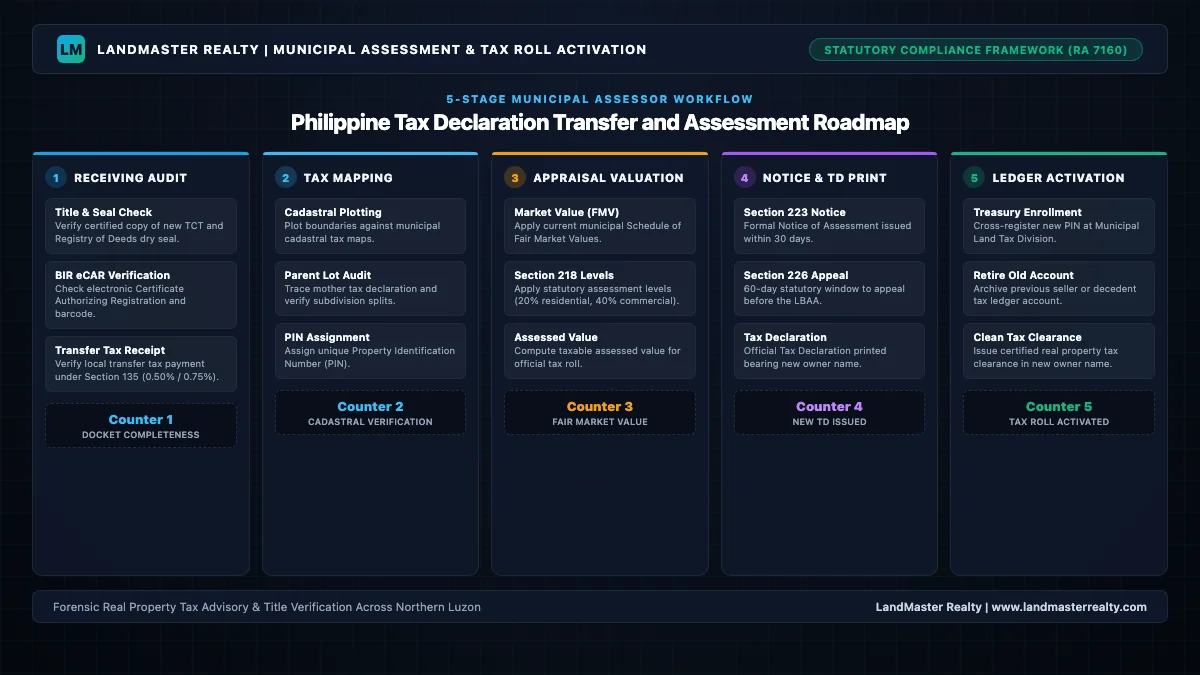
- The 5-Stage Assessor Counter Protocol: The transfer process moves sequentially through Counter 1 (Receiving and Documentary Audit), Counter 2 (Tax Mapping and Cadastral Plotting for boundary verification and PIN assignment), Counter 3 (Appraisal and Assessment computing Fair Market Value and Section 218 assessment levels), Counter 4 (Issuance of Section 223 Notice of Assessment and printed Tax Declaration), and Counter 5 (Treasury Land Tax Division cross-registration to open the new owner ledger).
- Statutory Timelines and Appeal Protections: Under Section 223 of RA 7160, the assessor must officially issue a written Notice of Assessment to the new owner within thirty (30) days of assessment. If the owner disputes the property valuation or classification, Section 226 grants a strict sixty (60) day statutory window from receipt to file a formal appeal before the Local Board of Assessment Appeals (LBAA).
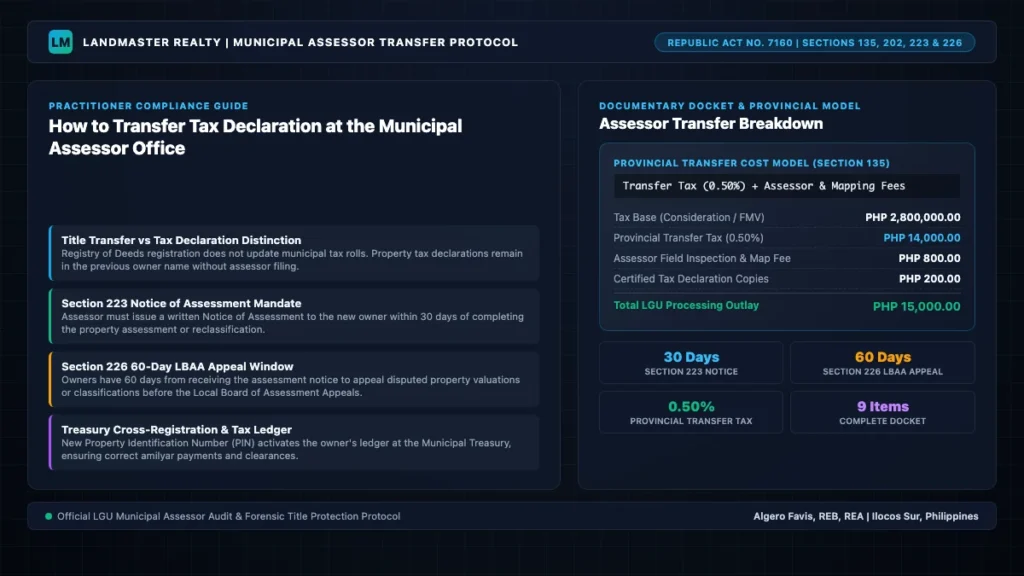
- Provincial Transfer Cost Model: Under Section 135 of RA 7160, the Provincial Transfer Tax is up to 0.50% of the total consideration or Fair Market Value (whichever is higher), or up to 0.75% in chartered cities, supplemented by modest assessor inspection, tax mapping, and certification fees (typically PHP 1,000 to PHP 2,000).
If you have recently registered a land title or inherited property in Northern Luzon, our team at LandMaster Realty provides comprehensive end-to-end representation. Explore our specialized Land Title Transfer and Registration Services and our Real Property Tax Payment and Municipal Compliance Services to ensure your ownership is fully synchronized across both national registry and local municipal records.
The Title Registration vs Tax Declaration Trap: Why Registry of Deeds Registration Does Not Update Municipal Tax Rolls
In our daily real estate brokerage and valuation practice in Ilocos Sur, we frequently encounter clients who fall victim to what property documentation specialists call the Title Registration vs Tax Declaration Trap. This trap arises because buyers assume that the Philippine land administration infrastructure functions as an interconnected, centralized digital database. In reality, the legal mandate governing ownership registration is structurally segregated from the legal mandate governing local municipal taxation.
1. Distinct Legal Mandates and Regulatory Authorities
To understand why this separation exists, one must examine the governing statutes:
- Torrens Title Registration (PD 1529): The Property Registration Decree (Presidential Decree No. 1529) places the registration of deeds, conveyances, mortgages, and Torrens titles under the exclusive jurisdiction of the Land Registration Authority (LRA) and the various Registries of Deeds nationwide. The Registry of Deeds operates under the national Department of Justice. Its primary mandate is to guarantee the indefeasibility, integrity, and state-backed conclusiveness of Torrens titles. It is not an assessment body, does not compute municipal tax rolls, and possesses no administrative responsibility to notify local governments when title changes hands.
- Tax Declaration Administration (RA 7160): Conversely, real property taxation is governed exclusively by Title II of Republic Act No. 7160, known as the Local Government Code of 1991. Under this statute, taxation authority is devolved directly to Local Government Units (LGUs): provinces, chartered cities, and municipalities. The City or Municipal Assessor is an LGU official responsible for discovering, listing, appraising, and valuing real properties within municipal territorial boundaries for local taxation purposes. The Assessor operates under the technical oversight of the Bureau of Local Government Finance (BLGF) under the Department of Finance, completely separate from the Department of Justice.
Because these government offices belong to separate departments, operate on independent IT platforms, and fulfill distinct legal functions, securing a new Torrens title at the Registry of Deeds does not transmit electronic or physical notice to the Municipal Assessor Office in Vigan, Bantay, Candon, or any other municipality. The statutory burden of informing the assessor rests entirely upon the acquiring property owner.
2. The Evidentiary Nature of Tax Declarations: The Supreme Court Doctrine
A frequent point of confusion among landowners is the legal difference between a Torrens title and a Tax Declaration. The Philippine Supreme Court has repeatedly clarified this evidentiary distinction across decades of landmark jurisprudence:
- In Cequeña v. Bolante (G.R. No. 137944), the Supreme Court ruled that tax declarations and real property tax payment receipts do not constitute conclusive evidence of ownership; they are merely indicia of possession and a basis for tax assessment.
- In Director of Lands v. Intermediate Appellate Court (G.R. No. 73246) and Republic v. Santos (G.R. No. 160453), the High Court firmly held that a tax declaration cannot prevail over a valid Torrens Title. A Torrens title is conclusive evidence of ownership against the whole world, whereas a tax declaration merely reflects the local government assessment of the property for ad valorem taxation.
However, while a tax declaration is subordinate to a Torrens title in determining legal title ownership, it is the supreme operational instrument for municipal property governance, building permit issuance, local utility connections, and tax compliance. Possessing a clean title without a corresponding tax declaration creates severe administrative gridlock.
3. The Severe Legal and Financial Risks of Failing to Transfer the Tax Declaration
When a new property owner neglects to file for a tax declaration transfer at the Assessor Office, the property remains registered on the municipal tax roll under the seller or decedent name. This creates four severe risks:
- Unnoticed Property Tax Delinquency: Municipal treasurers mail annual assessment notices and tax bills to the registered owner of record appearing on the tax roll. If the tax declaration remains in the prior owner name, all billing statements, late payment notices, and escalation warnings are dispatched to the previous owner or historical address. The true buyer never receives these notices, allowing unpaid taxes to accrue a 2% monthly interest penalty under Section 255 of RA 7160, capped at 72% per tax year.
- Unserved Warrants of Levy and Risk of Default Municipal Auction: Under Section 258 of RA 7160, when taxes remain delinquent, the City or Municipal Treasurer issues a Warrant of Levy. The treasurer serves this warrant upon the owner listed in the tax declaration. If the notice is served on the prior owner (who naturally ignores it because they sold the land), the new buyer receives no warning. The local government then proceeds to advertise and auction the property on the municipal steps under Section 260. We have witnessed buyers almost lose titled parcels to municipal tax sales simply because the tax declaration was never updated.
- Uncredited and Misposted Barangay Tax Payments: Many property owners pay their annual amilyar at barangay satellite payment centers or municipal cashiers by merely stating their lot number or presenting an old receipt. If the tax declaration has not been updated, payments are credited to the previous owner account. If the previous owner owned multiple lots or the parcel was partitioned from a mother lot, payments can be misapplied to the wrong Property Identification Number (PIN), leaving the buyer actual parcel officially delinquent on the municipal ledger.
- Future Transaction and Financing Paralysis: If you later decide to sell the property, donate it to your children, partition the estate, or use the land as collateral for a commercial bank mortgage, the financial institution or buyer due diligence team will demand a certified true copy of the Tax Declaration in your name alongside a certified Tax Clearance. If the title is in your name but the tax declaration is in the seller name, banks will refuse loan approval and buyers will reject the deal until an assessor rectification is completed.
To avoid these catastrophic outcomes, transferring the tax declaration must be treated as the mandatory concluding phase of every property conveyancing transaction. For deeper insight into how Torrens titles and tax declarations interact, read our detailed analysis on Tax Declaration vs Land Title in the Philippines and our core hub on Philippine Tax Declarations.
Statutory Mandates Under RA 7160: Section 202 Declarations, Section 223 Notices of Assessment, and Section 226 LBAA Appeals
The administrative process of updating a tax declaration is governed by strict statutory rules set forth in Title II of Republic Act No. 7160 (The Local Government Code of 1991). Understanding these legal provisions empowers property owners to enforce their rights, demand lawful assessment procedures, and challenge arbitrary municipal valuations.
1. Section 202: The Mandatory Sworn Declaration by Property Acquirers
Many buyers believe that applying for a tax declaration is optional or can be deferred indefinitely. However, Section 202 of RA 7160 imposes a strict statutory duty upon every person acquiring real property:
“It shall be the duty of all persons, natural or juridical, acquiring real property or making improvements thereon, or their duly authorized representative, to prepare, or cause to be prepared, and file with the provincial, city or municipal assessor, a sworn statement declaring the true value of subject property, within sixty (60) days after the acquisition of such property or upon completion or occupancy of the improvement, whichever comes earlier.”
Under Section 202, the law grants you exactly sixty (60) days from the date of acquisition (the date of deed notarization or title issuance) to submit a Sworn Declaration of Real Property Value to the assessor. This sworn statement formally initiates the assessment roll update and protects the acquirer from municipal non-declaration penalties.
2. Section 204: Assessor Authority to Declare Property Ex-Officio
If a property owner fails or refuses to file the sworn declaration required under Section 202, the law does not leave the property unassessed. Under Section 204 of RA 7160, the City or Municipal Assessor is legally mandated to declare the property under the owner name ex-officio, listing the property and assessing its market value based on available government records. When the assessor declares property under Section 204 without the owner participation, the assessment is frequently computed at highest prevailing classification rates without applicable agricultural or residential exemptions, resulting in significantly higher tax bills.
3. Section 223: The Mandatory 30-Day Notice of Assessment
Once the assessor completes the appraisal, applies the Schedule of Fair Market Values, and computes the new Assessed Value, the assessor cannot simply file the record away in secrecy. Section 223 of RA 7160 establishes a vital procedural safeguard:
“When real property is assessed for the first time or when an existing assessment is increased or decreased, the provincial, city or municipal assessor shall within thirty (30) days give written notice of such new or increased assessment to the person in whose name the property is declared.”
The Notice of Assessment is an official legal document served upon the property owner or administrator. It specifies:
- The previous assessed valuation versus the new assessed valuation.
- The exact land area, property classification (residential, commercial, industrial, agricultural, or special), and actual use.
- The market valuation per square meter based on the approved municipal Schedule of Fair Market Values (SMV).
- The statutory assessment level applied under Section 218 of RA 7160 (e.g., 20% for residential land, 40% for agricultural, 50% for commercial).
- The resulting total taxable Assessed Value that will be forwarded to the Municipal Treasurer for amilyar billing.
Receiving the formal written Notice of Assessment is a mandatory prerequisite before any new tax liability can be enforced. If an assessor fails to serve this notice within thirty days, or applies an increased tax rate without serving the Notice of Assessment, the assessment is procedurally flawed under administrative law.
4. Section 226: The 60-Day Appeal Window to the Local Board of Assessment Appeals (LBAA)
What happens if the assessor overvalues your land, misclassifies an agricultural coconut grove as prime commercial frontage, or computes an inflated area? Many property owners mistakenly argue fruitlessly with assessment clerks. The lawful remedy is provided under Section 226 of RA 7160:
“Any owner or person having legal interest in the property who is not satisfied with the action of the provincial, city or municipal assessor in the assessment of his property may, within sixty (60) days from the date of receipt of the written notice of assessment, appeal to the Board of Assessment Appeals of the provincial or city by filing a petition under oath in the form prescribed for the purpose, together with copies of the tax declarations and such affidavits or documents to submit in support of the appeal.”
Section 226 establishes a strict 60-day jurisdictional clock. The sixty days commence on the exact date you receive the written Notice of Assessment. If you fail to file a petition under oath before the Local Board of Assessment Appeals within this 60-day window, the assessor valuation becomes final, executory, and unappealable, locking in your tax liability for the entire assessment cycle.
In our valuation practice at LandMaster Realty, we evaluate whether an assessor market valuation conforms to local market realities and the approved provincial ordinance. If an erroneous assessment is made, we prepare the appraisal justification and documentary evidence required to petition the LBAA. To understand how property tax rates, assessment levels, and municipal discount schedules are structured, consult our companion guide on How to Pay Real Property Tax in the Philippines.
Complete Documentary Requirements Checklist for Transferring a Tax Declaration in the Philippines
City and Municipal Assessor Offices across the Philippines enforce a strict documentary audit before accepting an application to transfer a tax declaration. Because the assessor acts as the guardian of the municipal fiscal registry, every entry must be authenticated against original national titles, internal revenue clearances, and local treasury receipts.
Incomplete dockets are the leading cause of procedural delays. Below is the comprehensive 9-point documentary docket required by City and Municipal Assessors across Northern Luzon and nationwide:
| # | Required Document | Issuing Agency / Authority | Specific Verification Standard |
|---|---|---|---|
| 1 | Certified True Copy of New Title (TCT or OCT) | Registry of Deeds (LRA) | Must bear the new registered owner name, updated title number, official Registry of Deeds dry seal, and LRA electronic authentication stamp. |
| 2 | BIR electronic Certificate Authorizing Registration (eCAR) | Bureau of Internal Revenue (RDO) | Must include the official eCAR document bearing the security barcode, accompanied by the CAR Tax Return (BIR Form 1706 or 1801) and verification slip. |
| 3 | Notarized Deed of Conveyance | Commissioned Notary Public | Complete original or certified copy of Deed of Absolute Sale, Deed of Donation, or Extrajudicial Settlement with Deed of Sale, with complete notarial acknowledgment. |
| 4 | Official Receipt for Local Transfer Tax | Provincial or City Treasurer Office | Original Official Receipt proving payment of Local Transfer Tax under Section 135 of RA 7160 (0.50% provincial, 0.75% city) issued on Accountable Form No. 51. |
| 5 | Certified Copy of Previous Tax Declaration | City or Municipal Assessor Office | Certified True Copy of the current or cancelled Tax Declaration in the seller or decedent name, establishing the unbroken chain of tax roll succession. |
| 6 | Certified Real Property Tax Clearance | Municipal or City Treasurer (Land Tax) | Official certification certifying that all prior years and current calendar year real property taxes (Basic RPT and SEF) have been paid in full without arrears. |
| 7 | Government-Issued Identification | Authorized Government Agencies | Clear photocopies of valid government photo IDs (Passport, UMID, Driver License, PhilID) of both buyer and seller, or all surviving estate heirs and administrator. |
| 8 | Sworn Declaration of Real Property Value | Owner / Acquirer (Notarized) | Mandatory statutory sworn declaration executed by the owner or authorized broker under Section 202 of RA 7160 declaring true property value and actual use. |
| 9 | Subdivision Plan or DAR / CARP Clearance | DENR LMS / LRA / DAR | Approved subdivision or relocation survey plan if the lot was partitioned from a parent title, plus DAR Conversion Order or Clearance if classified as agricultural land. |
Every document in this docket serves an interlocking legal purpose. The BIR eCAR proves national capital gains or estate taxes have been settled; the Section 135 receipt proves local transfer taxes have been remitted; the Tax Clearance guarantees that the municipal government has collected all historical amilyar; and the new title guarantees that the Registry of Deeds has finalized the Torrens registration. For guidance on preparing transaction contracts, review our detailed guide on Deed of Absolute Sale Requirements in the Philippines.
Step-by-Step Municipal Assessor Walkthrough: From Receiving and Tax Mapping to Assessment and Ledger Activation
When an applicant enters a City Hall or Municipal Assessor Office in the Philippines, the file does not simply land on one clerk desk. The dossier moves sequentially through five distinct internal divisions, each responsible for technical verification, geodetic plotting, appraisal calculation, statutory notice generation, and treasury cross-enrollment.
Understanding this internal division of labor allows property owners and representatives to track progress and prevent unnecessary administrative bottlenecks:
Counter 1: Receiving and Documentary Audit
The process begins at the Receiving Section of the Assessor Office:
- Docket Verification: The receiving officer examines the complete docket against the municipal checklist. The officer inspects the certified true copy of the new title for the physical Registry of Deeds dry seal and verifies that the new owner name matches the grantee in the Deed of Sale.
- Security Barcode Verification: The BIR eCAR barcode and security numbers are logged into the assessor incoming registry. In modern LGUs, clerks cross-reference the eCAR number against regional BIR transmittal sheets to confirm that the tax clearance is genuine.
- Transfer Tax Official Receipt Check: The officer checks the Official Receipt issued by the Provincial or City Treasurer for the payment of the Local Transfer Tax under Section 135 of RA 7160. Without proof of local transfer tax payment, assessors are legally prohibited from accepting the application.
- Routing Slip Issuance: Upon passing audit, the application is stamped received, assigned a tracking control number, and forwarded to the Tax Mapping Division.
Counter 2: Tax Mapping and Cadastral Division Verification
The Tax Mapping Division is the technical geodetic heart of the Assessor Office:
- Cadastral Tax Map Plotting: Tax mappers pull the municipal cadastral map index covering the barangay and section where the property lies. They verify that the technical descriptions (bearings, distances, tie lines, and boundary adjoiners) on the new title align with the municipal base maps.
- Mother Lot and Subdivided Parcel Reconciliation: If the land was purchased from a larger mother title or partitioned among estate heirs, the mapper checks the approved subdivision plan. The mapper verifies that the parent tax declaration has sufficient area to accommodate the newly carved parcel.
- PIN Generation or Retirement: Every real property in the Philippines is identified by a unique multi-digit Property Identification Number (PIN) reflecting the region, province, municipality, district, barangay, section, and parcel index. The mapper cancels the old owner PIN (or reduces the parent lot area) and generates a brand-new, unique PIN for the new owner parcel.
- Tax Map Verification Endorsement: The mapper signs the assessment worksheet, certifying that the parcel does not overlap with municipal roads, public waterways, or adjoining private lots.
Counter 3: Appraisal and Assessment Division
With mapping cleared, the file moves to the Appraisal and Assessment Division:
- Fair Market Value (FMV) Computation: The appraiser determines the base unit market value per square meter. In local taxation, this is governed strictly by the approved municipal or provincial Schedule of Fair Market Values (SMV) enacted by the local Sanggunian. The base value is adjusted based on specific property factors: road proximity, corner lot adjustments, topography, and commercial influence. The base rate is multiplied by the surveyed area to establish the total Fair Market Value.
- Application of Section 218 Assessment Levels: Unlike market transactions where FMV represents the full selling price, real property taxation applies an statutory assessment level under Section 218 of RA 7160. For residential land, the statutory ceiling is 20%; for agricultural land, 40%; and for commercial or industrial land, 50%. The appraiser multiplies the FMV by the statutory assessment level to determine the Assessed Value.
- Improvement Valuation (Section 204): If existing buildings, houses, or perimeter concrete walls stand on the land, the appraiser determines whether improvements must be assessed on a separate building tax declaration or combined, applying building cost tables.
- Review and Approval: The Municipal Assessor reviews the appraisal computations, signs the assessment sheet, and authorizes the generation of the official tax roll document.
Counter 4: Issuance of Formal Notice of Assessment and New Tax Declaration
Once approved, the clerical division prepares the final official outputs:
- Printing the New Tax Declaration: The official Tax Declaration of Real Property is printed on security accountable forms. It prominently displays the new registered owner name, the new PIN, the title number, the exact area, the classification, the Fair Market Value, the assessment level, and the total taxable Assessed Value.
- Generation of Section 223 Notice of Assessment: The assessor issues the formal written Notice of Assessment addressed to the new owner, notifying them of the official valuation and stating the legal basis under RA 7160.
- Signing and Sealing: The Municipal Assessor affixes their official signature and the dry seal of the office. The applicant receives the owner duplicate original of the new Tax Declaration and signs the registry acknowledging receipt of the Section 223 notice (which starts the 60-day Section 226 appeal clock).
Counter 5: Cross-Registration with Municipal Treasurer Land Tax Division
Securing the printed tax declaration does not end the compliance journey. The applicant must proceed immediately to Counter 5, located at the Municipal Treasurer Land Tax Division:
- Ledger Transition and Account Enrollment: The Treasury clerk pulls the historical physical and electronic tax ledgers. The clerk formally archives and retires the seller or decedent account under the cancelled tax declaration number.
- Opening the New Owner Tax Ledger: A new master tax ledger is opened under the new owner name and newly assigned PIN. The taxable Assessed Value computed by the assessor is entered into the municipal amilyar billing database.
- Issuance of Initial Certified Tax Clearance: The treasurer verifies that the previous calendar quarter or year was settled during the title transfer phase, confirms the ledger balance is exactly zero, and issues an updated Certificate of Real Property Tax Clearance in the new owner name.
Following this 5-counter sequence guarantees that your ownership is seamlessly registered across both assessment and treasury departments, preventing lost bills or duplicate accounts. If you require expert due diligence before buying land, consult our comprehensive Philippine Real Estate Due Diligence Guide.
Provincial Reality in Northern Luzon: Resolving Area Discrepancies, Boundary Variances, and Untitled Land Tax Transfers
In rural and provincial settings across Northern Luzon, including our home province of Ilocos Sur (such as Vigan City, Bantay, Candon, Narvacan, Santa, Caoayan, San Juan, and Magsingal), processing a tax declaration transfer rarely follows a completely smooth path. Centuries of historical land records, Spanish royal grants, cadastral surveys from the early 20th century, and informal family boundary agreements frequently introduce discrepancies that must be forensically resolved before the assessor will sign off.
1. The Area Discrepancy Problem (Title vs Historical Tax Declaration)
The most frequent complication we resolve for clients is a direct numerical conflict between the land title and the old tax declaration:
- The Scenario: A newly issued Transfer Certificate of Title states the exact surveyed area is 1,000 square meters based on a modern geodetic survey. However, the historical tax declaration in the seller or ancestral name indicates an area of 850 square meters (or vice-versa).
- The Cause: Early tax declarations were frequently based on ocular estimates, pace measurements, or rough boundaries established before formal cadastral surveys were executed. Over decades, taxes were assessed on the historical estimate rather than the true geodetic boundary.
- The Mandatory Assessor Rectification Protocol: Under provincial assessment regulations, the Municipal Assessor cannot arbitrarily adjust the area without technical justification. The property owner must submit:
- A formal Letter of Request for Rectification of Area addressed to the Municipal Assessor.
- A Certified True Copy of the approved Subdivision or Relocation Survey Plan approved by the Land Management Bureau of the DENR or the Land Registration Authority.
- A Geodetic Engineer Certified Technical Description and Narrative Survey Report explaining the boundary monumentation.
- Assessment Adjustment: The assessor tax mapping division plots the approved survey, cancels the historical 850 sqm assessment, and issues a corrected Notice of Assessment reflecting the true 1,000 sqm area. If the area increased, the assessor may assess back taxes on the incremental difference for prior unassessed years under Section 222 of RA 7160 (capped at a maximum of ten prior years without penalty if the discrepancy was unintentional).
2. Untitled Land Tax Declaration Transfers (Ancestral Claims and Public Land Patents)
In many municipalities across Ilocos Sur, significant portions of residential and agricultural land remain untitled. Transactions involving untitled properties are executed via Deed of Absolute Sale of Unregistered Land, accompanied by the transfer of the Tax Declaration as the primary public instrument of possession.
Transferring a tax declaration on untitled land differs substantially from titled property:
- Absence of Torrens Title: Because no Registry of Deeds TCT exists, the assessor cannot rely on a state-guaranteed title. The assessor demands an exhaustive evidentiary chain proving continuous, uninterrupted tax declaration succession dating back at least thirty (30) years.
- Mandatory Ancillary Clearances: To transfer an untitled tax declaration, the applicant must submit:
- A Certified Certificate of Status from the Community Environment and Natural Resources Office (CENRO/DENR) certifying that the land is classified as Alienable and Disposable (A&D) public land and does not infringe upon public timberlands, forest reserves, or protected coastal easements.
- Barangay Certification of Actual Physical Possession and Non-Involvement in Boundary Disputes issued by the Punong Barangay.
- Affidavit of Adjoining Owners attesting to the applicant exclusive possession and acknowledging boundary monuments.
- Proof of publication of the transfer in a newspaper of local circulation for three consecutive weeks (if transferred pursuant to an extrajudicial settlement of estate).
- Evidentiary Warning: While securing a tax declaration in your name on untitled land allows you to pay amilyar and exercise possessory acts, it does NOT confer indefeasible Torrens ownership. As licensed brokers, we always advise clients on untitled land to proceed toward judicial or administrative titling. Explore our guides on Application of Land Title Services and Residential Free Patent Act (RA 10023) for complete titling roadmaps.
3. Unrecorded Improvements and Structures (Section 204 Declarations)
Another common provincial surprise occurs when a buyer purchases vacant land according to the title, but an unrecorded residential dwelling, ancestral house, warehouse, or perimeter fence stands on the property:
- Separate Tax Declarations for Land and Buildings: Under Philippine tax law, land and permanent improvements are treated as distinct real property entities. A single parcel of land may have one land tax declaration and one or more separate building tax declarations.
- The Unrecorded Structure Trap: If the previous owner constructed a residential house without securing a building permit or filing a declaration under Section 202, the municipal assessor ocular inspection team will discover the structure during the transfer mapping audit.
- Resolution: The assessor will require the submission of an Affidavit of Ownership of Improvement or building plans, compute the market value of the building based on current construction replacement schedules, and issue a separate Building Tax Declaration under Section 204. Transferring both land and building declarations simultaneously ensures complete municipal compliance.
Financial Arithmetic Model: Provincial LGU Transfer Tax Computation (Section 135) and Municipal Assessor Fees
Many property buyers budget carefully for national Bureau of Internal Revenue taxes (6% Capital Gains Tax or 6% Estate Tax, plus 1.5% Documentary Stamp Tax) and Registry of Deeds registration fees, but are caught completely unprepared by local government transfer taxes and assessor processing fees.
Understanding the statutory formula for local transfer taxes under Republic Act No. 7160 ensures exact financial preparation and eliminates unexpected closing costs.
1. Statutory Basis: Section 135 of the Local Government Code
Section 135 of RA 7160 authorizes local government units to impose a tax on the sale, donation, barter, or any other mode of transferring real property ownership:
“The province may impose a tax on the sale, donation, barter, or on any other mode of transferring ownership or title of real property at the rate of not more than fifty percent (50%) of one percent (1%) of the total consideration involved in the acquisition of the property or of the fair market value in case the monetary consideration involved in the transfer is not substantial, whichever is higher.”
Key legal parameters under Section 135 include:
- Statutory Tax Rate: In provinces (such as Ilocos Sur), the rate is capped at not more than 0.50% (one-half of one percent). In chartered cities (such as Manila, Quezon City, Cebu City, or Vigan City), the city council may impose a rate of up to 0.75% (three-fourths of one percent) pursuant to Section 151 of RA 7160.
- Taxable Base: The tax is computed on whichever is higher between:
- The total monetary consideration stated in the Deed of Absolute Sale; or
- The Fair Market Value (FMV) of the real property as determined by the Provincial or City Assessor.
- The 60-Day Payment Deadline: Under Section 135(b), the Local Transfer Tax must be paid to the Provincial or City Treasurer within sixty (60) days from the date of deed notarization or execution. If payment is made after 60 days, the treasurer imposes a mandatory 25% late payment surcharge plus 2% monthly interest under Section 168.
2. Worked Provincial Financial Model (Ilocos Sur Residential Property)
To demonstrate how local taxes and assessor fees are calculated in practice, let us examine a realistic transaction handled by LandMaster Realty in Ilocos Sur:
- Property Profile: An 800-square-meter titled residential lot located in Bantay, Ilocos Sur.
- Agreed Contract Price (Deed of Sale): PHP 2,500,000.00
- Assessor Fair Market Value (SMV): PHP 2,800,000.00 (PHP 3,500.00 / sqm x 800 sqm)
- Taxable Base: PHP 2,800,000.00 (higher of consideration and assessor FMV).
Below is the itemized financial breakdown of local government outlays required to complete the tax declaration transfer:
| Fee Component | Statutory / Local Authority | Calculation Formula | Payable Amount (PHP) |
|---|---|---|---|
| Provincial Transfer Tax | Section 135, RA 7160 | 0.50% of PHP 2,800,000.00 | PHP 14,000.00 |
| Assessor Field Inspection Fee | Municipal Revenue Ordinance | Standard ocular verification fee | PHP 500.00 |
| Tax Mapping & Cadastral Plotting | Municipal Revenue Ordinance | Map index and PIN update fee | PHP 300.00 |
| Certified Copy of New Tax Declaration | Assessor Administrative Fee | 2 certified true copies (PHP 100 each) | PHP 200.00 |
| Municipal Tax Clearance Certificate | Treasury Administrative Fee | Official certified clearance with seal | PHP 150.00 |
| Documentary Stamp Taxes (Local) | BIR Accountable Stamping | Local clearance documentary stamps | PHP 60.00 |
| TOTAL OFFICIAL LGU CASH OUTLAY | PHP 15,210.00 | ||
3. Comparing DIY Administrative Delays vs Organized Brokerage Execution
While the official government outlays total approximately PHP 15,210.00, property owners who attempt to handle this process independently often incur massive hidden financial costs:
- The Missed 60-Day Deadline Surcharge: If an unrepresented buyer delays paying the Local Transfer Tax beyond 60 days from deed notarization, the treasurer imposes an automatic 25% penalty on the transfer tax. On a PHP 14,000 transfer tax, that penalty is an immediate PHP 3,500.00 loss, plus 2% monthly interest.
- Multiple Lost Workdays and Provincial Travel: A typical DIY applicant visits the municipal hall between three and six times to resolve missing clearances, request certified true copies, coordinate tax mapping corrections, and queue at treasury cashiers. For professionals or business owners, this translates to tens of thousands of pesos in lost productive time.
- Incorrect Assessment Classification: Inexperienced applicants often fail to review the assessor computation sheet. If the assessor applies a 40% commercial assessment level to an 800 sqm residential lot instead of the lawful 20% residential rate, the property owner will overpay annual real property tax by 100% every single year into perpetuity.
Retaining licensed real estate brokers and appraisers at LandMaster Realty ensures that your tax base is accurately verified, assessment levels are lawfully applied, and documents are executed without penalty surcharges. To review penalty calculations when taxes have been neglected for multiple years, read our guide on Real Property Tax Delinquency, Penalties, and Amnesty.
Inherited Estate and Partition Transfers: Updating Tax Declarations on Subdivided Family Land
The most procedurally complex tax declaration transfers occur during the settlement and partition of inherited family estates. When an ancestral property passes from deceased parents or grandparents to multiple surviving heirs, transitioning from a single historical tax declaration to distinct individual tax declarations requires coordinated legal and geodetic execution.
1. Moving from an Undivided Parent Title to Individual Child Tax Declarations
In traditional family ownership, an entire parcel (e.g., 5,000 square meters) is covered by a single parent Torrens title and one master Tax Declaration registered under the name of the deceased patriarch or matriarch (often noted as “Heirs of [Decedent Name]”). When the heirs execute an Extrajudicial Settlement of Estate with Deed of Partition, the land is surveyed and divided into separate designated lots.
To transfer the tax declarations to individual heirs, the assessor requires:
- Approved Subdivision Plan (LRA or DENR): The assessor mapping division will not split a tax declaration based on an informal sketch. The heirs must provide a formal subdivision plan approved by the Land Registration Authority (for titled land) or the Land Management Services of the DENR (for untitled land), prepared by a licensed Geodetic Engineer.
- Notarized Deed of Extrajudicial Settlement and Partition: The deed must explicitly allocate specific lot numbers, areas, and technical descriptions to each respective heir.
- BIR Estate Tax eCAR: The electronic Certificate Authorizing Registration from the Bureau of Internal Revenue certifying that all estate taxes on the deceased owner estate have been paid in full.
- New Individual Torrens Titles: Individual TCTs issued by the Registry of Deeds for each subdivided lot (e.g., Lot 1-A, Lot 1-B, Lot 1-C).
2. The Parent Lot Cancellation and PIN Split Mechanism
Inside the Assessor Office, the Tax Mapping Division executes a formal Pin Split:
- Cancellation of Mother Tax Declaration: The historical tax declaration in the ancestor name is stamped CANCELLED across the official tax roll. The assessor records a cross-reference notation stating: “Cancelled by virtue of Extrajudicial Settlement and Subdivision Plan Psd-XX-XXXXXX, subdivided into Lots 1-A to 1-C.”
- Generation of Unique Child PINs: Each newly carved lot is assigned an independent Property Identification Number. Lot 1-A receives its own PIN and separate Tax Declaration in the name of Heir A; Lot 1-B receives its own PIN and Tax Declaration in the name of Heir B; and Lot 1-C receives its own PIN and Tax Declaration in the name of Heir C.
- Right-of-Way and Road Lot Allocation: If the subdivision plan includes an interior road right-of-way (ROW) lot to provide access to rear parcels, the assessor issues a distinct tax declaration for the road lot, often designated under exempt or co-ownership status.
3. Clearing Historical Family Arrears Before Partition
Under Section 247 of RA 7160, local treasurers are strictly prohibited from issuing a tax clearance for partition or transfer if any prior year amilyar remains unpaid on the parent lot. If the family has neglected taxes for ten or fifteen years, the accumulated debt plus 72% statutory interest must be settled in full before the assessor will release the new individual tax declarations. Our team at LandMaster Realty assists families by negotiating penalty condonations and structured compromise settlements with municipal treasurers. For broader guidance on family estate settlement, explore our commercial services on Partition and Consolidation of Property.
Remote Tax Declaration Transfer Protocol for OFWs and Absentee Heirs: Retaining LandMaster Advisory Representation
A substantial portion of real estate transactions in Northern Luzon involves Overseas Filipino Workers (OFWs) residing in North America, Europe, the Middle East, and Asia, as well as non-resident heirs living in Metro Manila. For these absentee property owners, navigating the multi-counter bureaucratic requirements of City and Municipal Assessor Offices is an operational impossibility.
Flying home to the Philippines to spend weeks queueing at government offices, resolving technical mapping questions, and coordinating between treasuries and assessors is financially prohibitive and inefficient. To solve this problem, LandMaster Realty has established a specialized Remote Tax Declaration Transfer Protocol that allows overseas and non-resident clients to execute complete municipal transfers without international travel.
| Pillar | Protocol Component | Operational Execution by LandMaster Realty |
|---|---|---|
| Pillar 1 | Special Power of Attorney (SPA) Execution | We draft a tailored, legally fortified Special Power of Attorney explicitly granting authority to represent the principal before the City or Municipal Assessor, Provincial and Municipal Treasury, and Registry of Deeds. The OFW executes the SPA at the Philippine Consulate abroad or before a local public notary with an Apostille certificate under the Hague Apostille Convention. |
| Pillar 2 | Remote Document Dispatch & Forensic Audit | The client securely dispatches the apostilled SPA and original titles via international courier (DHL/FedEx). Upon arrival at our Ilocos Sur office, our licensed brokerage team performs a forensic documentary audit, verifying that the title dry seal, BIR eCAR barcode, and notarial acknowledgments meet exact LGU standards. |
| Pillar 3 | In-Person Counter Representation | Our licensed brokers physically represent the client across all five assessor counters. We remit the Section 135 Local Transfer Tax to the Provincial Treasurer, work directly with tax mappers to resolve cadastral boundaries, review appraisal computation sheets for Section 218 compliance, and secure the Section 223 Notice of Assessment. |
| Pillar 4 | Treasury Enrollment & International Courier | We cross-register the new PIN at the Municipal Treasury, activate the new owner billing ledger, settle the current amilyar, and secure certified Certificates of Tax Clearance. The original certified new Tax Declarations, official receipts, and clearances are transmitted back to the client via insured international courier. |
This structured representation guarantees that our overseas clients enjoy complete legal protection, absolute transparency, and zero travel disruption. For comprehensive guidance on executing legal agency documents from abroad, read our detailed practitioner guide on Special Power of Attorney for OFW Property Transfers.
Master Tax Declaration Transfer, Statutory Authority, and Documentary Docket Matrix Table
To provide property owners, investors, and legal practitioners with a clear, all-in-one reference framework, the matrix below consolidates every phase of the tax declaration transfer workflow. It details the operational steps, responsible government bodies, governing statutory authorities under RA 7160, mandatory documentary inputs, fee parameters, and expected turnaround timelines:
| Stage / Workflow | Responsible Office | Statutory Citation | Required Documents & Evidence | Fee Structure | Standard Turnaround |
|---|---|---|---|---|---|
| 1. Title Conveyance & Release | Registry of Deeds (LRA) | PD 1529, Sections 57 & 58 | Deed of Sale, BIR eCAR, Transfer Tax OR, surrendered owner duplicate title. | Graduated LRA registration schedule. | 2 to 4 weeks. |
| 2. Local Transfer Tax Settlement | Provincial / City Treasurer | RA 7160, Section 135 | Notarized Deed of Sale, BIR CAR, copy of title, previous Tax Declaration. | 0.50% (provinces) or 0.75% (cities) of consideration or FMV. | 1 day (within 60 days of deed). |
| 3. Assessor Receiving & Audit | Municipal Assessor (Receiving) | RA 7160, Section 202 | Certified new TCT with dry seal, BIR eCAR, Deed of Sale, Section 135 OR, IDs. | Filing / processing fee (PHP 100 to 200). | 1 day. |
| 4. Tax Mapping & PIN Split | Assessor Tax Mapping Division | Manual of Real Property Appraisal | Cadastral base maps, approved subdivision / relocation survey plan. | Tax mapping fee (PHP 200 to 500). | 2 to 5 working days. |
| 5. Appraisal Valuation | Assessor Appraisal Division | RA 7160, Sections 212 & 218 | Approved municipal SMV schedule, field inspection report, improvement sworn statement. | Field inspection fee (PHP 300 to 500). | 2 to 4 working days. |
| 6. Notice & Tax Declaration Print | City / Municipal Assessor | RA 7160, Section 223 | Approved assessment worksheet, security paper forms, assessor dry seal. | Certified copy fee (PHP 100 per copy). | Within 30 days of assessment. |
| 7. Valuation Appeal Window | Local Board of Assessment Appeals | RA 7160, Section 226 | Petition under oath, comparative appraisal reports, tax declarations. | LBAA docket / filing fee. | Strict 60-day filing window from notice. |
| 8. Treasury Ledger Activation | Municipal Treasurer (Land Tax) | RA 7160, Section 247 | New Tax Declaration with PIN, prior amilyar official receipts. | Tax clearance certification fee (PHP 150). | 1 day. |
Frequently Asked Questions About Transferring Tax Declarations in the Philippines
1. Does transferring the land title automatically transfer the tax declaration?
No. Securing a new Transfer Certificate of Title (TCT) from the Registry of Deeds does not automatically transfer the tax declaration. The Registry of Deeds operates under the national Department of Justice, whereas City and Municipal Assessor Offices operate independently under local government units. The two agencies do not share a synchronized database. The property owner must submit a separate application, complete with certified title copies, BIR eCAR, and transfer tax receipts, directly to the Assessor Office to issue a new Tax Declaration.
2. What is the deadline to transfer a tax declaration after buying property in the Philippines?
Under Section 202 of the Local Government Code of 1991 (Republic Act No. 7160), persons acquiring real property or making improvements thereon must file a Sworn Declaration of Real Property Value with the provincial, city, or municipal assessor within sixty (60) days after acquisition. Furthermore, under Section 135(b), the Local Transfer Tax must be paid to the Provincial or City Treasurer within sixty (60) days from deed execution to avoid a 25% late penalty surcharge and monthly interest.
3. What is an Assessor Notice of Assessment under Section 223, and can I dispute it?
An Assessor Notice of Assessment is an official statutory notice mandated under Section 223 of RA 7160. The assessor must issue this written notice to the property owner within thirty (30) days of completing an appraisal, reassessment, or classification update. If you disagree with the assessed value or classification, Section 226 gives you exactly sixty (60) days from the date of receiving the notice to file a formal appeal under oath before the Local Board of Assessment Appeals (LBAA).
4. How much does it cost to transfer a tax declaration at a municipal assessor office?
The primary government cost is the Local Transfer Tax imposed under Section 135 of RA 7160, which is up to 0.50% of the purchase price or assessor Fair Market Value (whichever is higher) in provinces, or up to 0.75% in chartered cities. Assessor administrative fees are minimal, generally totaling between PHP 1,000 and PHP 2,000, covering inspection fees (PHP 500), tax mapping verification (PHP 300), certified copies (PHP 100 to 200), and municipal tax clearance certificates (PHP 150).
5. Can you transfer a tax declaration without a Torrens land title?
Yes. For untitled alienable and disposable (A&D) lands, a tax declaration can be transferred via a notarized Deed of Absolute Sale of Unregistered Land, accompanied by a BIR eCAR and local transfer tax receipts. However, the assessor requires extensive proof of unbroken chain of tax declarations, a CENRO alienable and disposable certification, barangay certifications of actual possession, and affidavits of adjoining owners. Transferring an untitled tax declaration conveys tax responsibility and possessory rights, but does not grant state-guaranteed Torrens title ownership.
6. Can an Overseas Filipino Worker (OFW) transfer a tax declaration without traveling to the Philippines?
Yes. OFWs and non-resident property owners can complete the entire tax declaration transfer through authorized representation. The principal executes a Special Power of Attorney (SPA) authenticated at a Philippine Consulate or apostilled under the Hague Convention. The appointed licensed broker or representative in the Philippines physically presents the SPA, pays the local transfer tax, coordinates tax mapping, and receives the new Tax Declaration and certified Tax Clearance on behalf of the owner.
Professional Tax Declaration and Municipal Property Compliance Services
Completing a property purchase, inheritance partition, or land consolidation requires meticulous administrative synchronization. Leaving your real property tax declaration under the seller or ancestor name exposes your investment to unnoticed tax penalties, unserved municipal warrants of levy, uncredited payments, and title transfer clouds. Securing your new Tax Declaration and activating your municipal treasury ledger is the only way to achieve complete, unassailable property ownership.
At LandMaster Realty, our licensed real estate brokers and appraisers provide comprehensive, hands-on representation across Northern Luzon. Whether you need to update a tax declaration following a title transfer, resolve historical area discrepancies with geodetic surveys, partition family estate tax rolls, or manage property compliance from overseas, our firm handles every counter with forensic accuracy and institutional rigor.
Ensure Complete Municipal Tax Compliance with LandMaster Realty
Do not let an outdated tax declaration cloud your Torrens title or trigger municipal tax penalties. Contact our licensed brokerage and appraisal team today for professional title conveyancing, assessor office representation, and comprehensive property compliance in Ilocos Sur and throughout the Philippines.