Introduction
A tax declaration of real property in the Philippines is the Assessor’s Office record of a property’s classification, area, and assessed value for taxation purposes. It is the document a family holding untitled land almost always has, and the one buyers and lenders check to understand a property’s tax status before anything else.
What is a Tax Declaration?
A tax declaration is issued and maintained by the Provincial or Municipal Assessor’s Office. It records who is being assessed for a given parcel, the property’s classification, residential, agricultural, or commercial, its area, and the assessed value used to compute real property tax. It is not proof of ownership. For untitled land, it can support a claim of possession, but only a registered title carries the legal weight of ownership under the Torrens system. See our guide to what an Original Certificate of Title actually is for that distinction in full.
The Importance of a Certificate of Tax Declaration (CTD)
The Certificate of Tax Declaration is what proves a specific tax declaration is on file and current with the Assessor’s Office. Every property owner should keep this updated, and it becomes especially important during any transaction: a sale, a mortgage application, or a title transfer, since the buyer’s or lender’s due diligence will ask to see it.
The Role of the City Assessor’s Office
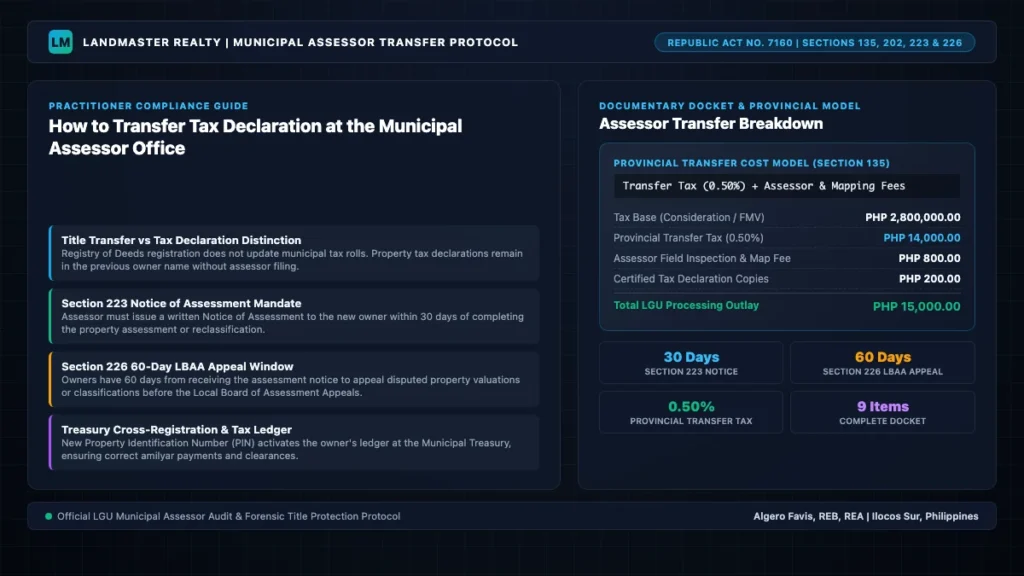
For property in Vigan or Magsingal, this is the Provincial or Municipal Assessor’s Office with jurisdiction over the parcel. The Assessor’s staff evaluate the property, based on submitted documents and, where relevant, a physical inspection, and issue or update the tax declaration accordingly. Any change of ownership, new construction, or subdivision needs to go through this office to keep the record current.
The Land Registration Process
Land registration and tax declaration are related but separate systems. Registration through the Registry of Deeds, producing an Original Certificate of Title or Transfer Certificate of Title, is the stronger form of proof and, where it exists, supersedes the tax declaration as evidence of ownership. Where no title exists yet, the tax declaration is the working record until the property goes through the titling process.
Real Property Tax (RPT)
Real property tax is the annual local tax computed against the assessed value on the tax declaration, paid to the Provincial or Municipal Treasurer. Provinces can levy up to 1% of assessed value under the Local Government Code; confirm the current local rate with the Treasurer’s Office, since it is set by ordinance within that ceiling. See our full real property tax guide for the payment process and deadlines.
Understanding Alienable and Disposable Lands
Only land classified as alienable and disposable, released from the public domain for private ownership, can be privately owned and is subject to real property tax. Land still classified as forest land or another inalienable category cannot be privately titled or taxed the same way, regardless of how long it has been occupied. Confirm classification at the DENR CENRO office before assuming a parcel is titleable.
The Local Government Code and Tax Declaration
The Local Government Code sets the legal framework for real property taxation nationwide, including the assessment levels, the tax rate ceilings, and the responsibilities of the Assessor’s and Treasurer’s offices. Local ordinances then set the exact rates within what the Code allows, which is why confirming the current figure locally matters more than relying on a single national number.
The Role of a Geodetic Engineer
A geodetic engineer prepares the technical description and survey that defines a parcel’s exact boundaries, the information a tax declaration and, later, a title both depend on. Where a property’s boundaries are unclear or disputed, or where land is being subdivided, a geodetic engineer’s survey is what resolves the technical description before the Assessor’s Office or the Registry of Deeds can act.
Keeping Your Tax Declaration Updated
Update the tax declaration whenever ownership changes, whenever a new structure is built, and periodically as required by the Assessor’s general revision schedule. A tax declaration that has drifted out of date, showing the wrong owner or the wrong area, is exactly the kind of discrepancy that stalls a sale or a titling application later. Keeping it current is a small, recurring task that avoids a much larger one down the line.
Conclusion
A tax declaration is not a title, but it is the record that carries the most weight for untitled land and the one every transaction checks first. Keep it accurate and current, and it works quietly in the background. Let it drift out of date, and it becomes the thing that stalls your next sale, loan, or titling application.
This is general information, not legal or tax advice. Confirm current figures and requirements with the Assessor’s Office and the Treasurer for the specific property.
Contact LandMaster Realty if your tax declaration needs updating or if you are not sure whether it matches your title.
Frequently Asked Questions (FAQs)
What is the role of a geodetic engineer in the tax declaration process?
A geodetic engineer surveys the property and prepares the technical description, boundaries, area, and lot identification, that the tax declaration and any future title depend on. Their work is what resolves boundary questions before the Assessor’s Office finalizes an assessment.
What is the significance of a Certificate of Tax Declaration?
It confirms a tax declaration is on file and current with the Assessor’s Office for a specific property, and it is one of the first documents a buyer, lender, or the BIR will ask to see during a transaction.
What is the difference between alienable and disposable lands and public domain lands?
Alienable and disposable land has been formally released from the public domain and can be privately owned, titled, and taxed. Public domain land, including forest land and other inalienable categories, remains government-owned and cannot be privately titled through the standard routes, regardless of possession history.