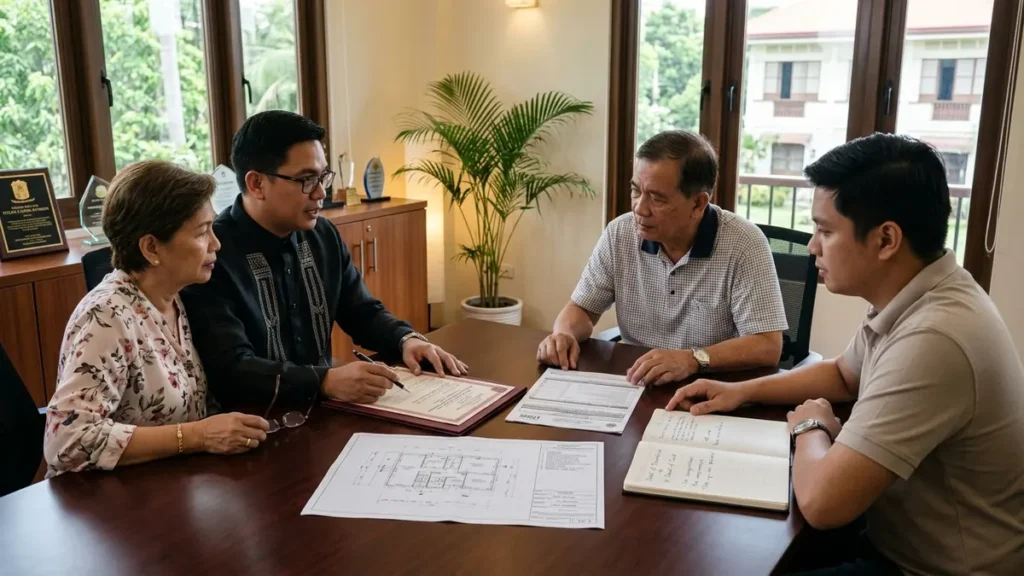
One of the most frequent dilemmas we encounter in our brokerage and property valuation practice at LandMaster Realty in Ilocos Sur revolves around a deceptively simple family decision: should parents transfer real estate to their children through a Deed of Donation, or is it better to execute a Deed of Absolute Sale? Property owners often arrive at our office with preconceived assumptions. Some believe that donating land is virtually free because no money changes hands. Others insist that executing a simulated deed of sale is the only safe way to protect the title from government interference. Both assumptions are legally flawed and financially hazardous.
Transferring real estate in the Philippines is never a casual administrative chore. Whether you choose a gratuitous conveyance through donation or an onerous conveyance through sale, Philippine law triggers a strict web of statutory obligations. You must satisfy internal revenue tax audits, secure local government clearances, comply with civil law inheritance rules, and register instruments before the Registry of Deeds to produce a new, indefeasible Transfer Certificate of Title (TCT).
Furthermore, the tax landscape governing Philippine property transfers was fundamentally transformed by the Tax Reform for Acceleration and Inclusion Law (TRAIN Law, Republic Act No. 10963). The historical tax gap between sales and donations has narrowed significantly, while civil law succession safeguards and future income tax implications have become paramount considerations. This comprehensive practitioner guide provides an exhaustive, real-world comparison of the donation vs sale property transfer tax philippines framework. Written from the perspective of an active licensed real estate broker and appraiser, this guide analyzes national tax codes, local transfer taxes, Documentary Stamp Tax exemptions, Civil Code collation rules, future capital gains carryover traps, and realistic closing expenses so you can select the right legal instrument for your property.
Quick Answer: Which Is Cheaper in the Philippines, Deed of Sale or Deed of Donation?
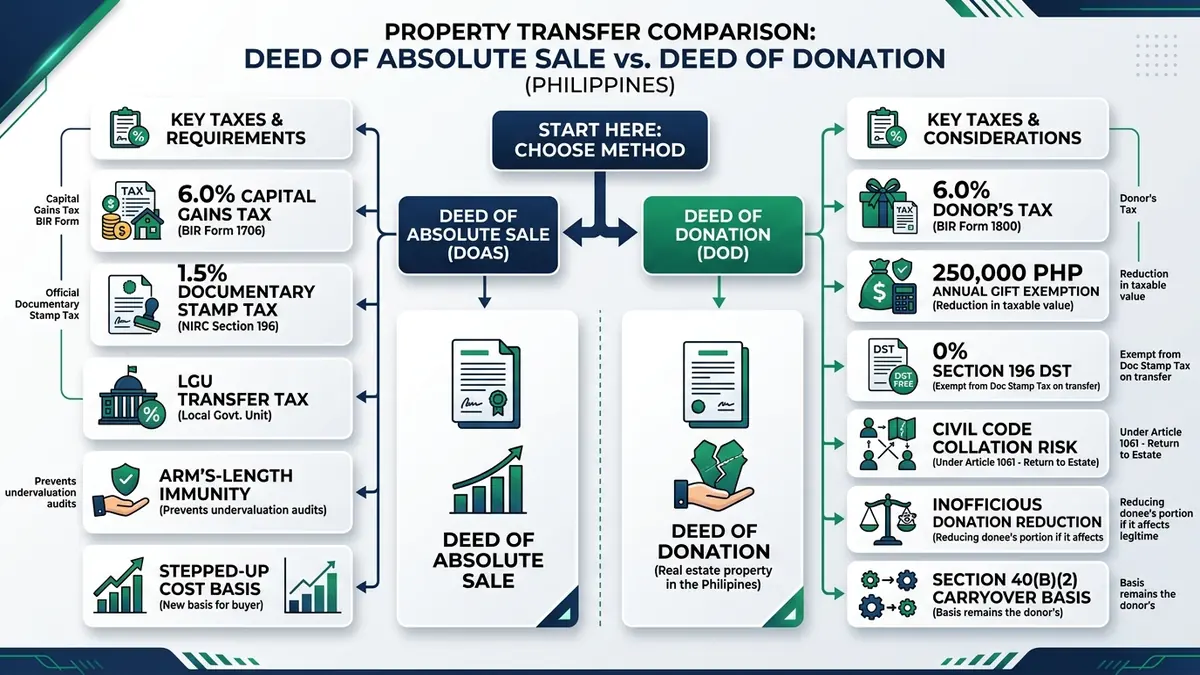
From an immediate, cash-out-of-pocket settlement perspective, a Deed of Donation is almost always cheaper than a Deed of Absolute Sale. Under the TRAIN Law (RA 10963), both conveyances are assessed at an identical headline tax rate of 6.0% (Capital Gains Tax for sales versus Donor Tax for donations). However, a donation provides two decisive upfront financial advantages:
- Annual Gift Exemption: Under Section 99(A) of the National Internal Revenue Code (NIRC), the first 250,000 PHP of net gifts made in a calendar year is completely exempt from donor tax per donor. For conjugal property donated jointly by both parents, the statutory exemption doubles to 500,000 PHP, saving 15,000 PHP to 30,000 PHP in taxes.
- Documentary Stamp Tax (DST) Exemption: Under NIRC Section 196, sales of real property incur a mandatory 1.5% Documentary Stamp Tax on the gross selling price or zonal value. In contrast, an ordinary, gratuitous Deed of Donation involving no monetary consideration or assumed debt is completely exempt from Section 196 DST, saving 15,000 PHP for every 1,000,000 PHP of property value.
However, immediate cash savings do not tell the complete story. A Deed of Donation introduces serious long-term legal and financial risks:
- Collation and Inofficious Donations: Under Civil Code Article 1061, property received by an heir through donation is legally treated as an advance on their inheritance. If the donation impairs the legal shares (legitimes) of other compulsory heirs upon the donor death, aggrieved co-heirs can file a court action to reduce or revoke the donation. A genuine, arm-length Deed of Absolute Sale is completely immune to collation.
- Section 40(B)(2) Carryover Cost Basis Trap: When property acquired through donation is later sold or developed commercially, the donee inherits the donor original historical cost basis rather than the market value at the time of donation. This can trigger massive income tax liabilities on subsequent disposals.
In summary: Choose a Deed of Donation if transferring to an only child or sole heir where family disputes are impossible and the property will remain in the family long term. Choose a bona fide Deed of Absolute Sale if you need to insulate the transfer from future sibling inheritance challenges or if the buyer intends to resell or develop the property commercially.
The Statutory Tax Framework Under the TRAIN Law (RA 10963)
To evaluate which conveyance method suits your family or investment strategy, one must first master the statutory taxation rules enforced by the Bureau of Internal Revenue (BIR). Prior to January 1, 2018, comparing a sale to a donation was relatively straightforward because the tax codes were dramatically different. The enactment of the TRAIN Law (Republic Act No. 10963) harmonized the national tax structure, eliminating old loopholes while introducing strategic estate planning opportunities.
Capital Gains Tax on Real Property Sales: NIRC Section 24(D)(1)
When an individual conveys real property classified as a capital asset through an onerous contract such as a Deed of Absolute Sale, the transaction is governed by Section 24(D)(1) of the National Internal Revenue Code. The seller is assessed a final Capital Gains Tax (CGT) of 6.0%.
It is vital to understand that Capital Gains Tax in the Philippines is not a tax on the actual economic profit or net gain realized from the sale. Instead, it is a transactional final tax levied on the highest of the following statutory tax bases:
- The gross selling price stated in the Deed of Absolute Sale;
- The current Bureau of Internal Revenue Zonal Value of the land and improvements; or
- The fair market value of the land and improvements as scheduled by the Provincial or City Assessor.
Even if the seller sells the property at a financial loss, Capital Gains Tax remains due based on the government zonal or assessed valuation. The tax return (BIR Form 1706) must be filed, and the tax paid to an Authorized Agent Bank (AAB), within thirty (30) calendar days from the date of notarial acknowledgment. Failure to pay within this statutory deadline triggers immediate compounding penalties under Sections 248 and 249 of the Tax Code, including a 25% surcharge, 12% annual deficiency interest, and administrative compromise penalties.
Donor Tax Overhaul: Flat 6.0% Rate and the 250,000 PHP Annual Exemption
Before the TRAIN Law took effect on January 1, 2018, donor taxation in the Philippines was notoriously complicated and expensive. Donations to relatives within the fourth civil degree of consanguinity were taxed under a graduated bracket system ranging from 2% to 15%. More critically, donations to strangers were subjected to a punitive flat tax of 30% of the net gift. Under the old rules, transferring property to an in-law, a close friend, or a distant relative incurred an exorbitant 30% tax liability, which frequently pushed landowners into executing simulated deeds of sale.
The TRAIN Law completely revolutionized this structure by amending Section 99 of the NIRC. Today, the donor tax framework features three fundamental pillars:
- Unification into a Flat 6.0% Rate: Donor tax is now computed at a flat rate of 6.0% on the total net gifts in excess of the statutory exemption. This rate matches the 6.0% Capital Gains Tax on property sales.
- The 250,000 PHP Annual Cumulative Gift Exemption: Under Section 99(A), gifts totaling 250,000 PHP or less made within one calendar year (from January 1 to December 31) are totally exempt from donor tax. The 6.0% tax rate applies strictly to the net gift value exceeding 250,000 PHP.
- Complete Abolition of the 30% Stranger Tax: The Tax Code no longer differentiates between family members and strangers. Whether you donate real property to your biological child, your spouse, a sibling, an in-law, or an unrelated party, the applicable tax rate is identical: a flat 6.0% on the net taxable gift above 250,000 PHP.
The donor tax return (BIR Form 1800) must be filed, and the tax paid, within thirty (30) calendar days after the date the gift is made (the date of notarization of the Deed of Donation).
Conjugal Property Donations: Maximizing the 500,000 PHP Dual Exemption
In our property consultation practice across Northern Luzon, many landowners fail to realize that the 250,000 PHP annual gift exemption is personal to each individual donor. It is not tied to the real estate parcel itself.
Under the Family Code of the Philippines (Executive Order No. 209), properties acquired during marriage generally form part of the Absolute Community of Property (Article 91) or the Conjugal Partnership of Gains (Article 106). When married parents decide to donate a piece of family land to their child, both the husband and the wife are considered joint co-donors, each donating their respective undivided 50% share of the property.
Under BIR Revenue Regulations No. 12-2018, each spouse is entitled to claim their own distinct 250,000 PHP statutory exemption during the calendar year. Therefore, when parents jointly execute a Deed of Donation for conjugal land:
- The father files a BIR Form 1800 for his 50% share of the property value, deducting his personal 250,000 PHP statutory exemption.
- The mother files a separate BIR Form 1800 for her 50% share of the property value, deducting her personal 250,000 PHP statutory exemption.
Combined, the married couple shields an aggregate of 500,000 PHP from national donor taxation. On a property with a zonal value of 3,000,000 PHP, this dual exemption reduces the taxable base to 2,500,000 PHP, saving the family 30,000 PHP in donor tax compared to a scenario where no exemption applies.
Documentary Stamp Tax and Local Transfer Tax Divergence
While Capital Gains Tax and Donor Tax both stand at 6.0%, the true financial divergence between a sale and a donation emerges in secondary transactional levies: specifically, national Documentary Stamp Tax (DST) and municipal Local Transfer Tax.
The 1.5% Documentary Stamp Tax Rule Under NIRC Section 196
When parties execute a contract of sale, the transaction triggers Section 196 of the NIRC, which imposes Documentary Stamp Tax on deeds of sale, conveyances, and instruments whereby real property is sold, transferred, or otherwise conveyed to a purchaser for valuable consideration.
Under Section 196, as amended by the TRAIN Law, the rate of DST is 15.00 PHP for every 1,000.00 PHP (or 1.5%) of the consideration or statutory zonal/fair market value, whichever is higher. On a provincial lot valued at 3,000,000 PHP, Section 196 DST amounts to 45,000 PHP. DST must be remitted via BIR Form 2000-OT on or before the fifth (5th) day of the month following the date of notarial acknowledgment.
Why Gratuitous Real Property Donations Avoid Section 196 DST
The single greatest statutory cost difference between a sale and a donation lies in the application of Section 196. By its explicit statutory wording, Section 196 applies exclusively to deeds and writings whereby realty is sold or conveyed to a purchaser for valuable consideration.
In a purely gratuitous donation, the transfer of ownership is motivated by pure liberality (animus donandi) and affection. There is no monetary consideration, and no commercial price is exchanged. Consistent rulings by the Bureau of Internal Revenue (including BIR Ruling No. DA-449-2007 and extensive ONETT administrative issuances) confirm that an ordinary, gratuitous Deed of Donation of real property does not fall within the scope of Section 196. Therefore, gratuitous donations of real property are exempt from the 1.5% Documentary Stamp Tax.
For landowners, this statutory exemption translates into an immediate 1.5% cash savings across the entire value of the property. On a 5,000,000 PHP residential property in Metro Vigan or Laoag, avoiding Section 196 DST saves the family 75,000 PHP in cash at the BIR revenue window.
The Critical Exception: Onerous and Remuneratory Donations
While pure donations escape Section 196 DST, property owners must be acutely cautious regarding conditional or encumbered donations. Under civil jurisprudence and tax law, donations are classified into three categories:
- Pure or Simple Gratuitous Donation: Given without conditions or monetary burden, motivated purely by generosity. This type is 100% exempt from Section 196 DST.
- Onerous Donation: Imposes a financial burden or charge upon the donee, such as requiring the donee to assume an outstanding bank mortgage, pay past-due real property taxes, or pay a specific sum of money.
- Remuneratory Donation: Given in consideration of past services rendered by the donee which do not constitute enforceable debts.
Under BIR regulations and Civil Code Article 726, an onerous donation is treated as a donation only to the extent that the property value exceeds the burden or charge. To the extent of the monetary burden or assumed debt, the transaction is legally treated as a contract of sale.
For example, if a parent donates a house worth 3,000,000 PHP to a child on the condition that the child assumes an outstanding bank loan balance of 1,000,000 PHP, the BIR treats 1,000,000 PHP of the conveyance as an onerous sale. That 1,000,000 PHP portion becomes immediately subject to the 1.5% Documentary Stamp Tax (15,000 PHP DST) as well as Capital Gains Tax rules, while only the remaining 2,000,000 PHP qualifies for gratuitous donor tax treatment.
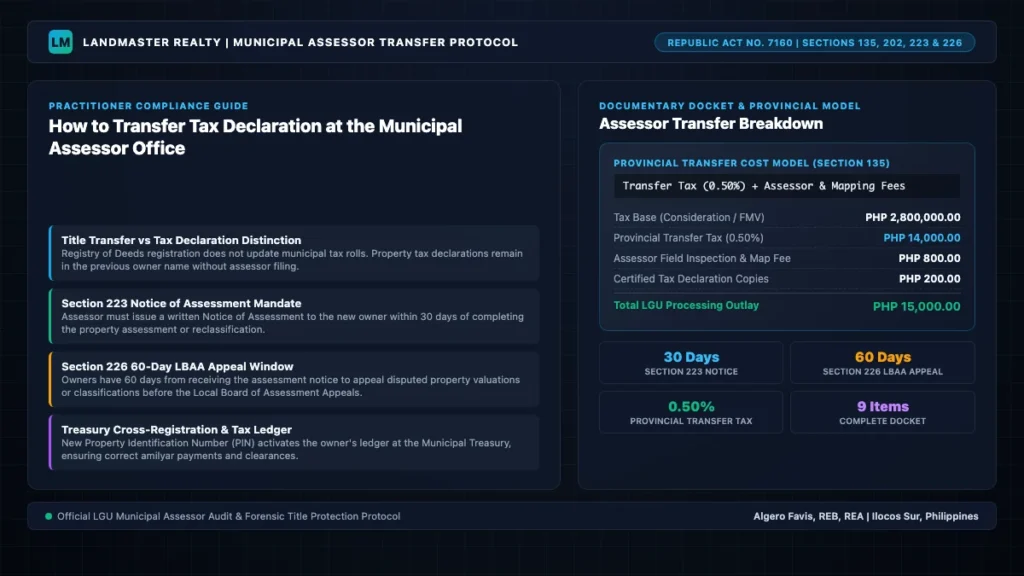
Local Government Unit Transfer Tax Under Local Government Code Section 135
Many property owners mistakenly believe that local government transfer taxes only apply to commercial sales. This is completely false. Section 135 of the Local Government Code of 1991 (Republic Act No. 7160) explicitly authorizes provinces and cities to levy a tax on the transfer of real property ownership.
The statutory language of Section 135 is comprehensive: it covers transfers through sale, donation, barter, or any other mode transferring ownership or title of real property. The statutory maximum rates are:
- Provinces: Up to 50% of 1% (or 0.50%) of the total consideration or fair market value, whichever is higher. In the Province of Ilocos Sur, the provincial transfer tax rate is 0.50%.
- Cities and Municipalities in Metro Manila: Up to 75% of 1% (or 0.75%) of the total consideration or statutory fair market value.
Whether you execute a Deed of Absolute Sale or a Deed of Donation, the transferee must pay the Local Transfer Tax at the Office of the Provincial or City Treasurer within sixty (60) calendar days from the date of notarial acknowledgment. Failure to settle this tax prevents the issuance of the Municipal Treasurer Transfer Tax Clearance, which is a mandatory prerequisite before the Registry of Deeds will accept the transfer documents.
Civil Code Inheritance Safeguards: Collation and Inofficious Donations
If financial analysis ended at immediate tax computations, almost every family would choose a Deed of Donation. However, conveyancing is fundamentally governed by property law and succession law. It is in the realm of the Civil Code of the Philippines (Republic Act No. 386) where the apparent advantages of a donation can rapidly unravel into catastrophic legal disputes.
Understanding Collation Under Civil Code Article 1061
In Philippine succession law, the property of a living person cannot be distributed in a manner that deprives their future legal heirs of their rightful inheritance. To maintain equality and fairness among family members, Article 1061 of the Civil Code establishes the mandatory doctrine of collation:
“Every compulsory heir, who succeeds with other compulsory heirs, must bring into the mass of the estate any property or right which he may have received from the decedent, during the lifetime of the latter, by way of donation, or any other gratuitous title, in order that it may be computed in the determination of the legitime of each heir, and in the account of the partition.”
In plain language: under Philippine law, an inter vivos donation given to a child during the parents’ lifetime is legally presumed to be merely an advance on their future inheritance. It is not an absolute, untouchable gift. When the parent eventually passes away, that donated land must be conceptually and mathematically added back to the gross estate to calculate whether the recipient received more than their legal share.
Inofficious Donations and the Impairment of Legitimes (Articles 750, 752, and 771)
The Civil Code sets unyielding limits on a person power to donate. Under Article 750, no person may give all their property away without reserving sufficient means for their own support. More critically, Article 752 codifies the ironclad boundary of testamentary capacity:
“No person may give or receive, by way of donation, more than he may give or receive by will. The donation shall be inofficious in all that it may exceed this measure.”
Under the rules of succession (Articles 886 to 914), compulsory heirs (which include legitimate children, surviving spouses, and illegitimate children) are entitled by law to a reserved portion of the estate called the legitime. A parent cannot freely give away their entire estate. Generally, fifty percent (50%) of a parent estate constitutes the compulsory legitime reserved by law for the children. The remaining 50% constitutes the free portion.
If a parent donates a prime titled lot to one favorite child, and the market value of that lot exceeds the disposable free portion of the parent estate, the donation is classified under law as an inofficious donation. Under Article 771 of the Civil Code, inofficious donations must be reduced or revoked upon the death of the donor to the extent necessary to restore the impaired legitimes of the other compulsory heirs.
Calculating the Net Estate and Compulsory Heirs Rights (Articles 908 to 910)
To determine whether a donation is inofficious, Articles 908, 909, and 910 of the Civil Code prescribe a precise mathematical formula that comes into play upon the donor death:
- The executor or court first inventories all remaining property left by the decedent at the time of death.
- The decedent debts and estate obligations are deducted, establishing the net hereditary estate.
- The market value of all property donated during the decedent lifetime (valued as of the time of the donation, under Article 908) is added back to the net estate to compute the aggregate estate mass.
- The legal legitimes of all compulsory heirs are calculated against this total mass.
- If the donated parcel exceeds the donee allowable legitime plus the available free portion, the other heirs have the legal right under Article 772 to demand that the donee return a portion of the property or reimburse the estate in cash.
Consider a real-world scenario from our experience in Northern Luzon: A father has three children. During his lifetime, he donates a prime commercial property along the national highway worth 3,000,000 PHP to his eldest son. When the father dies years later, he leaves only 1,000,000 PHP in bank savings and agricultural land. The total estate mass for collation purposes is 4,000,000 PHP (1,000,000 PHP remaining estate + 3,000,000 PHP collated donation). The three children are entitled to equal legitimes of the estate. The eldest son has already received 3,000,000 PHP, which far exceeds his lawful share and completely wipes out the free portion. The other two siblings can successfully sue in court to reduce the donation, forcing the eldest brother to surrender title to part of the land or pay his siblings hundreds of thousands of pesos in cash.
Why Arm-Length Sales Provide Complete Immunity Against Collation
In stark contrast to a donation, a bona fide Deed of Absolute Sale supported by valuable consideration provides total legal immunity against collation and inofficious donation claims.
A contract of sale is an onerous contract (Civil Code Article 1458). In a genuine sale, the parent does not diminish the net value of their estate through generosity. Instead, the parent exchanges an immovable asset for an equivalent sum of cash or valuable consideration. The real estate leaves the estate, but the purchase money enters the estate. Because there is no gratuitous alienation, Article 1061 does not apply. The property purchased by the buyer is completely outside the scope of collation and cannot be challenged or reduced by the seller children or heirs upon death.
The Dangerous Trap of Simulated Sales
Because some landowners know about the collation risks of donation, they frequently attempt a shortcut: they draft a Deed of Absolute Sale to one child, declaring a fictitious purchase price, but no money is ever actually paid. In legal parlance, this is a simulated contract of sale.
Executing a simulated deed of sale is one of the most dangerous blunders in Philippine real estate. Under Article 1471 of the Civil Code:
“If the price is simulated, the sale is void, but the act may be shown to have been in reality a donation, or some other act or contract.”
If excluded siblings discover that a brother or sister acquired family land through a deed of sale where no money changed hands, they can file an action for declaration of nullity of sale in the Regional Trial Court. Supreme Court jurisprudence (such as Castillo v. Castillo and Heirs of Spouses Intac v. Court of Appeals) establishes that where there is no actual consideration paid, the contract of sale is absolutely simulated and void ab initio. Even if the court determines that the parents intended to donate the land, the conveyance is converted back into a donation, subjecting the title to collation and legitime reduction. Worse, the parties face potential criminal liability for perjury and falsification of public documents before a notary public.
The Future Tax Trap: Section 40(B)(2) Carryover Basis Rules
Beyond immediate transactional taxes and civil law succession rules, property owners must analyze a third dimension: future tax exposure upon subsequent sale or disposal. This is governed by the carryover basis rules of the Tax Code.
Acquisition Cost Basis: Donation Carryover vs Stepped-Up Sale Basis
Whenever a person acquires real property, that transaction establishes the property official acquisition cost basis for taxation purposes. How that basis is determined depends entirely on whether the transfer occurred by sale or by gift:
- Onerous Acquisition (Sale): Under Section 40 of the NIRC, the buyer acquisition cost basis is the actual purchase price paid, or the statutory zonal/fair market value on which Capital Gains Tax and Documentary Stamp Tax were assessed. This is known as a stepped-up basis.
- Gratuitous Acquisition (Donation): Under Section 40(B)(2) of the NIRC, property acquired by gift or donation does not receive a stepped-up basis. Instead, the law enforces a strict carryover basis rule: the cost basis in the hands of the donee shall be the same as it would be in the hands of the donor or the last preceding owner by whom it was not acquired by gift.
To illustrate this carryover rule: Suppose a father purchased a rural parcel in Ilocos Sur in 1995 for 150,000 PHP. In 2026, the property BIR zonal value has risen to 3,000,000 PHP. If the father donates the property to his daughter, the daughter receives title to a parcel worth 3,000,000 PHP. However, under Section 40(B)(2), her legal tax acquisition cost basis remains frozen at the father original 1995 purchase price: 150,000 PHP.
When Carryover Basis Becomes a Catastrophe
Why does carryover basis matter if Capital Gains Tax is assessed at 6% of the gross selling price? For ordinary residential individuals holding property purely as a capital asset, the 6% CGT is computed on gross selling price or zonal value, meaning the historical acquisition basis is not directly deducted from the tax base. However, the carryover basis becomes an enormous financial trap in several critical situations:
- Conversion into an Ordinary Asset: If the donee is engaged in real estate business, operates a sole proprietorship, subdivides the land into residential lots for sale, or uses the property in business or trade, the parcel becomes an ordinary asset. When an ordinary asset is sold, it is not subject to 6% CGT. It is subject to regular individual income tax (up to 35%) or corporate income tax (20% to 25%) on the actual Net Taxable Gain (Selling Price minus Acquisition Cost Basis). With an inherited carryover basis of only 150,000 PHP on a 3,000,000 PHP property, the taxable gain is 2,850,000 PHP, resulting in staggering income taxes.
- Corporate Ownership or Property-for-Share Swaps: If the family decides to transfer the property to a family holding corporation or development company under Section 40(C)(2) of the Tax Code, the corporation inherits the donee carryover basis. When the corporation later disposes of the asset, it pays corporate income tax on the entire difference between the commercial selling price and the 150,000 PHP historical basis.
- Expropriation by Government: If the government acquires the land through eminent domain for a public highway, bypass road, or airport expansion, the taxpayer can elect to have the proceeds taxed under regular net income tax rules. Having a low carryover basis severely restricts tax minimization strategies.
Conversely, had the parents transferred the land through a legitimate Deed of Absolute Sale at the 3,000,000 PHP market valuation, the buyer would have locked in a clean, stepped-up acquisition basis of 3,000,000 PHP, wiping out latent capital gain exposure on future ordinary asset transactions.
Concrete Worked Financial Comparison Table: 3,000,000 PHP Property in Ilocos Sur
To provide complete clarity on the immediate transactional math, let us examine a realistic provincial conveyancing model based on actual administrative schedules in Northern Luzon. In this scenario, we evaluate the complete conveyancing expenses for a residential titled parcel in Ilocos Sur with a confirmed Bureau of Internal Revenue Zonal Value of 3,000,000 PHP (which also represents the fair market value and selling price).
We directly compare three distinct conveyancing scenarios:
- Scenario 1: Deed of Absolute Sale (Arm-length commercial transaction).
- Scenario 2: Deed of Donation by a Single Donor (Property owned exclusively by a single parent or sole owner).
- Scenario 3: Deed of Donation by Conjugal Donors (Community or conjugal property donated jointly by married parents).
| Transactional Fee / Tax Item | Deed of Absolute Sale | Deed of Donation (Single Donor) | Deed of Donation (Conjugal Donors) | Statutory Authority / Basis |
|---|---|---|---|---|
| Gross Property Value / Consideration | 3,000,000 PHP | 3,000,000 PHP | 3,000,000 PHP | BIR Zonal / FMV Baseline |
| Annual Statutory Gift Exemption | 0 PHP (Not applicable) | 250,000 PHP | 500,000 PHP (250k each spouse) | NIRC Section 99(A) |
| Net Taxable Amount | 3,000,000 PHP | 2,750,000 PHP | 2,500,000 PHP | Gross minus Statutory Deductions |
| Capital Gains Tax (6.0%) / Donor Tax (6.0%) | 180,000 PHP (CGT) | 165,000 PHP (Donor Tax) | 150,000 PHP (Donor Tax) | NIRC Sec. 24(D)(1) vs Sec. 99 |
| Documentary Stamp Tax (1.5% on sales) | 45,000 PHP | 0 PHP (Exempt) | 0 PHP (Exempt) | NIRC Section 196 |
| BIR Certification & Loose Stamp (eCAR) | 130 PHP | 130 PHP | 260 PHP (Two returns) | BIR ONETT Schedule |
| Local Government Transfer Tax (0.50%) | 15,000 PHP | 15,000 PHP | 15,000 PHP | LGC Section 135 (Ilocos Sur) |
| Registry of Deeds Registration Fee | 14,646 PHP | 14,646 PHP | 14,646 PHP | LRA Graduated Fee Schedule |
| LRA IT Service Fee | 349 PHP | 349 PHP | 349 PHP | Land Titling Computerization |
| RD Entry Fee & Research Fee | 240 PHP | 240 PHP | 240 PHP | LRA Administrative Fee |
| Issuance of New Owner Duplicate TCT | 300 PHP | 300 PHP | 300 PHP | LRA Title Issuance Fee |
| Notarial Fee (Customary 1.0% provincial) | 30,000 PHP | 30,000 PHP | 30,000 PHP | 2004 Rules on Notarial Practice |
| Assessor Transfer & Tax Declaration Fee | 500 PHP | 500 PHP | 500 PHP | Municipal Assessor Schedule |
| Total Out-of-Pocket Transaction Cost | 286,165 PHP | 226,165 PHP | 211,295 PHP | Combined Taxes and Fees |
| Immediate Cash Savings vs Sale | Baseline (0 PHP) | +60,000 PHP Saved | +74,870 PHP Saved | DST + Gift Exemption Gain |
Detailed Mathematical Analysis of Out-of-Pocket Closing Expenses
The financial arithmetic reveals the exact components driving the cost divergence:
- Documentary Stamp Tax Savings: In Scenario 1 (Sale), the buyer or seller must pay 45,000 PHP in DST under Section 196. In Scenarios 2 and 3 (Donation), this tax is zero because gratuitous transfers are exempt from conveyance DST. This accounts for the single largest chunk of the immediate savings.
- Statutory Gift Exemption Impact: In Scenario 2 (Single Donor), deducting the 250,000 PHP exemption shields that amount from the 6.0% tax, saving exactly 15,000 PHP (250,000 PHP multiplied by 6.0%). Combined with the 45,000 PHP DST saving, the single donor donation generates total immediate savings of 60,000 PHP.
- Conjugal Exemption Maximization: In Scenario 3 (Conjugal Donors), both parents utilize their independent 250,000 PHP exemptions, shielding an aggregate 500,000 PHP. This saves an additional 15,000 PHP in donor tax (total donor tax savings of 30,000 PHP). After factoring in a nominal 130 PHP additional BIR certification fee for processing two separate tax returns, the family achieves an immediate net cash savings of 74,870 PHP compared to executing a Deed of Sale.
- Identical Downstream Titling Fees: Local Transfer Tax (15,000 PHP), Registry of Deeds graduated fees (14,646 PHP), LRA IT fees (349 PHP), entry and research charges (240 PHP), new title printing (300 PHP), notarial fees (30,000 PHP), and assessor transfer fees (500 PHP) remain completely identical across all three transactions. Government titling and municipal transfer schedules are based on the fair market value of the land, regardless of the conveyance mode.
Master Decision Framework: When to Sell vs When to Donate
Now that both the transactional arithmetic and the legal risks are transparently established, how should a property owner make the final decision? At LandMaster Realty, we guide clients using a structured decision framework based on family dynamics, the number of legal heirs, and the intended future use of the real estate.
Scenario A: Transferring Property to an Only Child or Sole Heir
Recommendation: Execute a Deed of Donation.
If the parents have only one child, or if the transferee is the sole surviving compulsory heir, the primary legal risk of a donation (collation and inofficious donation disputes under Civil Code Article 1061) is completely eliminated. Because there are no co-heirs or competing siblings to assert legitime impairment, no one can challenge the donation upon the parents’ death. In this scenario, the family should fully capitalize on the immediate financial advantages: eliminating the 1.5% Documentary Stamp Tax and maximizing the 500,000 PHP conjugal gift exemption to save up to 74,870 PHP per 3,000,000 PHP of property value.
Scenario B: Multi-Sibling Families and Preventing Future Estate Litigation
Recommendation: Execute a Bona Fide Deed of Absolute Sale (or a Formal Partition / Estate Settlement).
If the family includes multiple children, stepchildren, or children from previous marriages, donating a valuable property to one child while leaving others with less valuable assets is an open invitation to bitter estate litigation. Upon the death of the parents, excluded siblings can compel collation under Article 1061, challenge the transfer as an inofficious donation under Article 771, and cloud the property title in court.
If parents genuinely intend for one child to acquire a specific parcel, the cleanest legal mechanism is a bona fide Deed of Absolute Sale supported by actual monetary consideration. The child should pay fair consideration, preferably documented through verifiable bank transfers or manager checks. Once a genuine sale is executed, the property leaves the parents’ estate permanently, completely immunizing the purchasing child from future collation demands by siblings. Alternatively, the family can execute an Extrajudicial Settlement of Estate with partition, allowing all co-heirs to sign unanimous quitclaims.
Scenario C: Property Intended for Rapid Commercial Resale or Development
Recommendation: Execute a Deed of Absolute Sale.
If the person acquiring the property intends to develop the land commercially, subdivide it into lots, hold it as corporate inventory, or resell it within a few years, executing a Deed of Donation creates a severe tax trap. Under Section 40(B)(2) of the NIRC, the donee inherits the donor original historical cost basis (which may be mere fractions of current market value). When the property is later disposed of as an ordinary asset, the donee faces enormous individual or corporate income taxes on the artificial capital gain. Executing a Deed of Absolute Sale establishes a modern, stepped-up acquisition basis equal to the current market value, protecting the owner against punitive future income taxation.
Scenario D: Third-Party Buyers and the Criminal Risks of Simulated Donations
Recommendation: Strictly Execute a Deed of Absolute Sale.
Occasionally, an unprincipled real estate agent or buyer will suggest executing a Deed of Donation instead of a Deed of Absolute Sale when transacting with an unrelated third party, purely to evade the 1.5% Documentary Stamp Tax. This is illegal. Executing a simulated donation between non-relatives where purchase money changes hands under the table constitutes criminal tax evasion under Section 254 of the NIRC. If the BIR investigates the transaction or discovers undocumented fund flows, the parties face criminal prosecution, a 50% fraud surcharge, and civil nullification. Transactions between unrelated parties must always be documented through an honest, transparent Deed of Absolute Sale.
The 5-Stage Step-by-Step Conveyancing Pipeline
Regardless of whether you choose a Deed of Absolute Sale or a Deed of Donation, the physical conveyancing pipeline required to secure a clean, computerized Transfer Certificate of Title (TCT) from the Registry of Deeds follows a rigorous 5-stage bureaucratic sequence.
Stage 1: Drafting and Legal Notarization
The conveyancing process begins with preparing the proper legal public instrument:
- Deed of Absolute Sale: Must clearly specify the contracting parties, legal status, exact technical description from the Torrens title, monetary consideration in words and figures, and warranty against encumbrances. If either party is married, mandatory spousal consent must be written into the instrument under Articles 96 and 124 of the Family Code.
- Deed of Donation: Under Article 749 of the Civil Code, the donation of an immovable must be made in a public document, specifying the property donated. Crucially, Article 749 mandates that the acceptance by the donee must be made either in the very same deed of donation or in a separate public document executed during the lifetime of the donor. If the acceptance is omitted or executed improperly, the donation is void ab initio.
- Notarization: Both parties must personally appear before a duly commissioned Notary Public, presenting competent evidence of identity under Rule II, Section 12 of the 2004 Rules on Notarial Practice (such as Philippine Passports, UMID cards, or Driver Licenses). Community Tax Certificates (Cedulas) are strictly disqualified.
Stage 2: BIR ONETT Tax Assessment and eCAR Issuance
Within thirty (30) days from the date of notarization, the parties must submit the conveyance docket to the Bureau of Internal Revenue One-Time Transaction (ONETT) team at the Revenue District Office (RDO) having jurisdiction over the property:
- For Sales: File BIR Form 1706 (Capital Gains Tax Return) and BIR Form 2000-OT (Documentary Stamp Tax Return). Pay the assessed taxes at an Authorized Agent Bank (AAB) or through approved electronic tax payment channels.
- For Donations: File BIR Form 1800 (Donor Tax Return). If married parents are donating conjugal property, two separate Form 1800 returns must be filed to claim the dual 250,000 PHP exemptions.
- Mandatory Attachments: Original Owner Duplicate Title, certified true copy of Title from the Registry of Deeds, certified true copies of latest Tax Declarations for land and improvements, Real Property Tax Clearance, Certificate of No Improvement (if vacant lot), and Sworn Statements of Total Value.
- eCAR Issuance: Once taxes and fees are verified, the BIR issues the barcoded electronic Certificate Authorizing Registration (eCAR). The eCAR is the sole proof of national tax settlement recognized by the Land Registration Authority.
Stage 3: Provincial or City Treasurer Transfer Tax Settlement
Within sixty (60) days from the date of notarization, the transferee must present the notarized deed, BIR eCAR, and real property tax clearance to the Provincial or City Treasurer Office having jurisdiction:
- The Treasurer computes the Local Transfer Tax (0.50% in provinces like Ilocos Sur, or up to 0.75% in chartered cities).
- Upon payment, the Treasurer stamps the back of the deed and issues the official receipt and Certificate of Transfer Tax Payment.
Stage 4: Registry of Deeds Title Registration
With national and local tax clearances secured, the transferee submits the complete registration packet to the Registry of Deeds under Section 57 of Presidential Decree No. 1529:
- The registration packet includes the original notarized deed, BIR eCAR with tax return receipts, Municipal Transfer Tax receipt and clearance, original Owner Duplicate Certificate of Title, and valid government IDs.
- The RD enters the transaction in the Primary Entry Book, calculates the graduated registration fees under LRA circulars, and cancels the old Torrens title.
- A brand-new computerized Transfer Certificate of Title (TCT) is generated, signed by the Register of Deeds, and released directly to the new registered owner.
Stage 5: Municipal Assessor Transfer and New Tax Declaration
The final stage takes place at the Office of the Municipal or City Assessor. The new owner presents the newly issued TCT, updated real property tax receipt, and transfer documents. The Assessor cancels the old Tax Declaration and issues a brand-new Tax Declaration in the name of the new owner, updating the local assessment roll.
Frequently Asked Questions About Property Donation vs Sale in the Philippines
Is a Deed of Donation really cheaper than a Deed of Sale in the Philippines?
Yes, from an immediate transactional tax perspective, a Deed of Donation is cheaper. Under the TRAIN Law (RA 10963), both transactions are subject to a 6.0% tax rate (Capital Gains Tax vs Donor Tax). However, a donation enjoys a 250,000 PHP annual gift tax exemption per donor (or 500,000 PHP for conjugal donations) and is completely exempt from the 1.5% Documentary Stamp Tax (DST) under NIRC Section 196. On a 3,000,000 PHP property, donating saves between 60,000 PHP and 74,870 PHP in immediate out-of-pocket costs compared to an outright sale.
Does a Deed of Donation require payment of Documentary Stamp Tax?
No, provided that the donation is purely gratuitous. Under Section 196 of the NIRC, Documentary Stamp Tax on conveyances applies strictly to real property sold or conveyed for valuable consideration. Purely gratuitous real property donations involve no monetary price and are exempt from Section 196 DST. However, if the donation is onerous (such as requiring the donee to assume an unpaid bank mortgage), the assumed loan portion is treated as an onerous conveyance and incurs the 1.5% DST.
Can siblings or other heirs challenge a Deed of Donation after parents pass away?
Yes. Under Civil Code Article 1061, any property donated by parents to a child during their lifetime is legally considered an advance on that child inheritance (collation). Upon the parents’ death, the value of the donated property must be brought back into the gross estate mass. If the donation exceeds the allowable free portion and impairs the legal legitimes of other compulsory heirs, aggrieved siblings can file a court action under Article 771 to reduce or revoke the inofficious donation. A bona fide Deed of Absolute Sale supported by valuable consideration is completely immune to collation.
Can parents execute a Deed of Absolute Sale to their own child instead of a donation?
Yes, Philippine law allows parents to sell real estate to their adult children. However, the transaction must be a bona fide, arm-length contract supported by actual valuable consideration. Money must actually be paid and documented (such as through bank deposit slips or manager checks). If parents execute a simulated deed of sale declaring a false purchase price where no money changes hands, the contract is void ab initio under Civil Code Article 1471 and can be nullified by excluded siblings.
What is the deadline to pay Donor Tax and Capital Gains Tax to avoid BIR penalties?
Both Capital Gains Tax (BIR Form 1706 for sales) and Donor Tax (BIR Form 1800 for donations) must be filed and paid within thirty (30) calendar days from the date of notarial acknowledgment. In addition, Documentary Stamp Tax on sales (BIR Form 2000-OT) must be settled on or before the 5th day of the month following notarization. Missing these deadlines triggers a mandatory 25% surcharge, 12% annual deficiency interest, and administrative compromise penalties under NIRC Sections 248 and 249.
What happens if a property acquired through donation is sold in the future?
Under Section 40(B)(2) of the NIRC, a donee inherits the donor original historical acquisition cost basis (carryover basis). If the donee later holds or sells the property as an ordinary asset (such as through a commercial business, corporate entity, or subdivision project), regular corporate income tax (20% to 25%) or individual income tax (up to 35%) is assessed on the entire net gain calculated from the donor low historical cost. This can result in much higher future income taxes than if the property had received a stepped-up basis through a Deed of Sale.
Professional Title Transfer and Estate Planning Guidance in Northern Luzon
Deciding between a Deed of Donation and a Deed of Absolute Sale is not simply a matter of calculating immediate tax savings. It requires balancing upfront tax exemptions against long-term family relationships, inheritance harmony, and future commercial flexibility. Incomplete drafting, missing acceptance clauses, or simulated contracts can leave your family property vulnerable to costly court battles and clouded titles decades down the road.
At LandMaster Realty, we provide comprehensive, legally grounded conveyancing and property guidance across Ilocos Sur and Northern Luzon. Our team of PRC-licensed real estate brokers and appraisers specializes in complex title transfers, estate partitions, BIR eCAR processing, and property due diligence. We examine your family specific ownership structure, compute your exact statutory taxes, draft airtight conveyancing instruments, and manage the entire titling pipeline from revenue clearance to the release of your clean new Transfer Certificate of Title.
Need Expert Title Transfer and Conveyancing Guidance in Northern Luzon?
At LandMaster Realty, we handle the complete end-to-end title transfer, property valuation, and tax clearance process across Ilocos Sur and Northern Luzon. Our licensed brokers and appraisers ensure airtight document preparation, BIR eCAR release, and seamless Registry of Deeds registration for local landowners, heirs, and overseas Filipinos.