Across the provinces of the Philippines, and particularly throughout Ilocos Sur, one of the most widespread property dilemmas facing families is living on untitled residential land. For decades, generations of families in municipalities such as Bantay, San Juan, Magsingal, and Narvacan have built their ancestral family homes, raised children, and paid municipal real property taxes (amilyar) on home lots supported solely by a local Tax Declaration. When property owners finally decide to secure an official title, they are often overwhelmed by conflicting advice. Some believe they must hire a private litigation lawyer and endure a costly, multi-year court proceeding to secure a title. Others assume that converting their residential lot into a government-guaranteed Torrens title is impossible because the parcel is too small to qualify as an agricultural farm. Both assumptions reflect outdated understandings of Philippine public land law.
To solve this massive historical titling bottleneck, the Philippine government enacted Republic Act No. 10023, officially known as the Residential Free Patent Act. Enacted in March 2010, this landmark legislation created a fast, accessible administrative pathway for residential occupants of alienable and disposable public land to obtain an Original Certificate of Title (OCT) directly through the Department of Environment and Natural Resources (DENR). Under RA 10023, eligible Filipino citizens who have continuously occupied and resided on their home lots for at least 10 years can secure an indefeasible Torrens title without stepping foot inside a courtroom.
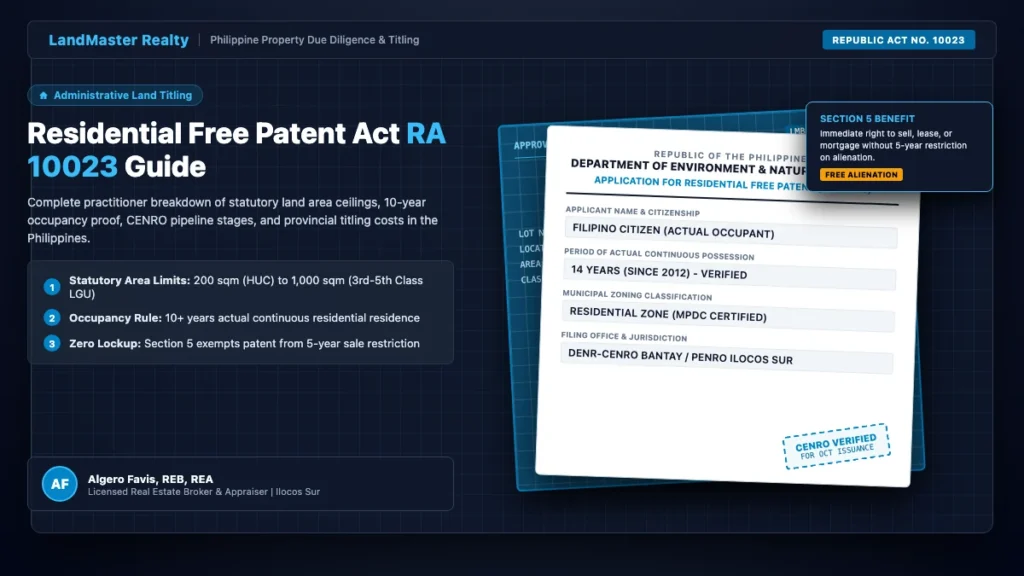
Crucially, RA 10023 eliminated the historic legal burdens that previously restricted public land patents under the Public Land Act (Commonwealth Act No. 141). Under Section 5 of the Residential Free Patent Act, residential patents are completely exempt from the 5-year prohibition against encumbrance and alienation. Once issued, a residential patent can be immediately sold, mortgaged to a commercial bank, or transferred without any waiting period. As a licensed real estate broker and appraiser practicing in Ilocos Sur, I have guided numerous homeowners through the administrative titling pipeline. This comprehensive practitioner guide provides an exhaustive analysis of the residential free patent act ra 10023 guide, examining statutory land area ceilings, mandatory eligibility criteria, admissible occupancy proof, the 5-stage CENRO pipeline, itemized provincial processing budgets, and critical disqualification red flags.
Quick Answer: What is the Residential Free Patent Act (RA 10023) and Who Qualifies?
The Residential Free Patent Act (Republic Act No. 10023) is an administrative land titling law in the Philippines that allows Filipino citizens to obtain an Original Certificate of Title (OCT) over untitled residential land through the Department of Environment and Natural Resources (DENR) without filing a court case. It was signed into law on March 9, 2010, specifically to legalize and secure the property rights of long-term residential occupants living on public alienable and disposable lands.
To qualify for a Residential Free Patent under RA 10023, an applicant must fulfill four core legal requirements:
- Citizenship: Must be a natural-born or naturalized Filipino citizen.
- 10-Year Actual Occupancy: Must have continuously occupied and resided on the residential parcel personally, or through predecessors-in-interest, for at least ten (10) consecutive years immediately preceding the filing of the application.
- Statutory Land Area Limits: The parcel must not exceed the strict statutory ceiling based on the Local Government Unit (LGU) classification: up to 200 square meters in Highly Urbanized Cities (HUCs); up to 500 square meters in other component cities; up to 750 square meters in 1st and 2nd class municipalities; and up to 1,000 square meters in 3rd, 4th, and 5th class municipalities.
- Zoning and Land Classification: The land must be officially certified as Alienable and Disposable (A&D) public land and designated as residential by the Municipal Planning and Development Coordinator (MPDC) or predominantly used for residential housing.
- No 5-Year Lockup: Unlike agricultural patents under Commonwealth Act No. 141, Section 5 of RA 10023 explicitly provides that residential free patents are freely alienable and mortgageable immediately upon title issuance. You do not have to wait five years to sell or mortgage the property.
The application is filed administratively at the Community Environment and Natural Resources Office (CENRO) having territorial jurisdiction over the property. Processing takes approximately 4 to 9 months and costs a fraction of judicial court confirmation.
Legislative Purpose: How RA 10023 Democratized Land Titling for Residential Occupants
To understand the profound impact of Republic Act No. 10023, one must examine the legal gridlock that existed prior to its passage in 2010. For nearly a century, the primary statutory mechanism for distributing public land in the Philippines was Commonwealth Act No. 141 (The Public Land Act of 1936). However, CA 141 was designed primarily for agricultural colonization. It granted free patents strictly to agricultural cultivators who actively farmed the soil, planted crops, or maintained livestock.
This historical framework created a severe legal blind spot for urban and provincial town centers. Millions of Filipino families lived on small residential lots where they had constructed concrete houses, established family compounds, and lived for generations. Because these home lots were not agricultural farms, the occupants could not qualify for agricultural free patents under CA 141. Their only alternative avenues for titling were either townsite sales patents (which required public auction bidding, exposing the family to outside bidders who could outbid them for their own ancestral homes) or filing a formal application for judicial confirmation of imperfect title before the Regional Trial Court (RTC) under Section 14 of Presidential Decree No. 1529.
The Historical Burden of Commonwealth Act No. 141
Judicial confirmation of title was financially and operationally impossible for the vast majority of provincial homeowners. Judicial titling requires hiring private legal counsel, paying court docket and sheriff fees, publishing formal legal notices in the Official Gazette and private newspapers of general circulation for three consecutive weeks, securing Land Registration Authority (LRA) reports, and enduring years of adversarial trial hearings before a Regional Trial Court judge. For a modest family occupying an 800 square meter home lot in provincial Ilocos Sur, spending 150,000 PHP to 250,000 PHP on judicial court proceedings often exceeded the historical assessed value of the land itself. Consequently, families simply held onto their municipal Tax Declarations, leaving millions of provincial parcels untitled, unbankable, and legally precarious.
Why RA 10023 Was Enacted for Urban and Rural Homeowners
Enacted in 2010 under the sponsorship of lawmakers seeking genuine agrarian and urban land reform, Republic Act No. 10023 bridges this legal divide. The statute democratized Philippine land titling by establishing a purely administrative mechanism tailored specifically for residential occupants. Congress recognized that residential security is a fundamental social right. If a family has resided on an alienable parcel of public land peacefully and continuously for at least a decade, the State should grant them a formal, indefeasible Torrens title without imposing judicial litigation barriers.
Under the implementing framework of DENR Administrative Order (DAO) No. 2010-12, jurisdiction was granted directly to the Community Environment and Natural Resources Office (CENRO) to process, investigate, and approve residential applications, with final patent signing delegated to the Provincial Environment and Natural Resources Officer (PENRO). This administrative decentralization drastically accelerated processing timelines and slashed titling costs from hundreds of thousands of pesos down to standard local surveying and administrative filing expenses.
The Immediate Right to Sell and Mortgage: Section 5 Exemption from CA 141 Restrictions
One of the most consequential legal features of RA 10023, and one that is routinely misunderstood by both property buyers and generalist real estate bloggers, is the statutory treatment of restrictions on alienation. Under Sections 118, 119, 121, 122, and 123 of Commonwealth Act No. 141, traditional agricultural free patents were burdened by severe statutory encumbrances:
- The 5-Year Prohibition on Sale and Mortgage: Lands acquired under agricultural free patents could not be encumbered, mortgaged, or alienated for a period of five (5) years from the date of the patent issuance, under pain of automatic reversion to the State.
- The 5-Year Right of Repurchase: The patentee or their legal heirs had the statutory right to repurchase the property within five years from the date of any subsequent conveyance.
- Corporate Ownership Restrictions: Corporations and non-individual entities were prohibited from acquiring patent-origin lands.
Crucially, Section 5 of Republic Act No. 10023 explicitly exempts residential free patents from all these restrictions. The law states clearly that the restrictions on alienation, transfer, encumbrance, and repurchase provided under CA 141 do not apply to residential patents issued under RA 10023.
“Section 5. Use of Land Certificate of Title. – The restrictions regarding alienation, transfer, or encumbrance of lands contained in Sections 118, 119, 121, 122 and 123 of Commonwealth Act No. 141, as amended, shall not apply to patents issued under this Act.”
This means that the very day the Registry of Deeds inscribes and releases your Original Certificate of Title under RA 10023, you hold an unrestricted Torrens title. You can immediately pledge the title as loan collateral to a commercial bank (such as BDO, BPI, Metrobank, or LandBank), apply for a housing construction loan with the Pag-IBIG Fund, or execute a Deed of Absolute Sale to convey the property to a prospective buyer. You do not have to wait five years, and your buyer does not need to worry about heirs repurchasing the land under obsolete public land rules.
While Republic Act No. 11231 (the Agricultural Free Patent Reform Act of 2019) subsequently lifted these restrictions for agricultural free patents as well, RA 10023 had this free-alienation protection built into its foundation since 2010. This makes residential free patent titles fully commercial, highly liquid, and immediately bankable.
Statutory Land Area Ceilings by Municipality Classification
A central tenet of Republic Act No. 10023 is that it was designed for individual residential housing, not for expansive commercial development or large-scale land banking. To prevent private corporations or wealthy individuals from using an administrative mechanism to monopolize public land, Section 1 of RA 10023 establishes precise statutory land area ceilings strictly tied to the official income and urban classification of the Local Government Unit (LGU) where the property is located.
Understanding these ceilings is essential before spending capital on boundary surveys or submitting an application to CENRO. If your land survey reveals that your residential parcel exceeds the statutory limit by even a few square meters, CENRO cannot approve the application in its entirety as filed.
Statutory Ceiling Table by LGU Classification
The table below details the statutory land area ceilings under Section 1 of RA 10023, cross-referenced with real-world provincial examples from Northern Luzon and Metro Manila:
| LGU Classification | Maximum Area Ceiling | Representative Jurisdictions & Examples |
|---|---|---|
| Highly Urbanized Cities (HUCs) | Up to 200 sq. meters | All Metro Manila cities (Quezon City, Manila, Makati, Taguig), Baguio City, Cebu City, Davao City, Iloilo City, Cagayan de Oro City. |
| Other Component Cities | Up to 500 sq. meters | Vigan City (Ilocos Sur), Candon City (Ilocos Sur), San Fernando City (La Union), Laoag City (Ilocos Norte), Dagupan City, Batangas City. |
| First and Second Class Municipalities | Up to 750 sq. meters | Bantay (Ilocos Sur), Narvacan (Ilocos Sur), Tagudin (Ilocos Sur), Bauang (La Union), Rosales (Pangasinan), major commercial provincial towns. |
| Third, Fourth, Fifth, and Sixth Class Municipalities | Up to 1,000 sq. meters | San Juan (Ilocos Sur), Magsingal (Ilocos Sur), Santa (Ilocos Sur), Caoayan (Ilocos Sur), Santo Domingo (Ilocos Sur), Sinait, Cabugao, rural provincial towns. |
Understanding Provincial City and Municipality Classes in Practice
The municipal classification of your property is determined by the Department of Finance (DOF) based on the annual regular income generated by the local government unit. In practice, this classification produces significant variations even between adjoining municipalities in Ilocos Sur:
- Vigan City vs. Bantay: Vigan is a component city, meaning that residential free patent applications within city limits (such as Barangay Tamag, Beddeng Laud, or Ayusan Norte) cannot exceed 500 square meters. However, if you cross the Govantes River into the adjacent 1st class municipality of Bantay, the statutory limit immediately expands to 750 square meters.
- Bantay vs. Magsingal: If you move further north from Bantay into Magsingal or San Juan (both classified as 3rd or 4th class municipalities), the allowable area increases to the statutory maximum of 1,000 square meters.
As an appraiser and broker, I always advise clients to verify the official LGU classification with the Municipal Assessor or Treasurer before completing their formal CENRO application dossier. Do not assume your municipality class based on population size or physical geography.
What Happens if Your Residential Lot Exceeds the Statutory Ceiling?
A frequent scenario we encounter in provincial brokerage involves families who occupy an untitled home compound that measures 1,200 square meters or 1,500 square meters in a 4th class municipality where the legal ceiling is strictly 1,000 square meters. If your property exceeds the statutory cap, you cannot simply request an administrative exemption from CENRO. CENRO officers are legally barred from granting a residential free patent beyond the statutory threshold.
In this situation, you have two practical, legally sound options:
- Subdivision and Segregation: You can engage a licensed Geodetic Engineer to conduct an administrative subdivision survey. Under this strategy, the 1,500 square meter property is formally divided into two distinct lots on the survey plan: Lot A (1,000 square meters, covering the primary family dwelling and yard) and Lot B (500 square meters, covering secondary space or garden). You file your RA 10023 application over Lot A to obtain your Original Certificate of Title immediately. Lot B can remain under a separate Tax Declaration, or can be applied for by another qualified family member (such as an adult child with independent actual occupancy), provided they meet the 10-year residency rule independently.
- Judicial Confirmation under Republic Act No. 11573: If the family insists on securing a single, unified Torrens title over the entire 1,500 square meter compound, administrative free patent titling cannot be used. Instead, the property owners must pursue judicial confirmation of imperfect title before the Regional Trial Court (RTC) pursuant to Republic Act No. 11573. Judicial confirmation does not have municipal area ceilings for residential land (it is subject only to the constitutional limit of 12 hectares for public land acquisition). However, as discussed later in this guide, judicial confirmation requires significantly higher legal and court expenses.
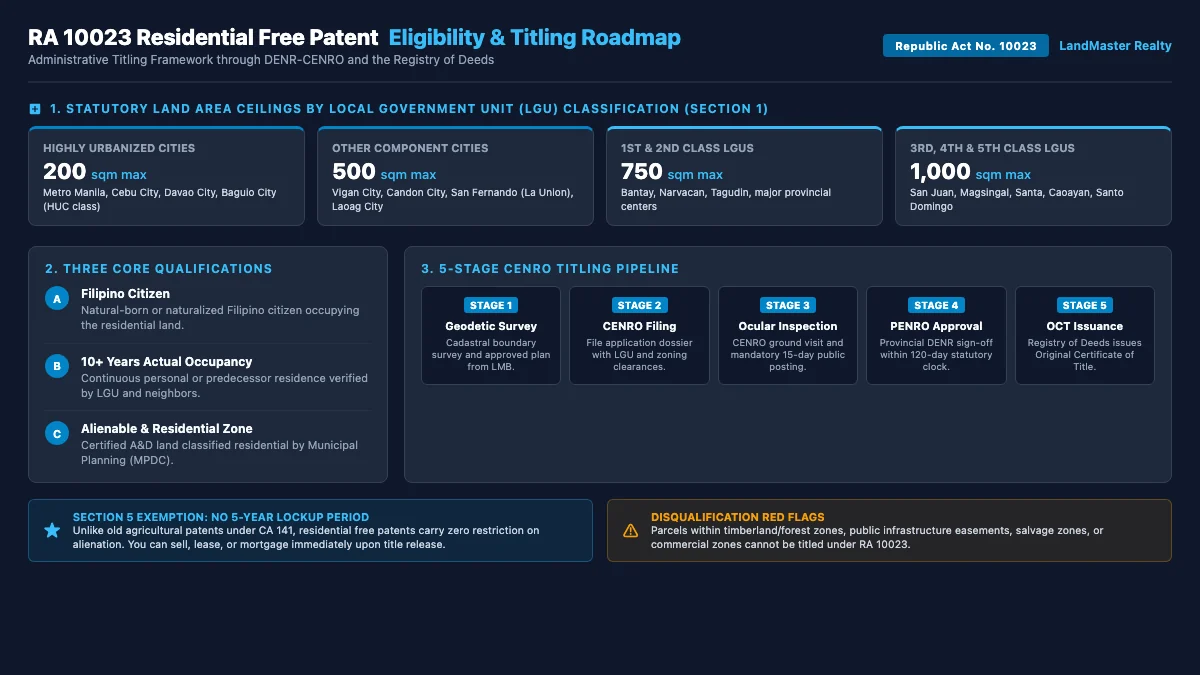
Decision roadmap and eligibility matrix detailing RA 10023 statutory land area ceilings, three core qualification pillars, and the 5-stage CENRO administrative titling pipeline through the Registry of Deeds.
Who Is Eligible? Mandatory Statutory Qualifications and Admissible Evidence
To successfully obtain a Residential Free Patent under RA 10023, the applicant must establish full legal compliance with the eligibility standards set forth in Section 1 of the statute and Section 3 of DENR Administrative Order No. 2010-12. Titling public land is an act of state grant; therefore, the burden of proof rests entirely on the applicant. Understanding the exact evidentiary requirements ensures your application is not rejected or delayed by CENRO investigators.
The Four Core Qualification Pillars under Section 1
Every applicant must satisfy four non-negotiable statutory pillars:
- Philippine Citizenship: The applicant must be a citizen of the Philippines. Natural-born and naturalized citizens are equally eligible. In the case of dual citizens under Republic Act No. 9225 (Citizenship Retention and Re-acquisition Act of 2003), the applicant must present their certified true copy of the Order of Approval and Identification Certificate from the Bureau of Immigration confirming the re-acquisition of Philippine citizenship. Corporations, partnerships, and foreign nationals are strictly disqualified from applying for a residential free patent.
- 10-Year Actual Continuous Occupancy: The applicant must have lived on, occupied, and used the parcel as their residential dwelling for at least ten (10) consecutive years immediately preceding the filing of the application. This occupancy can be established personally or through the applicant predecessors-in-interest (such as parents, grandparents, or legal predecessors from whom possessory rights were acquired).
- Residential Land Classification: The land must be public alienable and disposable (A&D) land officially zoned for residential purposes by the local government unit, or in the absence of a comprehensive zoning ordinance, the land must be located within an established residential cluster or zoned residential in the town Comprehensive Land Use Plan (CLUP).
- Landholding Ceiling Compliance: The applicant must not be the owner of more than the statutory limit of titled residential land within the same city or municipality. An applicant cannot use RA 10023 to accumulate multiple subsidized residential titles across the same local jurisdiction.
Proving the 10-Year Actual Occupancy Requirement
The most common reason for delayed or rejected applications at CENRO is failure to present competent, admissible evidence of actual, physical, and continuous residential occupancy for the full 10-year statutory window. In Philippine land administrative practice, paying taxes alone does not satisfy this requirement. As established in landmark jurisprudence such as Cequeña v. Bolante, tax declarations are merely an indicia of claim; they must be coupled with concrete proof of physical residence.
Actual occupancy means that the applicant has physically resided on the parcel. There must be an existing residential dwelling, house, or residential improvement on the land. Vacant, uncultivated, open agricultural fields without a dwelling structure do not qualify for a residential free patent under RA 10023 (such lands must be evaluated under agricultural patent laws or judicial titling).
Acceptable Documentary Proof of Continuous Residency
To withstand CENRO field investigation and ocular inspection, an applicant must assemble a robust evidentiary dossier. In our brokerage practice, we require clients to compile evidence across four distinct evidentiary categories:
| Evidence Category | Specific Primary Documents Required | Legal and Evidentiary Weight |
|---|---|---|
| Barangay Residency Certification | Official Barangay Certification signed by the Punong Barangay certifying that the applicant is a bona fide resident of the barangay and has continuously resided on the specific lot for at least 10 years. | Mandatory statutory requirement under DAO 2010-12. Primary baseline proof of physical community residence. |
| Assessor Tax Declarations & Receipts | Certified true copies of historical Tax Declarations spanning at least 10 consecutive years (in the name of the applicant or deceased parents), accompanied by official Real Property Tax (amilyar) receipts from the Municipal Treasurer. | Establishes continuous public claim of ownership and payment of local tax obligations without interruption. |
| Utility Connection Records | Historical electric billing receipts (such as ISECO in Ilocos Sur), municipal water district service connection contracts, or telephone/internet installation records dating back 10 or more years in the applicant name. | Highly persuasive corroborative proof of actual physical occupancy; utilities cannot exist on uninhabited or fictional property. |
| Disinterested Neighbor Affidavits | Joint Affidavit of Two (2) Disinterested Persons who are long-term residents of the same barangay or adjoining boundary lot owners, attesting under oath to the applicant personal occupancy since a specific year. | Mandatory legal affidavit required by DENR. Must be executed by non-relatives who have lived in the neighborhood for at least 15 to 20 years. |
| Physical Improvements & Photographs | Time-stamped color photographs of the residential house, front facade, perimeter fencing, concrete boundary monuments (mojones), and municipal building permit or tax assessment on the building. | Corroborates CENRO Land Investigator ocular inspection report, proving the lot is actively used for family residential living. |
Complete Documentary Requirements Checklist for CENRO Application
Assembling a complete and meticulously verified application dossier is the single most critical step in expediting your residential free patent. Incomplete document submissions result in official deficiency notices, pausing the statutory processing clock. Below is the comprehensive master checklist of documents required by DENR-CENRO:
Category 1: Applicant Identity and Civil Status Records
- Duly Accomplished Application Form: DENR-LMB Form No. 1 (Application for Residential Free Patent), signed under oath by the applicant.
- PSA Birth Certificate: Philippine Statistics Authority (PSA) authenticated Birth Certificate proving Filipino citizenship.
- PSA Marriage Certificate: If married, PSA Marriage Certificate. If the application is filed in the name of both spouses, both must sign the application.
- Government-Issued Photo IDs: Clear photocopies of two valid government identification cards showing name, signature, and residential address (e.g., Philippine Passport, Driver License, SSS/GSIS UMID, or National ID).
- BIR Tax Identification Number (TIN): Verification slip or BIR Form 1904 confirming the applicant registered TIN.
- Proof of Dual Citizenship (if applicable): Certificate of Re-acquisition of Philippine Citizenship under RA 9225.
Category 2: Geodetic Survey Plan and Technical Description
- Approved Cadastral Survey Plan: Certified copy of the Cadastral Map (Cadastral Survey Plan) or Advance Plan / Isolated Survey Plan duly approved by the Regional Surveys Division of the Land Management Bureau (LMB), DENR Regional Office (Region 1 for Ilocos Sur).
- Approved Technical Description: Official technical description bearing the verified boundary bearings, distances, lot number, block number, and total land area in square meters.
- Geodetic Engineer Certificate: Formal certification from the licensed Geodetic Engineer certifying that the boundary monuments (concrete mojones) have been properly established on the ground in the presence of adjoining lot owners.
Category 3: Local Government Clearances (Barangay, Assessor, MPDC)
- Barangay Certificate of Actual Residency: Official certification from the Punong Barangay affirming continuous residence and occupancy for at least 10 consecutive years.
- MPDC Zoning Certification: Official certification from the Municipal Planning and Development Coordinator (MPDC) or City Planning and Development Office certifying that the land is situated within an approved Residential Zone as defined by the municipal Comprehensive Land Use Plan (CLUP).
- Assessor Certificate of No Existing Title: Official certification from the Municipal or Provincial Assessor certifying that the parcel is not covered by any existing Torrens title or pending decree.
- Certified Chain of Tax Declarations: Certified copies of current and prior Tax Declarations demonstrating tax roll history for at least 10 consecutive years.
- Real Property Tax (Amilyar) Clearance: Official Tax Clearance issued by the Municipal Treasurer showing that all real property taxes on land and improvements are fully paid to date.
Category 4: DENR and CENRO Official Application Forms and Affidavits
- Notarized Joint Affidavit of Two Disinterested Neighbors: Joint affidavit executed by two long-term neighborhood residents attesting to the applicant exclusive, peaceful, and open possession for at least 10 years.
- Affidavit of Landholdings: Notarized sworn statement certifying that the applicant does not own more than the statutory limit of titled residential property within the municipality or city.
- CENRO Official Receipt: Official receipt proving payment of the administrative application filing fee (typically 50 PHP) and field ocular inspection fee.
Step-by-Step 5-Stage CENRO Titling Pipeline
The titling process under Republic Act No. 10023 follows a structured administrative pipeline designed to eliminate bureaucratic delays. Under Section 4 of RA 10023, the law establishes a mandatory 120-day statutory clock for CENRO to process, investigate, and approve or reject the application from the date of filing. In practice, taking into account survey preparation, local clearances, and transmittal to the Registry of Deeds, the complete end-to-end journey typically takes between 4 to 9 months in Northern Luzon.
Stage 1: Geodetic Boundary Survey and Approved Cadastral Plan
Before filing anything with the government, you must define the exact physical boundaries of the parcel. You must hire a licensed Geodetic Engineer to conduct an actual ground boundary survey. The engineer will locate the lot within the existing municipal cadastral map, verify whether a cadastral survey was previously executed by the Bureau of Lands, and plant standard concrete monuments (mojones) at all corner points. The engineer then submits the survey returns and isolated plan to the DENR-LMB Regional Surveys Division for technical verification and official approval. This approved survey plan forms the technical description of your future Torrens title.
Stage 2: Filing Application at CENRO and Document Screening
Once your approved survey plan, zoning clearances, barangay certificates, and affidavits are assembled, you submit the complete application folder to the CENRO office having territorial jurisdiction over the property (for example, properties in Metro Vigan, Bantay, and adjacent northern towns in Ilocos Sur are under the jurisdiction of CENRO Bantay). A designated Land Management Officer (LMO) screens the application against the checklist. If complete, you pay the official administrative filing fee at the cashier, and the application is officially docketed with a permanent Free Patent Application (FPA) control number.
Stage 3: CENRO Ocular Inspection and Mandatory 15-Day Posting
Upon docketing, two mandatory investigative actions take place simultaneously:
- Ocular Field Investigation: A CENRO Land Investigator visits the property in person. The investigator inspects the residential dwelling, verifies that the applicant is physically living on the lot, checks that the property does not encroach upon public roads or river easements, and conducts brief interviews with adjoining boundary neighbors.
- Mandatory 15-Day Public Posting: Under Section 4 of RA 10023, notice of the residential free patent application must be posted for at least fifteen (15) consecutive days in two public locations: on the official bulletin board of the Barangay Hall where the property is located, and on the bulletin board of the Municipal Hall. This public posting gives third parties an opportunity to file formal adverse claims or boundary oppositions if they dispute the applicant occupancy.
Stage 4: PENRO Review, Approval, and Patent Transmittal
Once the 15-day posting period lapses with zero oppositions filed, the Land Investigator drafts the official Investigation Report recommending approval. The CENRO Officer formally endorses the application and transmits the complete case folder to the Provincial Environment and Natural Resources Office (PENRO). The PENRO legal and technical staff review the documentation. Upon satisfaction that all statutory criteria under RA 10023 are met, the PENRO Officer formally signs the Residential Free Patent and issues the Patent Order. The patent instrument is then sealed and officially transmitted directly to the Registry of Deeds of the province.
Stage 5: Registry of Deeds Registration and OCT Release
The final stage occurs at the Registry of Deeds (RD). Under the Property Registration Decree (Presidential Decree No. 1529), the Registry of Deeds receives the signed patent from PENRO and enters it into the official Registration Book. The patent is transcribed onto official Judicial Form security paper, and an Original Certificate of Title (OCT) number is assigned. The applicant pays the standard registration fees, entry fees, and contribution to the Land Registration Authority (LRA) Assurance Fund. The Registry of Deeds retains the original vault copy and releases the Owner Duplicate Certificate of Title directly to the patentee. At this moment, your untitled residential home lot is officially transformed into registered Torrens land.
Concrete Worked Financial Budget: Cost to Title a Residential Lot in Ilocos Sur
One of the most persistent misconceptions among provincial property owners is that titling land under RA 10023 costs hundreds of thousands of pesos, or that it can be done entirely for free. While the government application filing fee at CENRO is nominal (typically only 50 PHP), an applicant must incur necessary out-of-pocket costs for private geodetic surveys, local government clearances, documentary taxes, and Registry of Deeds registration.
To provide complete financial transparency, our team at LandMaster Realty has developed an itemized, realistic budget model based on actual provincial titling transactions in Ilocos Sur. This model reflects the real-world cost of titling an 800 square meter residential lot in a 4th class municipality (such as San Juan or Magsingal):
| Expense Item / Fee Description | Issuing Entity / Payee | Estimated Budget Range (PHP) |
|---|---|---|
| Geodetic Cadastral Survey & Approved Plan | Private Licensed Geodetic Engineer | 18,000 PHP to 25,000 PHP |
| Concrete Boundary Monuments (Mojones & Installation) | Hardware / Survey Labor | 1,500 PHP to 2,500 PHP |
| Barangay Residency Certification | Barangay Treasurer / Punong Barangay | 300 PHP to 600 PHP |
| MPDC Zoning Certification (CLUP Compliance) | Municipal Planning & Development Office | 500 PHP to 1,200 PHP |
| Municipal Assessor Certified Tax Decs & No Title Cert | Office of the Municipal Assessor | 800 PHP to 1,500 PHP |
| Real Property Tax Clearance & Prior Dues | Office of the Municipal Treasurer | 1,500 PHP to 3,500 PHP |
| Notarization Fees (Joint Affidavits, Landholdings, Form) | Commissioned Notary Public | 1,500 PHP to 2,500 PHP |
| DENR-CENRO Application Filing & Inspection Fee | CENRO Cashier | 500 PHP to 1,200 PHP |
| Registry of Deeds Registration & Assurance Fund Fees | Registry of Deeds Cashier (LRA) | 2,500 PHP to 4,500 PHP |
| Documentary Copies, Blueprints & Local Travel Incidentals | Photocopying / Local Transportation | 3,000 PHP to 5,000 PHP |
| TOTAL ESTIMATED ADMINISTRATIVE TITLING BUDGET | All Inclusive Out-of-Pocket | 30,100 PHP to 47,500 PHP |
Administrative Titling vs Judicial Confirmation Cost Comparison
To appreciate the enormous financial savings delivered by RA 10023, consider how this budget compares against filing a petition for judicial confirmation of imperfect title before the Regional Trial Court under Republic Act No. 11573. In a judicial titling proceeding, mandatory expenses include:
- Legal Representation: Attorney acceptance fees (typically 60,000 PHP to 100,000 PHP) plus appearance fees per court hearing (3,000 PHP to 5,000 PHP per session).
- Mandatory Publication: Publishing the court notice of initial hearing in the Official Gazette and a newspaper of general circulation for three consecutive weeks (25,000 PHP to 40,000 PHP).
- Court Filing & Sheriff Fees: Judicial docket fees, summons, and sheriff posting fees (10,000 PHP to 18,000 PHP).
- Tracing Cloth Survey: Preparation and LMB certification of special original tracing cloth plans (25,000 PHP to 35,000 PHP).
In total, judicial confirmation routinely costs between 135,000 PHP and 210,000 PHP. By choosing administrative titling under RA 10023, a qualified homeowner saves over 100,000 PHP in direct out-of-pocket capital while cutting the titling timeline by more than half.
Avoiding Middlemen and Fixer Scams in Provincial Titling
Because untitled land transactions involve government agencies, provincial communities are unfortunately vulnerable to unauthorized fixers and self-proclaimed middlemen. In Ilocos Sur, we regularly encounter families who paid 80,000 PHP or 100,000 PHP to fixers promising an express title within 30 days, only to discover a year later that no application was ever filed with CENRO, or worse, that the fixer produced a counterfeit title on fake security paper.
Always transact directly with licensed professionals: engage a registered Geodetic Engineer for your boundary survey, consult a licensed Real Estate Broker or legal practitioner for document compliance, and personally pay official filing fees at the designated government cashier counters at CENRO and the Registry of Deeds.
Critical Risks, Red Flags, and Grounds for Application Disqualification
While Republic Act No. 10023 offers a streamlined path to land ownership, it is not an open license to claim any piece of unoccupied land. The State enforces rigorous statutory guardrails. If your parcel falls under any of the disqualification categories established under public land law and DENR regulations, your application will be denied, and any patent inadvertently issued can be cancelled through judicial reversion proceedings filed by the Office of the Solicitor General (OSG).
Non-Alienable Public Domain: Timberland, Mangroves, and Military Reservations
Under the Regalian Doctrine codified in Article XII of the 1987 Philippine Constitution, all lands of the public domain belong to the State. Public lands are classified into four categories: agricultural, forest or timberland, national parks, and mineral lands. Only lands classified as agricultural can be declared Alienable and Disposable (A&D) and transferred into private ownership.
If your residential dwelling is built on land classified as forest reserve, timberland, watershed protection zone, mangrove swamp, or military/naval reservation, it cannot be titled under RA 10023, even if your family has resided on the land for over fifty years. Under settled Supreme Court doctrine (such as Director of Forestry v. Muñoz), possession of forest land, no matter how long continued, can never ripen into private ownership. Before spending money on surveying, always request a preliminary Land Classification Status Verification from CENRO to confirm the parcel is certified Alienable and Disposable.
Public Infrastructure and Environmental Easements (Waterways and Highways)
Section 2 of RA 10023 explicitly bars the titling of lands needed for public service, government use, or infrastructure. Crucially, this includes mandatory legal easements under the Water Code of the Philippines (Presidential Decree No. 1067) and highway right-of-way laws:
- River and Waterway Easements: Lands bordering rivers, streams, creeks, and shores are subject to mandatory public easements: 3 meters in urban areas, 20 meters in agricultural areas, and 40 meters in forest zones throughout their entire length. These easement strips are devoted to public use and cannot be included in a residential free patent.
- Coastal Salvage Zones: Lands located within 20 to 40 meters of the high-tide mark along the seashore (salvage zones) cannot be titled under RA 10023.
- Road Right-of-Way: Lots encroaching upon national highways, provincial roads, or planned public infrastructure reservations are strictly excluded. The geodetic survey must set back the lot boundary outside the designated road right-of-way.
Land Zoned Strictly for Commercial or Industrial Use
RA 10023 is exclusively a residential titling statute. If the property is located in an area zoned strictly for commercial plazas, industrial manufacturing zones, or economic zones under the local government Comprehensive Land Use Plan (CLUP), it does not qualify for a residential patent. However, if the area is mixed-use (such as a residential neighborhood where the occupant operates a small home-based sari-sari store or home office), the predominant residential dwelling character protects eligibility. A formal MPDC Zoning Certification confirming residential use is required to satisfy this requirement.
Conflicting Boundary Claims and Oppositions Filed by Adjoining Owners
During the mandatory 15-day public posting period at the Barangay and Municipal halls, adjoining property owners have the legal right to inspect the survey plan and file written oppositions. Common disputes arise when:
- Boundary Overlaps: The new survey plan encroaches upon an adjoining titled parcel or another occupant historic compound.
- Co-Ownership Disagreements: The applicant is one of several surviving heirs, but filed the application exclusively under their own name, omitting brothers, sisters, or cousins who share equal ancestral rights.
- Rival Possessory Claims: A competing family presents an older Tax Declaration covering the exact same lot.
When a formal protest is lodged, the CENRO Land Management Officer must suspend the processing of the patent and refer the dispute to the DENR Regional Legal Division for administrative adjudication. Resolving boundary conflicts before filing through amicable boundary agreement with adjoining neighbors is the best way to prevent administrative delays.
RA 10023 (Residential) vs RA 11573 (Judicial) vs CA 141 (Agricultural): Master Comparison Table
Navigating the various land titling laws in the Philippines can be confusing because multiple statutes govern public land distribution. To help property owners, buyers, and heirs choose the exact statutory mechanism appropriate for their property, our advisory team has synthesized the structural differences between the three primary titling avenues in the master comparison matrix below:
| Comparison Parameter | RA 10023 (Residential Free Patent) | RA 11573 (Judicial Confirmation of Imperfect Title) | CA 141 / RA 11231 (Agricultural Free Patent) |
|---|---|---|---|
| Governing Forum & Authority | Administrative: DENR-CENRO & PENRO | Judicial: Regional Trial Court (RTC) | Administrative: DENR-CENRO & PENRO |
| Eligible Land Classification | Alienable & Disposable, zoned strictly for Residential housing | Alienable & Disposable, Agricultural or Residential | Alienable & Disposable, actively cultivated for Agriculture |
| Maximum Land Area Ceiling | 200 sqm (HUC), 500 sqm (Cities), 750 sqm (1st/2nd Class), 1,000 sqm (3rd-5th Class) | Up to 12 hectares (Constitutional maximum limit) | Up to 12 hectares (Subject to CARP retention limits) |
| Required Occupancy Period | At least 10 consecutive years of actual residential occupancy | At least 20 years continuous open possession immediately preceding filing | At least 30 years continuous cultivation and tax payment |
| Private Lawyer Required? | No (Administrative form filing; self-represented) | Yes (Mandatory counsel for court trial hearings) | No (Administrative filing at CENRO) |
| Restrictions on Sale / Mortgage | None: Section 5 exempts patent from CA 141 restrictions; freely alienable immediately | None: Immediate absolute Torrens title ownership | Lifted by RA 11231 in 2019 (previously subject to 5-year lockup under CA 141) |
| Typical Processing Timeline | 4 to 9 months (120-day statutory CENRO rule) | 1.5 to 3 years (Subject to court trial calendars) | 6 to 12 months |
| Estimated Total Cost Range | 30,000 PHP to 50,000 PHP (Survey + Clearances) | 135,000 PHP to 210,000 PHP+ (Legal + Court) | 35,000 PHP to 60,000 PHP (Survey + DAR checks) |
Choosing the Correct Titling Pathway for Your Property
When clients consult our firm in Ilocos Sur with untitled land, we apply a clear decision rule:
- Choose RA 10023 if: The land has an existing residential house, is zoned residential, fits within the municipal area limit (e.g., up to 1,000 sqm in San Juan or Magsingal; up to 500 sqm in Vigan City), and you have at least 10 years of proven residence. It is the fastest and least expensive path to a title.
- Choose RA 11573 (Judicial Confirmation) if: The lot significantly exceeds the municipal area limits (e.g., a 3,000 sqm residential estate), or if there is a complex chain of title dispute that requires a Regional Trial Court judge to resolve, or if the land was acquired via private purchase from an ancestral owner with over 20 years of possession.
- Choose Agricultural Free Patent if: The parcel is active agricultural land devoted to rice, corn, tobacco, or tree crops, without residential zoning.
Frequently Asked Questions About the Residential Free Patent Act
Can I sell or mortgage my property immediately after receiving a Residential Free Patent under RA 10023?
Yes, absolutely. Under Section 5 of Republic Act No. 10023, residential free patents are explicitly exempt from the restrictions on alienation, transfer, encumbrance, and repurchase under Sections 118, 119, 121, 122, and 123 of Commonwealth Act No. 141. You do not have to wait five years to sell or mortgage the land. Once the Registry of Deeds releases your Original Certificate of Title, you can immediately pledge the title as loan collateral to a commercial bank or Pag-IBIG Fund, or convey it to a buyer through a Deed of Absolute Sale.
What happens if my residential home lot is larger than the statutory area ceiling in my municipality?
If your residential parcel exceeds the statutory limit (such as an 800 sqm lot in Vigan City where the ceiling is 500 sqm), CENRO cannot approve the excess area under RA 10023. You have two options: either engage a Geodetic Engineer to subdivide the property into two lots and apply for the patent over the portion up to the statutory limit, or file a formal application for judicial confirmation of imperfect title before the Regional Trial Court under Republic Act No. 11573, which has no municipal area ceilings.
Can an Overseas Filipino Worker (OFW) or dual citizen apply for a Residential Free Patent?
Yes. Any Filipino citizen can apply. If an OFW is currently working abroad, they can execute a consularized or Apostilled Special Power of Attorney (SPA) appointing a trusted attorney-in-fact in the Philippines to sign documents, hire a geodetic engineer, and file the application at CENRO on their behalf. Dual citizens who re-acquired Philippine citizenship under Republic Act No. 9225 are also fully eligible upon presenting their Bureau of Immigration identification certificate.
Can heirs apply for a Residential Free Patent on an ancestral home lot where the original occupants have died?
Yes. Section 1 of RA 10023 expressly allows an applicant to tack or combine their own actual occupancy with that of their predecessors-in-interest. If your deceased parents occupied the residential land for forty years, the surviving heirs can execute an Extrajudicial Settlement of Rights or a joint affidavit of heirship and file the residential free patent application jointly, or designate one heir to hold the patent in trust for the family.
How long does the CENRO administrative titling process take from filing to receiving the title?
Under Section 4 of RA 10023, CENRO is mandated to process, investigate, and approve or reject the application within a 120-day statutory window from formal filing. Once endorsed to PENRO for signing and transmitted to the Registry of Deeds for inscription and title generation, the total end-to-end timeline typically averages between 4 to 9 months, assuming there are no boundary disputes or conflicting claims filed during the mandatory 15-day public posting period.
Can a commercial building or rental apartment complex qualify for a Residential Free Patent?
No. RA 10023 is strictly intended for residential dwellings and family home lots. Properties devoted primarily to commercial rental spaces, multi-unit apartment complexes, or industrial operations do not qualify. However, if a family operates a modest sari-sari store or home-based business within their primary dwelling place, CENRO considers the property eligible provided the predominant character of the improvement is family residential housing.
Professional Land Titling and Due Diligence Services in Northern Luzon
Securing a government-guaranteed Torrens title over your family residential land is the single most valuable financial investment you can make for your property. An official title protects your home against encroachment, unlocks 100% of fair market property value, and guarantees that your children inherit an unassailable asset.
At LandMaster Realty, our team of licensed real estate brokers, appraisers, and accredited geodetic survey partners specializes in resolving complex provincial land documentation across Ilocos Sur and Northern Luzon. Whether you need an approved cadastral boundary survey, guidance through the CENRO residential free patent pipeline, or assistance with tax declaration conversion and estate partitioning, our firm manages the entire process with meticulous legal precision.
Ready to Title Your Residential Land in Ilocos Sur?
Do not leave your ancestral home lot vulnerable to boundary disputes or informal claims. Contact our licensed brokerage team today for an expert document evaluation, geodetic survey coordination, and end-to-end CENRO administrative titling assistance.