Across the provinces of the Philippines, and especially throughout Ilocos Sur and Northern Luzon, thousands of families hold and cultivate expansive properties supported only by historical Tax Declarations (amilyar) and oral ancestral inheritance. For generations, landowners in municipalities such as Vigan, Bantay, Santa, Narvacan, Candon, and Magsingal have farmed productive agricultural parcels, maintained ancestral family compounds, or managed commercial tracts without ever obtaining a government-guaranteed Torrens title. When these owners decide to formally title their properties, they often confront a legal quagmire. Many assume that securing an Original Certificate of Title (OCT) through the courts requires proving their family lived on the land prior to World War II. Others believe that administrative free patents can cover any size or classification of provincial land. Both beliefs reflect obsolete understandings of Philippine land law.
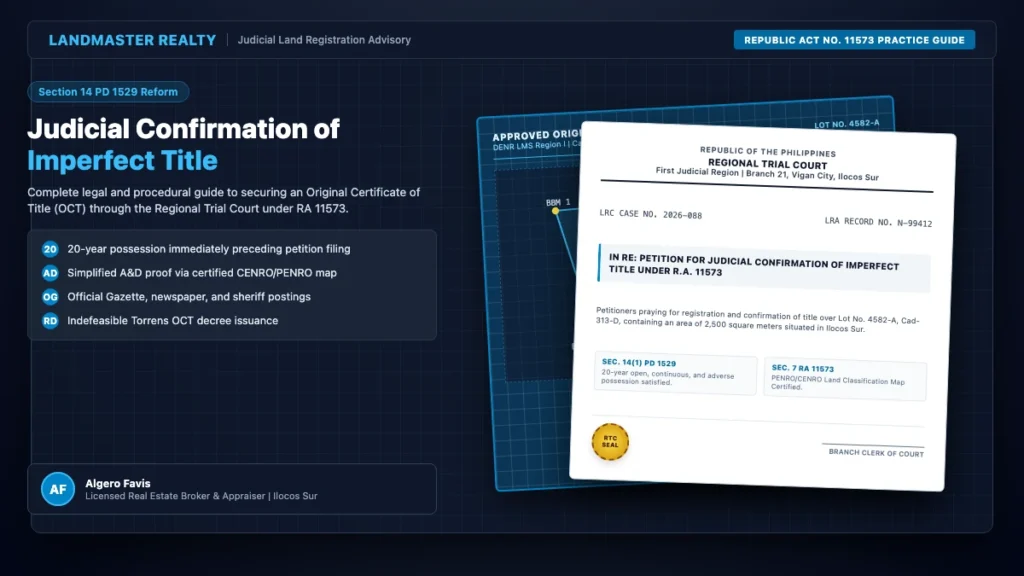
To resolve this massive legal gridlock, the Philippine Congress enacted Republic Act No. 11573, signed into law on July 16, 2021, and effective on September 1, 2021. RA 11573 completely revolutionized the statutory framework for the judicial confirmation of imperfect title ra 11573 by directly amending Section 14 of the Property Registration Decree (Presidential Decree No. 1529) and Section 48(b) of the Public Land Act (Commonwealth Act No. 141). Most significantly, the law abolished the virtually impossible June 12, 1945 possession benchmark and replaced it with a uniform, realistic requirement of at least twenty (20) years of open, continuous, exclusive, and notorious possession immediately preceding the filing of the petition.
Furthermore, RA 11573 eliminated the oppressive evidentiary hurdle established under the Supreme Court doctrine of Republic v. T.A.N. Properties, allowing landowners to prove Alienable and Disposable (A&D) status through certified CENRO or PENRO Land Classification maps rather than requiring elusive presidential proclamations. As a licensed real estate broker and appraiser practicing in Ilocos Sur, I regularly counsel property owners whose land cannot qualify for administrative patents due to size caps or statutory deadlines. This comprehensive practitioner guide details the complete legal and procedural architecture of judicial confirmation of title under RA 11573, including statutory reforms, evidentiary requirements, the 6-stage Regional Trial Court (RTC) sequence, an itemized provincial budget, and comparative titling frameworks.
Quick Answer: What is Judicial Confirmation of Imperfect Title under RA 11573 and Who Qualifies?
Judicial Confirmation of Imperfect Title under Republic Act No. 11573 is a formal court proceeding before the Regional Trial Court (RTC) that allows Filipino citizens to convert untitled alienable and disposable public land into an indefeasible Torrens Original Certificate of Title (OCT) by proving at least twenty (20) years of open, continuous, exclusive, and notorious possession immediately preceding the filing of the petition.
To qualify for judicial confirmation under RA 11573 (amending Section 14 of PD 1529), an applicant must satisfy five core legal criteria:
- Philippine Citizenship: The applicant must be a natural-born or naturalized Filipino citizen. Private domestic corporations may also apply if their individual predecessors-in-interest had already completed the required 20-year possession period while the land was alienable and disposable.
- 20-Year Adverse Possession: The applicant, personally or through predecessors-in-interest, must have exercised open, continuous, exclusive, and notorious possession under a bona fide claim of ownership for at least twenty (20) years immediately preceding the filing of the application. The old requirement of possession since June 12, 1945 is completely abolished.
- Alienable and Disposable (A&D) Land: The property must be classified as alienable and disposable agricultural land of the public domain at the time the petition is filed in court.
- Simplified Proof of Land Classification: Under Section 7 of RA 11573, presentation of a certified copy of the Land Classification (LC) Map accompanied by an official CENRO or PENRO certification is legally sufficient to prove alienable and disposable status, superseding the strict presidential proclamation rule.
- No Area Limitation for Private Claims: Unlike administrative residential patents which are capped at 200 to 1,000 square meters, judicial confirmation allows titling of large residential, agricultural, or mixed-use tracts, subject only to the constitutional 12-hectare ceiling for public land acquisition by individuals.
Judicial confirmation is filed through a verified petition with the Regional Trial Court having territorial jurisdiction over the property. Upon final judgment and issuance of the registration decree by the Land Registration Authority (LRA), the local Registry of Deeds issues an unassailable Original Certificate of Title (OCT).
The Landmark Reform: How RA 11573 Overhauled Section 14 of PD 1529 and Abolished the 1945 Possession Rule
To grasp the historic significance of Republic Act No. 11573, one must examine the legal impossibility that plagued Philippine land titling for over four decades. Prior to the passage of RA 11573 in 2021, judicial confirmation of imperfect title was governed primarily by Section 14(1) of Presidential Decree No. 1529 (the Property Registration Decree) and Section 48(b) of Commonwealth Act No. 141 (the Public Land Act), as amended by Presidential Decree No. 1073.
Under those legacy statutes, an applicant had to prove that they, personally or through their predecessors-in-interest, had been in open, continuous, exclusive, and notorious possession and occupation of alienable and disposable agricultural land of the public domain since June 12, 1945, or earlier.
The Historical Impasse of the June 12, 1945 Possession Standard
As decades passed, proving possession dating back to June 12, 1945 became virtually impossible for provincial property owners. Consider the arithmetic: by the year 2020, an applicant was required to present documentary and testimonial evidence covering 75 consecutive years of continuous occupation. In practical terms, this required:
- Locating witnesses who were at least 15 to 20 years old in 1945 (meaning they would have to be over 90 years old during the trial) to testify competently regarding who planted crops or fenced the property at the end of World War II.
- Producing tax declarations, assessor field sheets, or municipal receipts issued on or before June 12, 1945. In most provincial municipalities across Ilocos Sur, municipal halls, assessor vaults, and church registries were burned, flooded, or destroyed during the Second World War. Most assessor historical records only began systematic reconstruction between 1948 and 1952.
- Defending against routine oppositions filed by the Office of the Solicitor General (OSG). Government prosecutors routinely moved to dismiss land registration petitions solely because the applicant earliest tax declaration began in 1950 or 1955 rather than June 1945, dismissing decades of bona fide cultivation and substantial real property tax payments.
Furthermore, under the complicated dual-track jurisprudence of Heirs of Mario Malabanan v. Republic (G.R. No. 179987, 2009), if an applicant could not prove possession since June 12, 1945 under Section 14(1), they were forced to attempt titling under Section 14(2) of PD 1529 through prescription. However, the Supreme Court ruled that to title public land under Section 14(2), the land had to be expressly declared by the State as patrimonial property (no longer intended for public service or development of national wealth), and the 30-year acquisitive prescription period only began running after such an explicit patrimonial declaration. Because the State rarely, if ever, issued formal patrimonial declarations over agricultural lands, Section 14(2) became an operational dead end.
The New 20-Year Possession Rule under RA 11573
Recognizing that millions of Filipino families were trapped in an artificial legal vacuum, Congress enacted Republic Act No. 11573. Section 1 of RA 11573 decisively repealed Section 14(1) and Section 14(2) of PD 1529, replacing them with a single, clear, and realistic statutory standard:
“Section 14. Who May Apply. – The following may file at any time, in the proper Regional Trial Court, an application for registration of title to land, not exceeding twelve (12) hectares, whether personally or through their duly authorized representatives:
(1) Those who by themselves or through their predecessors-in-interest have been in open, continuous, exclusive and notorious possession and occupation of alienable and disposable lands of the public domain not conferred by any other law, under a bona fide claim of ownership, for at least twenty (20) years immediately preceding the filing of the application for confirmation of title, except when prevented by war or force majeure.”
By establishing a rolling 20-year possession period counted backward from the date the petition is filed in court, RA 11573 synchronized land registration with human reality. If you file a petition for judicial confirmation in 2026, you must prove continuous possession beginning in 2006. If you file in 2027, you must prove possession starting in 2007. This eliminates the necessity of hunting for century-old documents or surviving centenarian witnesses.
Retroactive Application and Supreme Court Ruling in Republic v. Pasig Rizal Co.
A vital legal development that every landowner and property investor must understand is the retroactive legal effect of RA 11573. In the landmark En Banc decision of Republic of the Philippines v. Pasig Rizal Co., Inc. (G.R. No. 213207, promulgated February 15, 2022), the Supreme Court ruled that Republic Act No. 11573 is a curative statute that applies retroactively to all pending land registration applications and appeals.
The High Court held that RA 11573 operates as a remedial law designed to cure the defects and social injustices of legacy titling statutes. Consequently, any land registration case filed under the old June 12, 1945 standard that was pending in trial courts, the Court of Appeals, or the Supreme Court when RA 11573 took effect on September 1, 2021 is now evaluated under the 20-year possession rule. Furthermore, applicants whose petitions had previously been dismissed for failure to prove possession since 1945 can file anew under RA 11573 without violating the principle of res judicata, provided they satisfy the 20-year requirement.
Proving 20 Years of Open, Continuous, Exclusive, and Notorious Possession
While RA 11573 dramatically reduced the possession period from 75+ years to 20 years, it did not lower the strict legal standard required to prove that possession. In judicial proceedings before the Regional Trial Court, land registration is an in rem action against the entire world. The applicant bears the absolute burden of overcoming the Regalian Doctrine (which presumes that all lands not appearing to be private belong to the State). Mere casual occupation, sporadic visits, or self-serving verbal assertions will result in the outright dismissal of your petition.
To secure a favorable court judgment, you must build an airtight documentary and testimonial dossier demonstrating that your possession satisfies the four classic statutory elements:
- Open: The possession is visible, manifest, and apparent to the entire community. The land is not occupied clandestinely or hidden from neighbors.
- Continuous: The possession has been maintained without interruption, abandonment, or legal eviction for the full 20-year period preceding the petition filing.
- Exclusive: The applicant holds the property solely for themselves, exercising dominion and excluding all other claimants, rather than occupying the land in common with the public or as a mere tenant.
- Notorious: The property occupation is widely known, acknowledged, and recognized by the barangay authorities, adjoining parcel owners, and local residents.
Building an Unbroken Chain of Tax Declarations
The foundational documentary pillar of judicial land registration is an unbroken chain of real property Tax Declarations spanning at least 20 years. In Philippine jurisprudence, while a tax declaration is not conclusive title in itself, an unbroken series of tax declarations is the most persuasive documentary evidence of a bona fide claim of ownership.
To prove 20 years of possession for a petition filed in 2026, you must submit certified true copies of tax declarations from the Municipal Assessor Office dating back to 2006 or earlier. If the land was originally held by your parents or grandparents, you rely on the doctrine of tacking of possession under Article 1138 of the Civil Code. Under this principle, your current period of possession is added to the possession period of your predecessors-in-interest. However, you must prove the unbroken legal transfer of that possession through registered Deeds of Sale, Extrajudicial Settlements of Estate, or Deeds of Donation, accompanied by the sequential cancelation and issuance of the corresponding tax declarations.
Realty Tax Official Receipts as Prima Facie Proof of Possession
Filing tax declarations without paying the corresponding real property taxes (amilyar) will arouse immediate judicial skepticism. Courts consistently hold that voluntary payment of municipal taxes demonstrates a clear animus possidendi (intent to possess as owner). No rational person pays annual taxes on land they do not own or possess.
When preparing your judicial dossier in Ilocos Sur, you should secure an official Certificate of Tax Clearance or Certificate of Non-Delinquency from the Municipal Treasurer, accompanied by the original or certified copies of the official real property tax receipts (O.R.s) covering the 20-year timeline. If there were delinquent years that were settled in a single lump-sum amnesty payment, you must be prepared to present supplementary corroborating evidence of physical possession during those delinquent years, as government prosecutors will argue that late payments were made merely to manufacture a paper trail for court titling.
Proving Physical Acts of Ownership: Cultivation, Fencing, and Structures
Documentary tax records must be reinforced by concrete evidence of physical acts of dominion. The Supreme Court has repeatedly ruled that possession under Section 14 of PD 1529 requires actual occupation and physical exploitation of the land. During trial, you must establish the physical improvements introduced on the parcel:
- Agricultural Cultivation: In provincial agricultural settings, detailed evidence must show continuous farming. In Ilocos Sur, this includes presenting proof of seasonal crop planting (such as tobacco, rice, corn, and garlic), planting and harvesting of fruit-bearing trees (such as mature mango, coconut, or mahogany trees with estimated ages exceeding 20 years), and maintenance of livestock enclosures.
- Perimeter Fencing and Monuments: Concrete boundary monuments (mojones), concrete hollow block walls, wooden fencing, or established living hedgerows (such as kakawate or bougainvillea) demarcating property boundaries provide powerful proof of exclusive dominion.
- Permanent Structures: Residential houses, agricultural storage warehouses, irrigation pump sheds, solar drying pavements, or deep well installations built on the land. Presenting municipal building permits, electrical connection records from the local electric cooperative (such as ISECO in Ilocos Sur), or water utility billing statements confirms long-term physical presence.
The Decisive Value of Adjoining Landowner and Community Elder Testimonies
Live oral witness testimony during the RTC trial hearings is the ultimate test of your case. Judicial confirmation petitions often succeed or fail based on the credibility of the witnesses who take the stand before the trial judge. In addition to the petitioner testimony, you should present at least two independent, disinterested witnesses.
The most effective witnesses are adjoining lot owners or respected community elders (octogenarians or long-serving former barangay captains) who have lived adjacent to the property for several decades. These witnesses must testify under oath that they personally know the petitioner and their family, that they share a common boundary with the property, that neither the State nor any private party has ever disputed the applicant peaceful possession, and that the family has harvested crops or lived on the parcel continuously for over twenty years. A clear, unshakeable testimony from an adjacent landowner refutes any suspicion of encroachment and satisfies the court requirement of notorious possession.
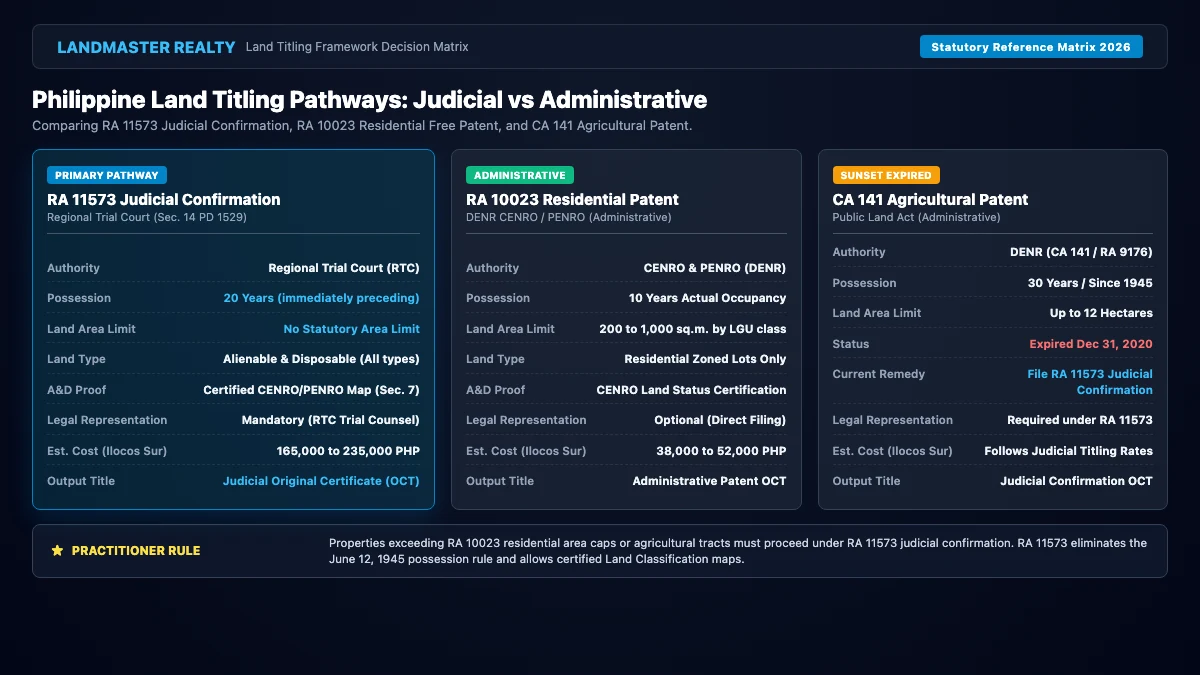
Comprehensive decision matrix comparing RA 11573 judicial confirmation of title, RA 10023 residential free patent, and CA 141 agricultural patent across court jurisdiction, possession period, costs, and parcel size limits.
Simplified Alienable and Disposable (A&D) Proof: Section 7 of RA 11573 vs Republic v. T.A.N. Properties
Even if an applicant possesses 50 years of uninterrupted tax receipts and five credible witness testimonies, their petition will be summarily denied if they fail to prove that the property is classified as Alienable and Disposable (A&D) agricultural land of the public domain. Under the Regalian Doctrine, forest lands, mineral lands, national parks, and protected military or watershed reserves are completely inalienable; no amount of time or adverse possession can ever ripen into private ownership over non-disposable public land.
Historically, establishing the A&D status of land in court was an agonizing evidentiary nightmare due to rigid Supreme Court jurisprudence. Republic Act No. 11573 revolutionized this procedural requirement, eliminating administrative bottlenecks and creating a standardized evidentiary protocol.
The Demise of the Presidential Proclamation Requirement
For over a decade, Philippine land registration was bound by the strict doctrine enunciated in Republic v. T.A.N. Properties, Inc. (G.R. No. 154953, June 26, 2008). In that case, the Supreme Court established that to prove land is alienable and disposable, an applicant could not simply submit a CENRO or PENRO certification. The applicant was legally required to present two distinct pieces of evidence:
- A certification from the CENRO or PENRO having custody of the land records; and
- A certified true copy of the original proclamation, executive order, administrative order, or presidential decree signed by the President or the DENR Secretary declaring the area alienable and disposable, certified by the official legal custodian of the national archives or DENR central records.
The T.A.N. Properties doctrine caused thousands of meritorious land titling applications to be dismissed across the Philippines. Most municipal CENRO and PENRO offices had never been provided certified true copies of presidential proclamations signed in the 1920s, 1930s, or 1950s. Applicants were forced to travel to Manila to scour the National Archives, the Land Management Bureau central records, or the Malacañang Records Office, often discovering that historical paper decrees had deteriorated or been lost. Landowners who had peacefully farmed their ancestral land for generations found their title petitions dismissed on pure evidentiary technicalities.
What the DENR CENRO and PENRO Certification Must Explicitly State
To eliminate this systemic paralysis, Section 7 of Republic Act No. 11573 enacted a statutory overhaul of evidentiary proof, explicitly superseding the T.A.N. Properties doctrine. Section 7 provides:
“Section 7. Proof of Land Classification Status. – For purposes of judicial confirmation of imperfect title, a duly signed certification by a duly designated DENR geodetic engineer that the land is part of alienable and disposable agricultural lands of the public domain, which should contain the project number, map number, and date of release, accompanied by an approved cadastral survey plan or approved plan on tracing cloth or polyester film… shall be sufficient proof of the alienable and disposable status of the land.”
Under this streamlined standard, applicants are no longer required to produce original presidential decrees or executive orders. Instead, a formal CENRO or PENRO Certification of Land Classification Status is legally conclusive, provided it contains specific statutory recitals:
- Project Number: The official Land Classification Project Number under which the parcel was surveyed (e.g., Project No. 12-A).
- Map Number: The specific Forestry Management Bureau (FMB) or Land Management Bureau Land Classification (LC) Map Number covering the municipality (e.g., LC Map No. 203).
- Date of Release: The exact date when the administrative issuance declared the area alienable and disposable.
- Negative Clearance: An explicit statement that the lot falls entirely within alienable and disposable agricultural land and does not encroach upon timberland, forest reserves, river easements, or military reservations.
The Approved Cadastral Survey Plan on Tracing Cloth or Polyester Film
The second mandatory technical requirement is the submission of the Original Survey Plan approved by the Regional Technical Director of the DENR Land Management Services (LMS). Under long-standing land registration rules (reaffirmed by Section 7 of RA 11573 and Supreme Court circulars), the court must be provided with the physical plan prepared on tracing cloth or polyester film (mylar).
A simple blue-print paper copy or photocopy is legally inadmissible to support a final judgment in a land registration case. The original tracing cloth plan, bearing the official seal and signature of the Regional Technical Director (for Region I, based in San Fernando, La Union), establishes the exact mathematical coordinates, boundary distances, area computations, and monument markers (BLLM / BBM). It must be accompanied by the verified and certified Geodetic Engineer technical description of the lot. At LandMaster Realty, we coordinate directly with accredited geodetic engineers to ensure that survey plans strictly conform to DENR LMS standards before petition filing.
Step-by-Step 6-Stage RTC Land Registration Court Procedure from Petition to Decree and Registry of Deeds OCT
Judicial confirmation of imperfect title under RA 11573 is an in rem court proceeding that requires strict adherence to jurisdictional prerequisites. Unlike ordinary civil litigation where a defect can often be waived by mutual consent of the parties, failure to satisfy any statutory step in a land registration case strips the Regional Trial Court of subject-matter jurisdiction, rendering any subsequent judgment or issued title void ab initio. The entire legal process spans six systematic stages.
Stage 1: Pre-Filing Preparation, Geodetic Survey, and Petition Drafting
The first stage focuses on compiling an airtight evidentiary dossier and drafting the formal verified petition. This requires executing three parallel tracks:
- Cadastral Survey Execution: Engaging a licensed Geodetic Engineer to conduct an advance or cadastral verification survey of the property, submit the survey data to the DENR LMS regional office, and secure the approved plan on tracing cloth/polyester film and certified technical descriptions.
- Document Compilation: Securing the certified CENRO/PENRO Land Classification certification under Section 7 of RA 11573, obtaining the 20-year chain of certified tax declarations and tax clearances from the municipal assessor and treasurer, and gathering birth, marriage, and death certificates proving succession if relying on tacking of possession.
- Drafting the Verified Petition: Retaining private land registration trial counsel to draft the verified petition for land registration under Section 14 of PD 1529, as amended by RA 11573. The petition must explicitly describe the land boundaries, state its assessed and market values, identify all adjoining property owners with their complete postal addresses, affirm that the land is not subject to any mortgage or encumbrance, and state that the applicant is in actual open, continuous, exclusive, and notorious possession.
Stage 2: Filing the Petition and Jurisdictional Verification at the RTC
The verified petition, together with all original annexes and required duplicate copies, is filed with the Office of the Clerk of Court of the Regional Trial Court having territorial jurisdiction over the municipality where the land is located. In Ilocos Sur, cases are filed at the RTC branches in Vigan City, Candon City, Narvacan, or Tagudin.
Upon payment of the prescribed court docket fees, sheriff mileage fees, and legal research fund assessments, the case is assigned an official Land Registration Case (LRC) docket number. The case is then raffled to a specific RTC branch. The trial judge examines the petition for formal compliance. If the petition is sufficient in form and substance, the court issues an Order Setting the Case for Initial Hearing, establishing the date and time when the court will formally establish jurisdiction.
Stage 3: Notice of Initial Hearing, Official Gazette, and Newspaper Publication
This is the most critical jurisdictional stage in the entire proceeding. Section 23 of Presidential Decree No. 1529 mandates that the public be given comprehensive legal notice of the application. The Notice of Initial Hearing must be promulgated across three distinct channels:
- Publication in the Official Gazette: The court clerk transmits the Notice of Initial Hearing to the National Printing Office (NPO) for publication in the Official Gazette. The notice must be published once, and the hearing date set by the court must be at least ninety (90) days from the date of the court order to accommodate NPO printing schedules. Publication in the Official Gazette is an absolute jurisdictional requirement; failure to publish or publication after the hearing date voids the entire proceeding.
- Publication in a Newspaper of General Circulation: The notice must also be published once in a local newspaper of general circulation in the province (such as established provincial weekly newspapers circulating in Ilocos Sur and Region I). The publisher must execute an Affidavit of Publication and submit newspaper clippings as formal exhibits.
- Mailing of Notices to Public Authorities and Adjoining Owners: The Land Registration Authority (LRA) and the Clerk of Court must send copies of the Notice of Initial Hearing by registered mail to all adjoining landowners listed in the petition, the Secretary of Public Works and Highways, the Provincial Governor, the Municipal Mayor, the Director of Lands (DENR), and the Office of the Solicitor General.
Stage 4: Sheriff Posting, OSG Representation, and LRA Land Investigation Report
Simultaneously with publication, the provincial court sheriff is directed to physically post certified copies of the Notice of Initial Hearing in conspicuous public places:
- On the bulletin board of the municipal hall of the town where the land lies;
- On the bulletin board of the barangay hall of the specific barangay;
- Directly on a conspicuous post or gate on the parcel of land itself; and
- On the bulletin board of the Regional Trial Court.
The sheriff executes a formal Sheriff Return of Service and Certificate of Posting certifying compliance. Meanwhile, the Office of the Solicitor General (OSG) enters its formal appearance as counsel for the Republic of the Philippines, usually deputizing the local Provincial or City Prosecutor to represent the State during trial. Concurrently, the Land Registration Authority (LRA) conducts a geographic records check to verify that the surveyed parcel does not overlap or duplicate any previously titled property, submitting an official LRA Verification Report directly to the trial judge.
Stage 5: Court Trial, Formal Offer of Evidence, and Promulgation of Judgment
On the date of the initial hearing, the petitioner counsel presents the jurisdictional exhibits (the Official Gazette issue, the newspaper affidavit, the registry return receipts, and the sheriff certificate of posting) to establish the court authority to proceed. If no private oppositor appears, the court enters an Order of General Default against the whole world, except the Republic of the Philippines represented by the Public Prosecutor.
The case then proceeds to trial on the merits. The applicant counsel presents the witnesses:
- The Petitioner: Testifying on personal background, citizenship, history of acquisition, unbroken possession, payment of real property taxes, and physical improvements.
- The Geodetic Engineer: Authenticating the tracing cloth plan, explaining the technical boundary coordinates, and verifying that monuments are established on the ground.
- The Adjoining Landowners and Community Witnesses: Testifying on the notorious, peaceful, and continuous possession of the petitioner family for over twenty years without conflict.
Following cross-examination by the Public Prosecutor, the petitioner files a written Formal Offer of Documentary Evidence. If the prosecutor has no controverting evidence from the DENR, the case is submitted for decision. Within 30 to 90 days, the RTC judge renders a written Decision / Judgment confirming the imperfect title of the applicant and ordering the registration of the land in their name.
Stage 6: Finality of Judgment, Issuance of Decree of Registration, and Registry of Deeds OCT
After the court judgment is promulgated, a 15-day statutory period begins. If no appeal or motion for reconsideration is filed by the OSG or any party, the decision becomes final and executory. The court clerk issues a Certificate of Finality.
The petitioner counsel then files a Motion for Issuance of Decree of Registration. The RTC judge issues an Order directing the Land Registration Authority in Quezon City to issue the official decree. The LRA assigns a permanent Decree Number, inscribes the technical description, and transmits the original decree dossier to the local Registry of Deeds (such as the Registry of Deeds of Ilocos Sur in Vigan City).
Upon payment of the registration fees, entry fees, and legal contributions to the Land Registration Assurance Fund, the Register of Deeds enters the decree into the registration books and issues the original duplicate Original Certificate of Title (OCT) directly to the registered owner. The property is now fully and permanently registered under the Torrens system, guaranteed by the Republic of the Philippines.
Concrete Worked Financial Budget: Itemized Cost Breakdown to Judicially Title Land in Ilocos Sur
A primary reason property owners hesitate to pursue judicial confirmation of title is uncertainty regarding court costs and professional fees. Generic legal websites routinely give vague answers, stating that judicial titling costs depend on the lawyer. At LandMaster Realty, we believe in total financial transparency. While legal representation fees vary depending on parcel complexity, provincial litigation costs follow predictable fee schedules.
To provide actionable planning figures, the table below details a realistic, worked financial budget for judicially titling an untitled 2,500 square meter agricultural or residential parcel situated in provincial Ilocos Sur under Republic Act No. 11573:
| Expense Category & Statutory Requirement | Estimated Cost Range (PHP) | Operational Details & Payee |
|---|---|---|
| Geodetic Cadastral Survey, Tracing Cloth, & DENR LMS Regional Approval | 25,000 to 35,000 PHP | Licensed Geodetic Engineer field survey, boundary monumenting, polyester film drafting, and LMS Region I approval fees. |
| DENR CENRO / PENRO Land Classification Status Certifications | 5,000 to 8,000 PHP | Official CENRO inspection fees, project/map verification, and certified land classification map issuance under Section 7 RA 11573. |
| Legal Acceptance Fee (Private Land Registration Counsel) | 60,000 to 90,000 PHP | Retainer and drafting of verified petition, collation of documentary evidence, judicial affidavits, and pre-trial filings. |
| Court Appearance Fees (Estimated 5 to 7 Hearings @ 3,500 – 5,000 PHP) | 17,500 to 35,000 PHP | Paid to private counsel per court session (initial hearing, direct examination, cross-examination, formal offer). |
| RTC Filing Fees, Docket Assessment, & Legal Research Fund | 8,000 to 12,000 PHP | Office of the Clerk of Court assessment based on the assessed market value of the 2,500 sq.m. parcel. |
| Official Gazette Mandatory Publication Fee (National Printing Office) | 12,000 to 18,000 PHP | Statutory publication fee paid directly to the National Printing Office for printing the Notice of Initial Hearing. |
| Newspaper of General Circulation Publication Fee | 15,000 to 22,000 PHP | Two-week publication in an accredited provincial newspaper circulating in Ilocos Sur, including publisher affidavit. |
| Court Sheriff Mileage, Posting Fees, & Registered Mail Notices | 6,000 to 9,000 PHP | Physical posting at municipal hall, barangay hall, court bulletin, and registered mail postage to adjoining owners. |
| LRA Decree Issuance & Transmittal Assessment | 3,500 to 6,000 PHP | Land Registration Authority administrative fee for drafting the official decree of registration and judicial record book binding. |
| Registry of Deeds Entry Fees, Assurance Fund, & OCT Release | 4,500 to 7,500 PHP | Official RD registration fees, entry stamps, contribution to the Assurance Fund, and owner duplicate certificate generation. |
| Incidentals: Certified Assessor Tax Records, Affidavits, & Barangay Certifications | 6,000 to 9,000 PHP | Certified copies of historical tax declarations, tax clearances, notarial fees for affidavits, and municipal assessor certifications. |
| TOTAL ESTIMATED BUDGET (Ilocos Sur 2,500 SQ.M. Parcel) | 162,000 to 248,500 PHP | Typical provincial average: ~195,000 PHP over a 12 to 24 month period. |
Strategic Cost Comparison: Judicial Confirmation vs Administrative Free Patent
When evaluating this budget, landowners must weigh the investment against the administrative alternative. An administrative residential free patent under Republic Act No. 10023 costs between 38,000 PHP and 52,000 PHP in Ilocos Sur. However, as explained below, administrative free patents are strictly limited to small residential parcels (up to 1,000 square meters in 4th class towns or 500 square meters in Vigan City).
If your property measures 2,500 square meters, 5,000 square meters, or multiple hectares, or if the land is classified as agricultural, an administrative patent cannot legally be granted. Spending 160,000 PHP to 245,000 PHP to judicially confirm an imperfect title under RA 11573 permanently transforms an illiquid, unbankable tax declaration into an indefeasible Torrens title. In the commercial banking sector, an untitled provincial parcel is collateralized at zero value, whereas an OCT allows the owner to mortgage the property for millions of pesos or sell it at 100% of fair market value. The economic return far outweighs the legal and publication costs.
Avoiding Costly Delays: Common Procedural Pitfalls in RTC Titling Cases
In our advisory practice, we have seen judicial titling cases drag on for four or five years simply because private counsel made basic procedural errors. To keep your case within a 12 to 18 month timeline, avoid these three critical traps:
- Scheduling Hearings Too Early for the Official Gazette: The National Printing Office often has a publication backlog of two to three months. If your lawyer sets the initial hearing date only 45 days after the court order, the Official Gazette issue containing your notice will not be printed in time for the hearing. The judge will be forced to cancel the hearing, issue an amended order, and restart the 90-day clock.
- Submitting Incomplete Adjoining Owner Addresses: If the names and addresses of adjoining lot owners in your petition are vague (such as merely listing “Juan Dela Cruz, Vigan City” without barangay and street details), the registered mail notices sent by the court will be returned unserved. The trial judge will refuse to issue an order of general default until proof of actual receipt or personal sheriff service is established.
- Failing to Monitor the LRA Report: After the initial hearing, the court will wait for the Land Registration Authority formal investigation report. If your legal team does not proactively follow up with the LRA Docket Division in Quezon City, your case can stall for over a year waiting for a standard one-page clearance.
When Judicial Confirmation Is Mandatory: Parcels Exceeding RA 10023 Caps and Agricultural Sunset
Many provincial property owners ask why they should incur the higher expense and formal courtroom procedure of RA 11573 judicial confirmation if administrative free patents exist through the DENR. The reality is that for a massive proportion of provincial landholders, administrative titling is legally unavailable. Understanding where administrative avenues terminate and judicial confirmation becomes legally mandatory prevents wasted application fees and administrative dismissals.
The December 31, 2020 CA 141 Agricultural Patent Sunset Trap
The single most widespread misconception in provincial land titling involves agricultural free patents. Under Commonwealth Act No. 141, Filipino farmers could historically file an administrative application with CENRO for an agricultural free patent over cultivated public agricultural land of up to 12 hectares.
However, under Republic Act No. 9176 (enacted in 2002), Congress established a strict statutory sunset deadline: the period for filing administrative agricultural free patent applications was extended only until December 31, 2020. When that deadline arrived, Congress did not enact any legislation extending the administrative agricultural filing period.
CRITICAL STATUTORY DEADLINE: Since December 31, 2020, the DENR (CENRO and PENRO) has been legally stripped of authority to accept new administrative agricultural free patent applications under CA 141. Any property owner holding untitled agricultural land (such as rice paddies, tobacco fields, corn lands, or fruit orchards) CANNOT obtain an administrative title. The ONLY legal avenue remaining to title untitled agricultural land in the Philippines today is judicial confirmation of imperfect title before the Regional Trial Court under Republic Act No. 11573.
If you own an untitled agricultural farm in Ilocos Sur and an informal agent or fixer promises that they can get you a CENRO free patent, they are either misinformed or operating an unlawful scheme. CENRO will reject the application at initial intake.
Lots Exceeding RA 10023 Residential Statutory Ceilings
While administrative titling remains fully active for residential parcels under the Residential Free Patent Act (RA 10023), that law imposes non-negotiable statutory land area ceilings:
- Up to 200 square meters in Highly Urbanized Cities (HUCs);
- Up to 500 square meters in component cities (such as Vigan City and Candon City);
- Up to 750 square meters in 1st and 2nd class municipalities (such as Bantay and Narvacan); and
- Up to 1,000 square meters in 3rd, 4th, 5th, and 6th class municipalities (such as San Juan, Magsingal, and Santa).
In provincial towns, ancestral residential home lots are frequently 1,500 square meters, 2,500 square meters, or larger, encompassing ancestral houses, gardens, poultry yards, and family driveways. If the family refuses to physically subdivide the land into separate smaller lots among different relatives, the parcel cannot be titled under RA 10023. The property owners must file for judicial confirmation under RA 11573, which accommodates parcels of any size up to the 12-hectare constitutional limit.
Properties with Boundary Conflicts, Overlaps, or Institutional Inquiries
Administrative patent applications at CENRO are summary, non-adversarial proceedings. Under DENR rules, if an adjoining neighbor files a formal protest or claims a boundary encroachment, or if there is an overlapping survey claim, CENRO will often suspend the proceedings or dismiss the application, advising the parties to litigate their dispute before the courts.
By contrast, the Regional Trial Court possesses full judicial power to resolve adverse boundary claims, summon opposing claimants, evaluate conflicting geodetic surveys, examine historical witness testimony under oath, and render a final judgment that binds all parties under the doctrine of res judicata. For high-value provincial properties where informal boundary encroachments or heir disputes exist, judicial confirmation provides permanent, unassailable legal certainty that an administrative patent can never match.
RA 11573 (Judicial) vs RA 10023 (Residential Free Patent) vs CA 141 (Agricultural): Master Comparison Table
Selecting the correct titling pathway requires analyzing governing statutes, government agencies, possession periods, eligible land classifications, and total processing costs. The master comparison table below summarizes the fundamental legal and operational differences among the three primary land titling frameworks in the Philippines:
| Comparison Feature | RA 11573 Judicial Confirmation | RA 10023 Residential Free Patent | CA 141 Agricultural Patent |
|---|---|---|---|
| Governing Statute | RA 11573 (Amending Sec. 14 PD 1529) | Republic Act No. 10023 | CA 141 as amended by RA 9176 |
| Deciding Authority | Regional Trial Court (Judicial) | DENR CENRO & PENRO (Administrative) | DENR CENRO & PENRO (Administrative) |
| Current Filing Status | Active and Permanent (No Sunset) | Active and Permanent (No Sunset) | EXPIRED (Sunset Dec 31, 2020) |
| Required Possession Period | At least 20 years immediately preceding filing | At least 10 years actual occupancy | 30 years or since June 12, 1945 |
| Eligible Land Classifications | All Alienable & Disposable Public Lands (Agri, Res, Mixed) | Alienable & Disposable Zoned Residential Land Only | Agricultural Public Lands Only (Expired) |
| Maximum Allowable Area | Up to 12 Hectares (Constitutional Max) | 200 to 1,000 sq.m. based on LGU Class | Up to 12 Hectares (Expired) |
| A&D Evidentiary Standard | CENRO/PENRO Certified Map (Sec. 7 RA 11573) | CENRO Land Status Certification | CENRO Land Status Verification |
| Legal Representation | Mandatory (Private RTC Trial Lawyer) | Optional (Direct Filing by Owner/Broker) | Optional (Direct Filing) |
| Estimated Timeline | 12 to 24 Months | 4 to 9 Months | N/A (Expired) |
| Estimated Total Cost (Provincial) | 160,000 to 245,000 PHP | 38,000 to 52,000 PHP | N/A (Must use RA 11573) |
| Title Granted & Indefeasibility | Judicial Original Certificate of Title (OCT); Indefeasible after 1 year | Patent OCT; Subject to 1-year administrative review | Patent OCT (Expired) |
How LandMaster Realty Guides Provincial Landowners to the Correct Pathway
At LandMaster Realty, our first operating principle when consulting with property owners is conducting a rigorous preliminary document audit. Before committing client funds to geodetic surveys or legal retainers, we examine three definitive factors:
- Zoning and Physical Land Use: If the land is purely residential and within municipal area limits, we guide the client through the faster, cost-effective RA 10023 administrative patent process. If the property is agricultural (even partially) or exceeds residential area limits, we immediately establish the RA 11573 judicial roadmap.
- Cadastral Map and Survey Verification: We verify the parcel against DENR LMS cadastral index maps in San Fernando, La Union, ensuring there are no overlapping titled claims or public reservations.
- Chain of Tax Declarations: We audit municipal assessor archives to confirm that the unbroken 20-year documentary chain is legally complete, eliminating surprise oppositions from the Office of the Solicitor General.
Frequently Asked Questions About Judicial Confirmation of Title under RA 11573
Below are authoritative answers to the most frequent legal and practical questions posed by provincial landowners, real estate investors, and overseas Filipino workers (OFWs) regarding judicial land titling in the Philippines:
1. Can I still file an administrative agricultural free patent at CENRO today?
No. Under Republic Act No. 9176, the statutory authority of the DENR to accept and process administrative agricultural free patent applications under Commonwealth Act No. 141 permanently expired on December 31, 2020. Congress has not extended this deadline. If you hold untitled agricultural land, you cannot obtain an administrative free patent. Your only legal remedy to title agricultural public land is filing a petition for judicial confirmation of imperfect title before the Regional Trial Court under Republic Act No. 11573.
2. What is the main difference between Section 14(1) of PD 1529 before and after RA 11573?
The primary difference is the required period of adverse possession. Before RA 11573, an applicant was required to prove open, continuous, exclusive, and notorious possession since June 12, 1945 or earlier (requiring over 75 years of historical evidence). Under RA 11573, the June 12, 1945 requirement was completely abolished and replaced by a rolling requirement of at least twenty (20) years of possession immediately preceding the filing of the petition. Furthermore, RA 11573 repealed Section 14(2) regarding acquisitive prescription of patrimonial property, consolidating titling under a unified 20-year possession standard.
3. How do I prove 20 years of possession if the tax declaration was only transferred to my name five years ago?
You prove possession through the legal doctrine of tacking of possession under Article 1138 of the Civil Code and Section 14(1) of PD 1529. The law explicitly permits you to tack your five years of personal possession onto the prior possession of your predecessors-in-interest (such as your parents, grandparents, or the previous seller). You must present certified historical tax declarations showing your predecessors held the property for at least 15 preceding years, supported by registered conveyancing deeds (such as a Deed of Absolute Sale or Extrajudicial Settlement of Estate) proving how lawful ownership passed to you.
4. Is a private attorney required to file a judicial confirmation of imperfect title?
Yes. Judicial confirmation of title is a formal civil proceeding conducted before the Regional Trial Court. A licensed attorney must draft the verified petition, formally mark and offer documentary exhibits, conduct direct examinations of your geodetic engineer and factual witnesses, and cross-examine government prosecutors. Attempting to file a judicial land registration petition without experienced land litigation counsel will result in dismissals due to procedural defects in jurisdictional publication or technical survey evidence.
5. What happens if the DENR CENRO certifies that my land is classified as timberland or forest reserve?
If the DENR CENRO certifies that the land falls within classified timberland, forest reserves, national parks, or watershed reservations, your petition cannot succeed. Under the Regalian Doctrine, forest lands cannot be alienated or privately acquired, regardless of whether your family has occupied the parcel for 50 or 100 years. The court will dismiss the petition for lack of subject-matter jurisdiction. The only recourse is for Congress or the DENR Secretary to formally declassify the area and reclassify it as alienable and disposable public land through official executive issuance.
6. How long does the entire judicial confirmation process take from filing to the release of the Original Certificate of Title?
In provincial jurisdictions such as Ilocos Sur, the typical timeline for judicial confirmation of title ranges between 12 and 24 months. The initial pre-trial and publication phase takes approximately 4 to 6 months to accommodate National Printing Office schedules for the Official Gazette. Court trial and presentation of evidence require 3 to 6 months. Once judgment is rendered, finality and the issuance of the Decree of Registration by the Land Registration Authority (LRA) in Quezon City takes an additional 4 to 8 months before the local Registry of Deeds issues the final owner duplicate Original Certificate of Title (OCT).
Professional Land Titling and Judicial Petition Assistance in Northern Luzon
Judicial confirmation of imperfect title under Republic Act No. 11573 represents the ultimate legal investment in your property. By converting an untitled provincial tax declaration into an unassailable Torrens Original Certificate of Title, you eliminate boundary disputes, secure 100% of fair market property value, and create an enduring asset that can be safely mortgaged, leased, or inherited across generations.
At LandMaster Realty, founded in 2023, our firm specializes in managing complex provincial property documentation, title verification, and land registration coordination across Ilocos Sur and Northern Luzon. Led by licensed real estate broker and appraiser Algero Favis, our team works in close coordination with accredited geodetic engineers and experienced land litigation counsel. We oversee the entire titling sequence, from field cadastral surveys and CENRO Land Classification certifications to chain-of-title assembly, court trial support, and final Registry of Deeds OCT registration.
Ready to Judicially Title Your Land under RA 11573 in Ilocos Sur?
Do not let your untitled agricultural land or expansive residential parcel remain legally vulnerable. Contact LandMaster Realty today for an expert document evaluation, cadastral survey review, and end-to-end judicial titling guidance.