Under Philippine real property law, failing to pay your annual real property tax (known colloquially as Amilyar) does far more than generate a minor administrative penalty. Under Title II of Republic Act No. 7160, commonly known as the Local Government Code of 1991, an unpaid real property tax bill triggers an escalating, statutory enforcement pipeline. This pipeline begins with a mandatory 2% monthly surcharge, establishes an automatic legal tax lien that primes all private mortgages, culminates in the administrative seizure of your land via a Warrant of Levy, and concludes with the public auction sale of your property on the municipal hall steps.
For thousands of landowners, estate heirs, and Overseas Filipino Workers (OFWs) across the Philippines, real property tax delinquency is often discovered during moments of high transaction vulnerability. Heirs attempting to settle an ancestral estate find that decades of unpaid back taxes prevent the issuance of a Bureau of Internal Revenue (BIR) electronic Certificate Authorizing Registration (eCAR). Buyers conducting due diligence discover registered warrants of levy annotated on the Torrens certificate of title. Absentee property owners return home only to learn that their provincial residential lot or agricultural farm in Ilocos Sur has already been scheduled for public auction by the local municipal treasurer.
Yet property tax delinquency is not an insurmountable legal dead end. The law provides defined statutory relief mechanisms, including the statutory 72% interest cap, the strict 1-year redemption window following a tax sale, and periodic Local Government Unit (LGU) tax amnesty ordinances enacted by municipal and provincial sanggunians that condone accumulated interest surcharges. As a licensed real estate broker and appraiser practicing in Ilocos Sur, I regularly guide landowners through forensic tax audits, treasury negotiations, and lien cancellations at LandMaster Realty. This comprehensive practitioner guide deconstructs the exact statutory mechanics of real property tax delinquency under RA 7160, explains the arithmetic of penalty accumulation and auction redemption, outlines how to leverage municipal tax amnesties, and details the step-by-step procedure to restore clean, unencumbered title ownership.
Quick Answer: What Are the Penalties for Delinquent Real Property Tax, and How Can You Avoid Public Auction?
To understand real property tax delinquency penalties and prevent municipal auction in the Philippines, review these core statutory realities:
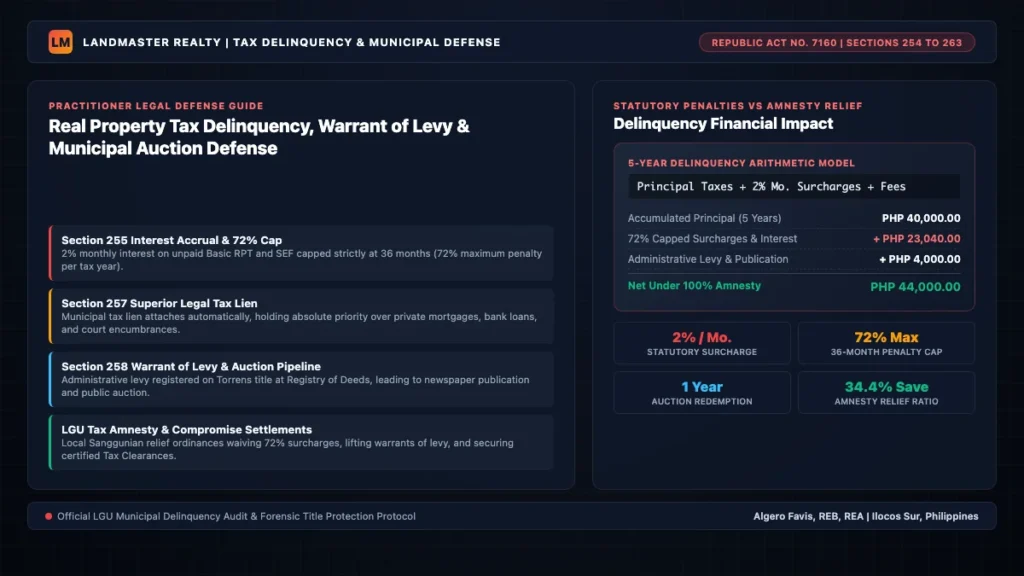
- Statutory Penalty Rate: Under Section 255 of Republic Act No. 7160, unpaid real property tax accrues an interest surcharge of two percent (2%) per month on the unpaid balance, applied simultaneously to both Basic Real Property Tax and the 1% Special Education Fund (SEF) levy.
- The 72% Statutory Interest Ceiling: Section 255 establishes a strict maximum penalty period of thirty-six (36) months. Consequently, accumulated interest is capped at exactly 72% of the delinquent tax due for any individual tax year. However, if taxes remain unpaid for multiple years, each annual assessment accrues its own separate 2% monthly penalty until that specific year reaches the 72% cap.
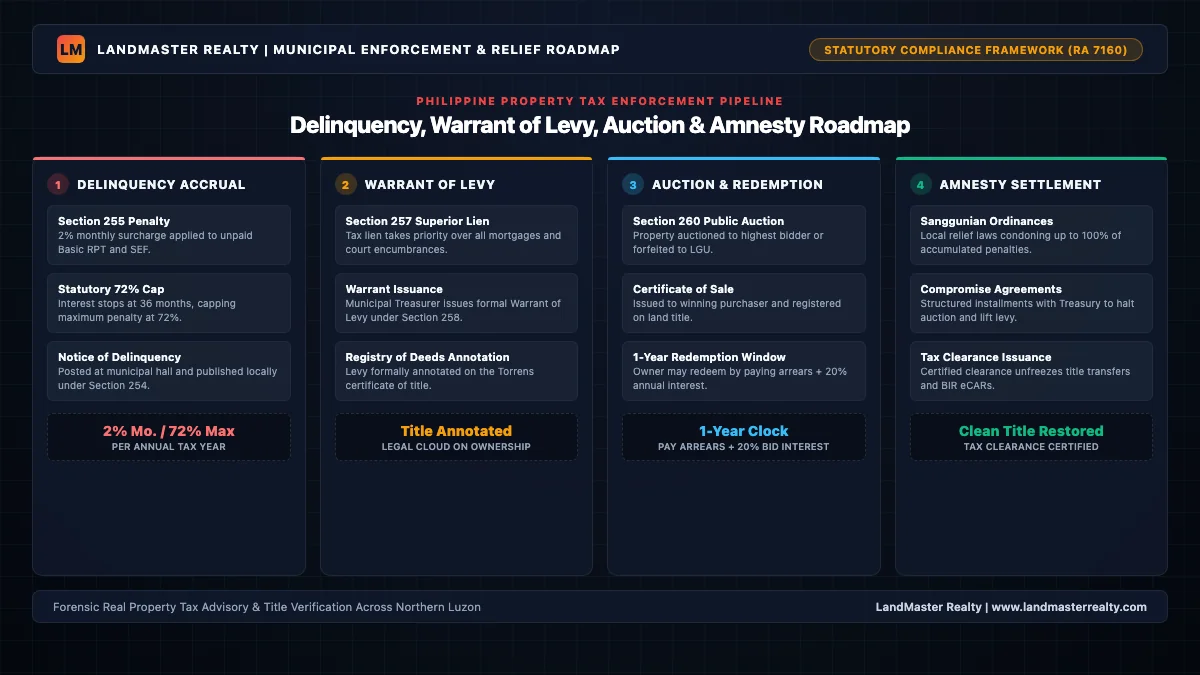
- Escalating Municipal Enforcement: Under Section 257, an automatic tax lien attaches to the property superior to all private mortgages and bank liens. Under Section 258, if taxes remain delinquent, the City or Municipal Treasurer issues a Warrant of Levy, annotates the seizure on the Torrens title at the Registry of Deeds, and advertises the property for public auction under Section 260.
- The 1-Year Statutory Redemption Window: If your land is sold at a municipal public auction, Section 261 grants the registered owner a strict one-year redemption period from the date the sale is annotated. To redeem, the owner must pay the delinquent taxes, accumulated penalties, administrative auction expenses, plus an onerous twenty percent (20%) annual interest on the winning auction bid price payable to the purchaser. Failure to redeem permanently forfeits ownership and cancels the original title.
- Amnesty and Compromise Defense: Property owners can resolve delinquencies by taking advantage of local Sanggunian tax relief ordinances (which often waive 100% of accumulated interest surcharges upon full payment of the principal) or by entering into a structured compromise settlement agreement with the municipal treasurer to pay arrears in installments and immediately lift warrants of levy.
If you have discovered unpaid back taxes or received a notice of levy on property in Northern Luzon, proactive intervention is essential. You can consult our dedicated Real Property Tax Payment and Delinquency Services or review our companion guide on how to pay real property tax online and at LGU municipal treasurers to understand standard payment schedules.
Statutory Mechanics of RPT Delinquency: Section 255 Local Government Code, 2% Monthly Interest, and the 72% Statutory Cap
To defend against property tax delinquency, one must first master the statutory language governing how interest surcharges accumulate. Real property taxation is an ad valorem assessment governed exclusively by Title II of the Local Government Code of 1991 (Republic Act No. 7160). Section 255 of this statute defines the exact financial consequences of late payment:
“In case of failure to pay the basic real property tax or any other tax levied under this Title upon the expiration of the periods as provided in Section 250, or when due, as the case may be, there shall be collected as part of the tax an interest at the rate of two percent (2%) per month on the unpaid amount or a fraction thereof, until the delinquent tax shall have been fully paid: Provided, however, That in no case shall the total interest on the unpaid amount or a portion thereof exceed thirty-six (36) months.”
This statutory provision contains four critical legal principles that govern every municipal tax bill across the Philippines:
1. Application to Both Basic RPT and the Special Education Fund (SEF)
As established under Sections 233 and 235 of RA 7160, every property tax assessment consists of two mandatory components: the Basic Real Property Tax (1% in provinces, up to 2% in chartered cities) and the Special Education Fund levy (a uniform 1% ad valorem tax). Because Section 255 explicitly applies to the basic tax and “any other tax levied under this Title,” the 2% monthly interest penalty applies to both levies simultaneously. If your annual tax obligation is PHP 10,000 (comprising PHP 5,000 Basic RPT and PHP 5,000 SEF), a one-month delinquency generates a 2% penalty on the full PHP 10,000, resulting in a PHP 200 monthly surcharge.
2. Monthly Accrual Without Compounding on Surcharges
The 2% monthly interest is simple interest applied to the principal delinquent tax due; it does not compound upon prior accrued interest. If a taxpayer owes PHP 10,000 in principal taxes, each month of delinquency adds exactly PHP 200 (2% of PHP 10,000). After 12 months, the accrued interest is exactly 24% (PHP 2,400). After 24 months, the accrued interest is exactly 48% (PHP 4,800).
3. The 36-Month Ceiling and the 72% Statutory Cap
The proviso in Section 255 establishes that “in no case shall the total interest on the unpaid amount or a portion thereof exceed thirty-six (36) months.” Mathematically, 36 months multiplied by 2% per month equals exactly seventy-two percent (72%). Once an annual tax bill remains unpaid for 36 months (three full calendar years), interest ceases to accrue on that specific year’s tax liability. Even if a property owner fails to pay that specific year for ten, twenty, or thirty years, the maximum interest penalty that the local government can legally collect on that year is 72% of the original principal.
In our practice in Ilocos Sur, we frequently encounter municipal assessment clerks who inadvertently apply arbitrary multipliers or calculate interest beyond 36 months when dealing with decades-old family arrears. Knowing the statutory 72% cap protects landowners from paying unauthorized surcharges during treasury reconciliation.
4. The Multi-Year Arrears Stacking Principle
A critical trap that ensnares many taxpayers is assuming that the 72% cap applies to the property’s entire historical debt. This assumption is false. Real property tax is an annual obligation that accrues on the first day of January of each calendar year under Section 246 of RA 7160. Therefore, each tax year operates as an independent, distinct tax liability with its own 36-month interest timeline.
Consider a parcel that has been delinquent for five consecutive years (Year 1 through Year 5):
- Year 1: Delinquent for 60 months. Interest is capped at 36 months (72%).
- Year 2: Delinquent for 48 months. Interest is capped at 36 months (72%).
- Year 3: Delinquent for 36 months. Interest is capped at 36 months (72%).
- Year 4: Delinquent for 24 months. Accrued interest is 48% (2% x 24 months).
- Year 5: Delinquent for 12 months. Accrued interest is 24% (2% x 12 months).
Because each year stacks independently, a five-year delinquency on an annual tax of PHP 10,000 results in PHP 50,000 of principal taxes plus PHP 28,800 in accumulated interest surcharges, bringing the total gross tax liability to PHP 78,800 before administrative fees. Understanding this stacking principle is essential for auditing municipal billing statements.
The Escalating Enforcement Pipeline: Section 257 Tax Liens, Section 258 Warrants of Levy, and Municipal Auction Procedures
Local government units do not merely wait for delinquent taxpayers to settle voluntarily. The Local Government Code arms provincial, city, and municipal treasurers with aggressive administrative remedies to enforce collection. Sections 256 through 260 establish a rigid enforcement pipeline designed to convert delinquent land into municipal revenue.
1. The Superior Legal Tax Lien (Section 257)
The moment real property tax becomes delinquent, a superior legal tax lien attaches automatically to the property by operation of law. Section 257 of RA 7160 defines the legal power of this lien:
“The basic real property tax and any other tax levied under this Title constitutes a lien on the property subject to tax, superior to all liens, charges or encumbrances in favor of any person, irrespective of the owner or possessor thereof, enforceable by administrative or judicial action, and may only be extinguished upon payment of the tax and the related interests and expenses.”
In Philippine jurisprudence, as affirmed by the Supreme Court in National Housing Authority v. Commission on Settlement of Land Problems (G.R. No. 142601), the municipal real property tax lien enjoys absolute priority over private mortgages, bank loans, mechanic liens, attachment orders, and judicial judgments. Even if a commercial bank holds a registered first mortgage on a parcel of land, the local government tax lien primes that mortgage. A private sale, donation, or mortgage foreclosure cannot extinguish the municipal tax lien; only full settlement of the delinquent taxes, interest, and costs can release the property.
2. Notice of Delinquency (Section 254)
When real property tax becomes delinquent, the local treasurer is legally mandated under Section 254 to post a Notice of Delinquency at the main entrance of the provincial capitol, city hall, or municipal building, as well as in a publicly accessible and conspicuous place in each barangay where the delinquent properties are situated. Furthermore, the notice must be published in a newspaper of general circulation in the province or city once a week for two consecutive weeks.
The Notice of Delinquency specifies the date on which taxes became delinquent and warns property owners that unless the tax and penalties are paid within thirty (30) days from publication, the administrative remedies of levy and auction will be executed against the property.
3. Issuance and Registration of the Warrant of Levy (Section 258)
If the delinquency is not settled following the publication period, Section 258 empowers the provincial, city, or municipal treasurer to issue a formal Warrant of Levy on the real property. The execution of a Warrant of Levy follows a strict statutory protocol:
- Issuance of Warrant: The treasurer issues a formal warrant describing the property (Property Identification Number, Tax Declaration number, Transfer Certificate of Title number, and boundaries) and stating the total amount of delinquent taxes and penalties due.
- Service of Notice: The warrant must be mailed to or served directly upon the delinquent owner or the person having legal custody of the property. If the owner cannot be found at their last known address, service is effected by leaving a copy with the occupant or posting it conspicuously upon the real property.
- Registry of Deeds Annotation: The treasurer officially files the Warrant of Levy with the Registrar of Deeds of the province or city where the land is located. The Registrar of Deeds is legally obligated to annotate the Warrant of Levy upon the original Transfer Certificate of Title (TCT) or Original Certificate of Title (OCT) and its memorandum of encumbrances, as well as on the municipal tax declaration roll.
- Report to Sanggunian: The levying officer must submit a formal written report on the levy to the local Sanggunian within ten (10) days after service.
Once annotated on the Torrens title, the Warrant of Levy creates a formidable legal cloud. The owner cannot sell, mortgage, subdivide, or transfer the land, and any prospective buyer conducting title due diligence will immediately halt the transaction.
4. Conduct of Public Auction Sales (Section 260)
Within thirty (30) days after the service of the Warrant of Levy, the local treasurer proceeds to advertise the property for public auction. Section 260 governs the auction procedure:
- Public Notice: The treasurer posts a notice of sale at the main entrance of the provincial, city, or municipal building and in a conspicuous location in the barangay where the land is located. The notice must also be published once a week for two consecutive weeks in a newspaper of general circulation in the province or city.
- Public Bidding: The auction is conducted at public bidding at the municipal hall. The property is awarded to the highest bidder whose cash offer is sufficient to satisfy the delinquent tax, penalties, and administrative auction expenses.
- Certificate of Sale: Following the auction, the treasurer delivers a formal Certificate of Sale to the winning bidder, which details the property, the purchase price, and the date of the auction sale. The Certificate of Sale is subsequently registered with the Registry of Deeds and annotated upon the memorandum of encumbrances of the title.
- Purchase by the Local Government Unit (Section 263): In provincial municipalities where private bidders do not participate, Section 263 provides that the treasurer shall purchase the property on behalf of the local government unit for the exact amount of the delinquent taxes, penalties, and costs. The title is then subject to municipal forfeiture.
The 1-Year Statutory Redemption Window: Legal Rights under Section 261, Penalty Payoff Math, and Avoiding Title Forfeiture
Many property owners mistakenly believe that the moment the municipal auction gavel falls, their ownership of the land is permanently extinguished. This is legally incorrect. To safeguard private property rights against administrative forfeiture, the Local Government Code establishes a mandatory redemption period under Section 261.
The 1-Year Statutory Clock
Under Section 261 of RA 7160, the registered owner, their legal heirs, or any person having a legal interest in the property (such as a mortgagee or tenant) has the statutory right to redeem the delinquent property within exactly one (1) year from the date the auction sale is registered with the Registry of Deeds. During this one-year period, the registered owner remains in legal possession of the property and retains the right to enjoy its fruits and agricultural harvest.
The Financial Arithmetic of Redemption
While the right of redemption exists, exercising it is financially punitive. Section 261 prescribes the exact formula that a redeeming property owner must pay to the local treasurer to nullify the auction sale:
STATUTORY REDEMPTION PAYOFF FORMULA (SECTION 261):
Total Redemption Amount = [Delinquent Principal Taxes]
+ [Accrued 2% Monthly Interest from Delinquency to Sale Date (up to 72% cap)]
+ [Administrative Costs of Warrant of Levy, Publication, and Sale]
+ [Interest of 2% Per Month (24% Per Annum) on the Purchase Price from Sale Date to Redemption Date]
Notice the critical addition: the redeeming owner must pay a mandatory interest surcharge of two percent (2%) per month (which compounds to 24% over a full year) directly on the purchase price paid by the auction winner. If an investor purchased a delinquent parcel at auction for PHP 100,000 and the owner redeems exactly twelve months later, the owner must pay the PHP 100,000 bid price plus an additional PHP 24,000 in interest to the winning bidder, in addition to reimbursing all municipal costs.
The treasurer holds the purchase price and the accrued 20% to 24% interest in trust, remitting the funds directly to the purchaser upon formal redemption.
Legal Consequences of Non-Redemption (Section 262)
If the one-year redemption period expires without the registered owner or their heirs paying the required redemption sum, the forfeiture becomes absolute. Section 262 mandates that the local treasurer execute a final Deed of Conveyance in favor of the purchaser (or in favor of the local government unit if purchased under Section 263).
The purchaser then files a formal petition in the Regional Trial Court (RTC) under Section 107 of Presidential Decree No. 1529 (the Property Registration Decree) for the court-ordered cancellation of the delinquent owner’s Owner Duplicate Certificate of Title. Upon judicial approval, the Registry of Deeds cancels the original Torrens title and issues an entirely new Transfer Certificate of Title in the name of the auction purchaser. At that point, the original owner’s legal rights are permanently extinguished, and the purchaser can obtain a judicial writ of possession to physically eject the former owner from the premises.
Navigating auction redemption requires urgent legal and operational coordination. If your property is involved in title disputes or facing encumbrances, review our comprehensive analysis on how to read a title memorandum of encumbrances and understand your legal options.
Municipal Tax Amnesties and Penalty Condonation: How Local Ordinances Work, Eligibility Rules, and Timing Windows
For property owners burdened by decades of compounded interest surcharges, the most powerful financial relief mechanism is a municipal tax amnesty, formally known as a penalty condonation ordinance. However, navigating tax amnesties requires understanding the strict boundary between national and local tax laws.
National Amnesties vs Local LGU Tax Amnesties
A frequent error among property owners is confusing national tax amnesties enacted by the Philippine Congress with municipal property tax relief enacted by local city and provincial councils:
- National Tax Amnesties (e.g., Estate Tax Amnesty under RA 11956): Enacted by the Congress of the Philippines and administered by the Bureau of Internal Revenue (BIR). RA 11956 applies exclusively to national internal revenue taxes, specifically the estate tax owed on deceased persons’ assets. A national estate tax amnesty does not forgive a single peso of delinquent municipal real property tax. For guidance on national estate settlement, consult our dedicated guide on Estate Tax Amnesty in the Philippines under RA 11956.
- Local Government Tax Amnesties (LGU Relief Ordinances): Enacted by the Sanggunian Panlalawigan (provincial board) or Sanggunian Panlungsod (city council) under their general taxing powers granted by Section 192 and Section 276 of the Local Government Code. These local ordinances apply exclusively to Basic Real Property Tax and the Special Education Fund levy administered by the municipal or city treasurer.
How Penalty Condonation Ordinances Operate
Under Section 276 of RA 7160, the Sanggunian concerned may, by ordinance, condone or reduce the real property tax and interest for any year in case of general failure of crops, substantial decrease in commodity prices, or public calamity. In addition, local councils routinely enact general tax relief and amnesty ordinances to encourage delinquent property owners to voluntarily update their accounts and boost municipal treasury collections.
A typical local tax amnesty ordinance provides the following relief structure:
- 100% Interest Condonation: The ordinance waives 100% of all accumulated 2% monthly surcharges (including the 72% statutory caps) provided that the taxpayer pays the entire principal amount of unpaid Basic RPT and SEF in a single lump-sum payment during the amnesty window.
- Tiered Discount Schedules: Some ordinances provide tiered relief: for example, 100% penalty waiver if paid within the first 60 days, 75% waiver if paid within 90 days, and 50% waiver if paid within 120 days.
- Compromise Installment Agreements: Many ordinances permit taxpayers with large arrears to enter into a structured compromise settlement agreement with the city or municipal treasurer, allowing the principal balance to be paid across 6, 12, or 24 monthly installments, with penalties condoned conditionally upon successful completion of the payment schedule.
- Immediate Lifting of Warrants: Upon entering into an approved compromise agreement or paying under an active amnesty ordinance, the treasurer issues an official order to lift and cancel any registered Warrant of Levy, removing the property from the municipal auction list.
How to Monitor and Verify Active LGU Amnesties
Because municipal tax amnesties are enacted by local ordinances rather than national statutes, they are not published in national broadsheets. In Ilocos Sur, amnesties are typically announced through Sanggunian Panlalawigan resolutions, posted on municipal bulletin boards in towns such as Vigan, Bantay, Candon, and Narvacan, or broadcast via local radio and official LGU social media pages. Engaging local licensed real estate professionals who maintain daily operational contact with provincial treasuries is the most effective way to identify active amnesty windows before they expire.
Step-by-Step Settlement Protocol: Auditing Arrears at the Municipal Treasury, Negotiating Compromise Agreements, and Securing Tax Clearance
Clearing a multi-year real property tax delinquency requires a structured, multi-counter treasury walkthrough. Navigating this process without professional preparation often leads to incorrect penalty calculations or uncredited payments. Follow this battle-tested practitioner protocol:
Step 1: Assembly of Property Documentation
Before visiting the municipal hall, assemble the complete documentary docket for the parcel:
- Certified True Copy of the Transfer Certificate of Title (TCT) or Original Certificate of Title (OCT) from the Registry of Deeds.
- Latest official Tax Declaration from the Municipal Assessor Office.
- Last issued official receipt (Accountable Form No. 56) or prior Certificate of Tax Clearance, if available.
- Valid government-issued identification of the registered owner or estate administrator.
- If representing the owner: a notarized Special Power of Attorney (SPA) or consularized/apostilled SPA if the owner resides abroad. For detailed SPA drafting rules, review our practitioner guide on Special Power of Attorney for OFW property transactions.
Step 2: Municipal Assessor Roll Audit and Ledger Verification
Proceed to Counter 1 at the Municipal Assessor Office. Request an official verification of the Property Identification Number (PIN) and confirm that the tax declaration has not been cancelled, superseded, or transferred. Verify the property classification (residential, agricultural, commercial) and the official Fair Market Value. Obtain an updated certified copy of the Tax Declaration.
Step 3: Treasury Land Tax Division Assessment and Calculation Audit
Proceed to Counter 2 at the Land Tax Division of the Municipal Treasurer Office. Request a formal Statement of Account detailing all historical arrears. Conduct an on-the-spot mathematical audit of the billing sheet:
- Verify that the principal tax due matches the statutory formula: Assessed Value multiplied by the combined Basic RPT and SEF rate.
- Audit the interest surcharges: ensure that the 2% monthly penalty is capped at exactly 72% for any tax year that has been delinquent for more than 36 months under Section 255.
- Check whether an active Sanggunian tax amnesty ordinance applies to your property, and verify that the condonation discount is correctly deducted from the billing summary.
Step 4: Negotiation of Compromise Settlement Agreement
If the accumulated arrears are substantial and you cannot pay the full balance immediately, request an audience with the Municipal Treasurer or the Chief of the Land Tax Division to apply for a Compromise Settlement Agreement. Submit a formal written proposal requesting:
- A structured monthly installment payment plan across 6 to 12 months.
- A conditional waiver or reduction of penalties upon adherence to the installment schedule.
- The immediate issuance of an administrative suspension halting any pending Warrant of Levy or scheduled public auction.
Step 5: Payment Execution and Accountable Form No. 56 Validation
Proceed to Counter 3 (Treasury Cashier). Settle the agreed payment in cash or via bank manager check payable directly to the City or Municipal Treasurer. Ensure that the cashier issues an official, machine-validated receipt on Accountable Form No. 56. Verify that each tax year settled is explicitly stamped and listed on the face of the receipt.
Step 6: Cancellation of Warrant of Levy and Certificate of Tax Clearance
Proceed to Counter 4 (Clearance and Certification Section). If a Warrant of Levy was previously registered against the property, submit the validated Accountable Form No. 56 receipts and obtain a formal Order of Lifting and Cancellation of Warrant of Levy signed by the Treasurer. File this cancellation order with the Registry of Deeds to remove the encumbrance from the Torrens title. Finally, request an official, dry-sealed Certificate of Tax Clearance certifying that all real property taxes on the parcel are fully paid up to the current calendar year.
Worked Financial Model: 5-Year Delinquency Arithmetic for Provincial Land (Gross Surcharges vs Net Amnesty Savings)
To illustrate how statutory penalties accumulate in practice and quantify the financial impact of a municipal tax amnesty, let us examine a realistic provincial case study modeled on a residential parcel located in Ilocos Sur.
The Property Profile
- Location: Metro Vigan area, Ilocos Sur
- Property Classification: Residential Land
- Land Area: 500 square meters
- Schedule of Fair Market Values (SFMV): PHP 4,000 per square meter
- Total Fair Market Value (FMV): PHP 2,000,000.00
- Statutory Assessment Level (Section 218): 20%
- Taxable Assessed Value (AV): PHP 400,000.00 (PHP 2,000,000 x 20%)
- Combined Tax Rate: 2.0% (1.0% Basic Provincial RPT + 1.0% SEF)
- Base Annual Tax Obligation: PHP 8,000.00 per year (PHP 400,000 x 2.0%)
- Delinquency Period: Five (5) consecutive calendar years (Year 1 through Year 5)
- Administrative Enforcement Status: Warrant of Levy issued, published in local circulation
Line-by-Line Gross Delinquency Calculation (Without Amnesty)
Under Section 255 of RA 7160, each of the five delinquent tax years accrues its own separate interest calculation up to the 36-month (72%) statutory ceiling:
| Delinquent Tax Year | Principal Tax Due | Months Elapsed | Statutory Penalty Rate | Accrued Interest | Total Year Obligation |
|---|---|---|---|---|---|
| Year 1 (Oldest Arrears) | PHP 8,000.00 | 60 months | 72.0% (36-mo. Cap) | PHP 5,760.00 | PHP 13,760.00 |
| Year 2 | PHP 8,000.00 | 48 months | 72.0% (36-mo. Cap) | PHP 5,760.00 | PHP 13,760.00 |
| Year 3 | PHP 8,000.00 | 36 months | 72.0% (36-mo. Cap) | PHP 5,760.00 | PHP 13,760.00 |
| Year 4 | PHP 8,000.00 | 24 months | 48.0% (2% x 24 mos) | PHP 3,840.00 | PHP 11,840.00 |
| Year 5 (Current Arrears) | PHP 8,000.00 | 12 months | 24.0% (2% x 12 mos) | PHP 1,920.00 | PHP 9,920.00 |
| Subtotal: Taxes & Penalties | PHP 40,000.00 | — | — | PHP 23,040.00 | PHP 63,040.00 |
| Administrative Levy Service, Publication & Registration Fees | PHP 4,000.00 | ||||
| TOTAL GROSS DELINQUENT LIABILITY (WITHOUT AMNESTY) | PHP 67,040.00 | ||||
Net Negotiated Liability Under an Active LGU Tax Amnesty Ordinance
Now, let us examine the financial outcome if the property owner avails of an active municipal tax amnesty ordinance enacted by the local Sanggunian that provides a 100% condonation of accumulated penalties upon full settlement of principal arrears:
FINANCIAL AUDIT COMPARISON:
- Gross Total Delinquent Debt (Without Amnesty): PHP 67,040.00
- Total Principal Tax Due (5 Years): PHP 40,000.00
- Waived Statutory Interest Surcharges (100% Amnesty Relief): – PHP 23,040.00
- Mandatory Administrative Levy & Publication Fees: + PHP 4,000.00
- NET CASH REQUIRED TO SETTLE UNDER AMNESTY: PHP 44,000.00
- TOTAL DIRECT CASH SAVINGS: PHP 23,040.00 (34.4% Net Debt Reduction)
By monitoring municipal legislative calendars and executing an amnesty settlement, the landowner permanently saves PHP 23,040.00 in cash, completely dissolves the municipal tax lien, lifts the registered Warrant of Levy, and secures a pristine Certificate of Tax Clearance.
Delinquent Inherited Land and Title Transfer Clearance: Unfreezing BIR eCARs and Estate Settlement Blockers
In our daily brokerage and title transfer practice at LandMaster Realty, the single most common cause of real property tax delinquency is undivided ancestral inheritance. When the matriarch or patriarch of a Filipino family passes away, heirs frequently continue using the family home or agricultural land without executing a formal estate settlement. Over ten, twenty, or thirty years, property tax receipts are lost, payments lapse, and municipal assessments fall decades behind.
The Section 247 Administrative Bar
When the surviving heirs finally decide to partition the estate, sell the property, or transfer the land into their own names, they encounter a complete administrative freeze. Section 247 of Republic Act No. 7160 imposes a strict statutory prohibition on property transfers:
“The Registrar of Deeds shall not register any document transferring, encumbering or altering the title to real property unless the certificate of the provincial, city or municipal treasurer, stating that all taxes due thereon have been paid, is presented.”
This statutory bar cascades across all government agencies involved in property conveyancing:
- Bureau of Internal Revenue (BIR): To process an Extrajudicial Settlement of Estate and issue the mandatory electronic Certificate Authorizing Registration (eCAR), Revenue District Offices strictly require a certified true copy of the latest Tax Declaration and an official Certificate of Tax Clearance issued by the municipal treasurer. Without tax clearance, the BIR will not compute estate taxes or issue the eCAR. For a detailed breakdown of this process, review our guide on BIR eCAR requirements and processing.
- Registry of Deeds (RD): Even if heirs hold a notarized extrajudicial settlement and a BIR eCAR, the Registrar of Deeds will summarily reject the registration of the title transfer under Section 247 unless accompanied by a certified Tax Clearance dated within the current quarter.
- Municipal Assessor Office: The assessor will not cancel the deceased owner’s tax declaration or issue new tax declarations in favor of the heirs until all historical tax ledgers are reconciled with the treasury.
The Estate Reconciliation Protocol
To unfreeze an inherited estate burdened by decades of tax delinquency, heirs must execute a synchronized legal and treasury protocol:
- Audit Physical Treasury Ledgers: In older provincial municipalities across Ilocos Sur, tax records from the 1980s and 1990s are preserved in physical leather-bound ledgers rather than digital databases. Retaining experienced local practitioners to trace historical ledger books ensures that payments made by deceased ancestors are properly credited.
- Reconcile Tax Declarations with Land Titles: Ancestral land often carries discrepancy between the area stated on the Torrens title and the area listed on the tax declaration. Discrepancies must be reconciled with the assessor before final tax billing. For guidance on resolving document mismatches, consult our comprehensive guide on Tax Declaration versus Land Title in the Philippines.
- Execute Extrajudicial Settlement Documentation: Coordinate the settlement of delinquent taxes simultaneously with the drafting and notarization of the Deed of Extrajudicial Settlement and newspaper publication. Review our practitioner guides on Extrajudicial Settlement of Estate and Title Transfer and Partition of Property Services to understand estate distribution rules.
Remote Delinquency Defense Protocol for OFWs and Absentee Heirs: Retaining LandMaster Advisory Representation
Overseas Filipino Workers (OFWs), Filipino immigrants residing abroad, and domestic landowners living outside their home provinces face disproportionate legal exposure to municipal property tax auctions. Living thousands of miles away, absentee owners cannot physically monitor local bulletin boards, check municipal mailboxes, or read provincial newspapers where Notices of Delinquency and Warrants of Levy are published.
Furthermore, relying on well-meaning relatives or unaccredited fixers often results in disaster. In many cases we handle, relatives report that taxes are being paid annually, but upon treasury inspection, we discover that receipts are unvalidated, payments were unremitted, or funds were diverted, leaving the property facing imminent auction.
The 4-Pillar LandMaster Remote Defense Framework
To protect overseas Filipinos and absentee heirs from property forfeiture, LandMaster Realty provides an end-to-end, remote tax audit and municipal defense service across Ilocos Sur and Northern Luzon:
Pillar 1: Forensic Municipal Tax Roll Audit
Our team visits the Municipal Assessor and Treasurer offices in person. We cross-reference your Torrens title number, Property Identification Number (PIN), and historical tax declarations against master tax rolls to establish the exact, certified status of your account, identifying any pending warrants of levy or auction schedules.
Pillar 2: Section 255 Penalty Recalculation and Amnesty Matching
We audit the municipal billing statement line by line, ensuring that interest penalties comply strictly with the 36-month (72%) statutory ceiling. We actively monitor provincial Sanggunian Panlalawigan and municipal Sanggunian Bayan legislative records to identify active or upcoming tax amnesty ordinances that condone accumulated interest.
Pillar 3: Formal In-Person Representation and Compromise Negotiation
Operating under a formal Special Power of Attorney (SPA), our licensed brokers and appraisers represent you directly before the City or Municipal Treasurer. We negotiate formal compromise installment agreements to immediately suspend auction proceedings and remove your property from municipal delinquency rosters.
Pillar 4: Treasury Cashier Settlement and Certified Document Dispatch
We execute payments directly with the treasury cashier, securing machine-validated Accountable Form No. 56 official receipts. If a levy was registered, we obtain and file the formal cancellation of levy with the Registry of Deeds. Finally, we secure the certified Certificate of Tax Clearance and courier the original sealed documents directly to your residence abroad via secure international courier.
With professional local representation, overseas property owners can completely resolve decades of back taxes, protect ancestral landholdings, and maintain clean Torrens titles without the expense and inconvenience of flying home to the Philippines. Learn more about retaining our team through our comprehensive Tax Payment and Municipal Compliance Services.
Master Real Property Tax Delinquency, Penalty Schedule, and Enforcement Action Matrix Table
The following master reference matrix synthesizes the complete statutory lifecycle of real property tax delinquency in the Philippines, mapping timeframes, legal references under Republic Act No. 7160, financial penalties, municipal enforcement remedies, and recommended owner defense strategies:
| Delinquency Stage | Elapsed Timeframe | Statutory Reference | Financial Penalty Rate | Municipal Enforcement Remedy | Owner Defense Strategy |
|---|---|---|---|---|---|
| 1. Prompt Payment Window | Before Jan 1 or on/before Mar 31 | Section 250 & Section 251 | 0% Penalty (10% to 20% Prompt Discount) | None (Regular treasury collection) | Pay annual lump-sum in advance to capture maximum statutory discount. |
| 2. Initial Delinquency | 1 to 12 Months | Section 255 | 2% per month (up to 24% annual interest) | Billing statement reminders issued; interest accrual | Settle immediately at treasury to stop monthly 2% interest accrual. |
| 3. Statutory Cap Reached | 36 Months (3 Years) | Section 255 Proviso | 72.0% Maximum Statutory Interest Cap | Interest stops on specific year; account flagged delinquent | Audit billing statement to ensure interest does not exceed 72% for that year. |
| 4. Automatic Tax Lien | Upon delinquency | Section 257 | Continuing statutory interest surcharges | Superior legal lien attaches; primes all private mortgages | Resolve taxes prior to mortgage transactions or title conveyancing. |
| 5. Notice of Delinquency | Prior to levy | Section 254 | Interest plus municipal publication expenses | Posted at municipal building; published in newspaper | File written notice of intent to settle within 30-day publication window. |
| 6. Warrant of Levy | After notice period expires | Section 258 | Interest + levy fees + registration expenses | Levy served on owner; annotated on Torrens title at RD | Apply for LGU tax amnesty or execute compromise agreement to lift levy. |
| 7. Public Auction Sale | Within 30 days of levy | Section 260 | Full delinquent balance + costs | Property auctioned to highest bidder; Certificate of Sale issued | Attend auction or tender full settlement prior to opening of bids. |
| 8. Statutory Redemption | Within 1 Year from Sale Registration | Section 261 | Arrears + costs + 20% to 24% interest on auction bid price | Owner retains possession; redemption payment held in trust | Pay full redemption sum to treasurer before the 1-year deadline expires. |
| 9. Final Forfeiture | Upon expiration of 1 Year | Section 262 & PD 1529 Sec 107 | Total loss of property equity and ownership | Final Deed executed; court cancels owner title; new TCT issued | Redemption barred by law; legal remedy restricted to action for damages. |
| 10. Municipal Tax Amnesty | During enacted LGU relief window | Section 192 & Section 276 | Up to 100% Condonation of Accumulated Interest | Halts public auction; lifts warrants of levy; restores clean record | Settle principal in full or enter compromise agreement during active window. |
Frequently Asked Questions About Real Property Tax Delinquency and Amnesty in the Philippines
1. What is the maximum penalty for unpaid real property tax in the Philippines?
Under Section 255 of Republic Act No. 7160 (the Local Government Code of 1991), delinquent real property tax accrues interest at the rate of two percent (2%) per month on the unpaid balance. However, the law imposes a strict statutory ceiling: the interest penalty cannot exceed thirty-six (36) months, capping the maximum accumulated interest at exactly seventy-two percent (72%) for any individual tax year. If property taxes remain unpaid across multiple years, each year stacks independently, accruing its own 2% monthly interest until it reaches its individual 72% cap.
2. Can the municipal government confiscate my titled land for unpaid property taxes?
Yes. Under Sections 256 through 260 of the Local Government Code, local government units possess the statutory power to enforce tax collection through administrative levy and public auction. If taxes remain delinquent after notice, the City or Municipal Treasurer issues a Warrant of Levy, annotates the levy on the Torrens title at the Registry of Deeds, and advertises the property for public auction. If the property is not redeemed within one year following the auction sale, the treasurer issues a final deed of conveyance, the court cancels the original owner’s title under Section 107 of PD 1529, and a new Torrens title is issued to the winning bidder or the local government unit.
3. How can property owners find out if an LGU tax amnesty is currently active?
Because municipal tax amnesties are enacted through local Sanggunian Panlalawigan (provincial board) or Sanggunian Panlungsod/Bayan (city/municipal council) ordinances rather than national legislation, they are not published in nationwide broadsheets. Property owners can verify active relief ordinances by contacting the Land Tax Division of the Municipal Treasurer Office where the property is located, inspecting official municipal bulletin boards, checking local government websites, or engaging licensed local real estate brokers and property tax consultants who regularly monitor provincial legislative enactments.
4. What happens if a property is sold at a municipal tax auction?
A tax auction sale does not immediately strip the owner of possession. Under Section 261 of RA 7160, the registered owner or their legal heirs have a strict one-year redemption period starting from the date the auction sale is registered with the Registry of Deeds. During this period, the owner retains physical possession. To redeem the land and cancel the sale, the owner must pay the delinquent taxes, accrued penalties, administrative expenses, plus an additional interest surcharge of twenty percent (20%) per annum on the winning auction bid price payable directly to the purchaser.
5. Can I transfer a land title if there are unpaid real property taxes?
No. Under Section 247 of Republic Act No. 7160, the Registrar of Deeds is strictly prohibited from registering any deed of absolute sale, deed of donation, extrajudicial settlement of estate, or any document transferring or encumbering real property without a certified Certificate of Tax Clearance from the local treasurer. Furthermore, the Bureau of Internal Revenue (BIR) will not process or issue an electronic Certificate Authorizing Registration (eCAR) without verifying that all local real property taxes are fully paid up to the current calendar year.
6. How can Overseas Filipino Workers (OFWs) settle delinquent property taxes remotely?
Overseas Filipino Workers and non-resident heirs can resolve property tax delinquencies safely without traveling back to the Philippines by executing a notarized and apostilled Special Power of Attorney (SPA) appointing a licensed real estate broker or trusted representative in the Philippines. The authorized representative conducts an in-person tax roll audit at the municipal hall, verifies whether active tax amnesties or compromise settlement plans apply, pays the treasurer directly, secures validated Accountable Form No. 56 receipts, lifts any registered warrants of levy, and obtains a certified Certificate of Tax Clearance.
Professional Real Property Tax Delinquency Audit and Municipal Compliance Services
Resolving multi-year real property tax delinquencies, auditing provincial assessment rolls, negotiating structured compromise agreements with municipal treasurers, and lifting warrants of levy requires specialized statutory expertise and trusted local presence. Founded in 2023 and based in Ilocos Sur, LandMaster Realty provides comprehensive real estate brokerage, appraisal, and transaction advisory services across Northern Luzon.
Whether you need to audit decades of unpaid taxes on an undivided ancestral estate in Vigan City, halt a pending municipal auction in Bantay, verify statutory penalty caps on commercial acreage in Candon, or secure a certified Certificate of Tax Clearance for a title transfer, our licensed professionals represent your interests with rigor, precision, and complete transparency.
Resolve Your Property Tax Delinquency and Protect Your Title
Do not allow compounded penalties or administrative warrants of levy to endanger your Torrens title. Leverage municipal tax amnesties, enforce statutory 72% penalty caps, and secure certified tax clearances with licensed real estate professionals in Northern Luzon.


