Across the provinces of Northern Luzon, particularly in Ilocos Sur, one of the most common real estate inquiries we receive at LandMaster Realty involves untitled properties: “Attorney, may Tax Declaration po ako. Pwede ko na po bang ibenta o tayuan ng bahay? Pareho lang ba ito sa titulo?” Provincial buyers often encounter expansive rural parcels, beachfront agricultural lands, or residential lots offered at steep discounts simply because the seller holds only a municipal Tax Declaration rather than a Torrens certificate of title. Many buyers assume that paying municipal real property taxes for several decades grants automatic legal ownership. Others believe that converting a tax declaration into an official Torrens land title is a quick, rubber-stamp administrative visit to the town hall. Both assumptions are legally unsound and financially dangerous.
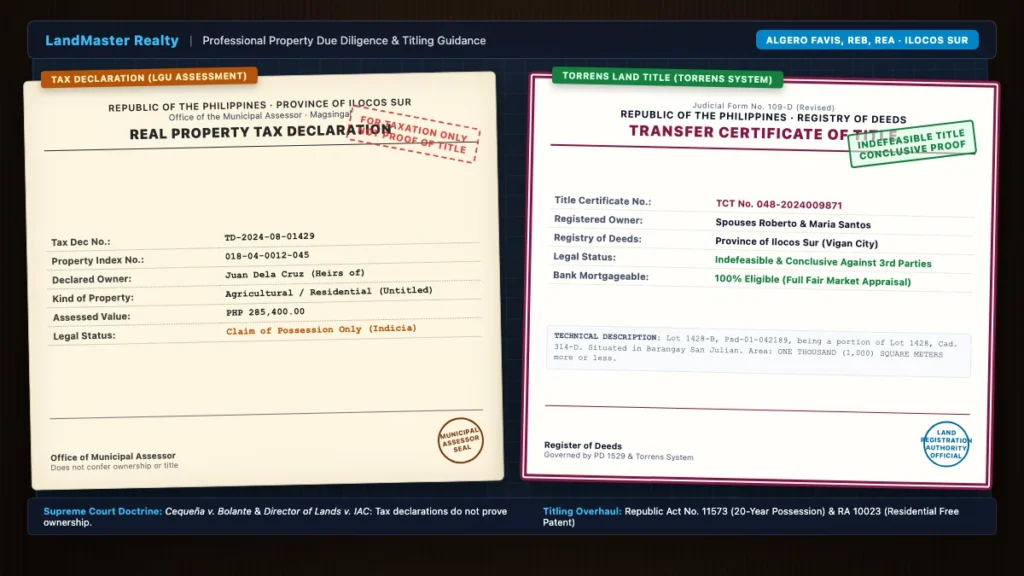
In Philippine property law, a Tax Declaration is fundamentally not a land title. Paying real property taxes to the municipal treasurer is merely evidence of an ongoing tax liability and an indicia of possessory claim. It does not establish indefeasible, government-guaranteed ownership. If you purchase real property supported solely by a Tax Declaration, you are not buying registered land. You are purchasing an imperfect, highly vulnerable possessory right that can be superseded, disputed by rival claimants, or invalidated if the parcel turns out to be part of the inalienable public forest reserve.
However, holding a Tax Declaration is not worthless. When backed by decades of continuous, peaceful possession, certified Alienable and Disposable (A&D) land classification, and an approved cadastral survey, a Tax Declaration serves as the primary evidentiary foundation for acquiring a government-guaranteed Torrens title. Furthermore, landmark legislative reforms, specifically the enactment of Republic Act No. 11573 in 2021 and the Residential Free Patent Act (Republic Act No. 10023), have dramatically modernized and streamlined the titling process in the Philippines. This comprehensive practitioner guide provides an exhaustive legal, financial, and operational analysis of the tax declaration vs land title philippines framework. As a licensed real estate broker and appraiser practicing in Ilocos Sur, I will walk you through binding Supreme Court doctrines, institutional differences, statutory titling pathways, rigorous buyer due diligence protocols, and concrete financial budgets to convert untitled provincial land into an indefeasible Torrens title.
Quick Answer: Is a Tax Declaration as Good as a Land Title in the Philippines?
No. A Tax Declaration is not as good as a Land Title, and the two documents cannot be equated under Philippine law. A Torrens certificate of title, whether an Original Certificate of Title (OCT) or a Transfer Certificate of Title (TCT), is conclusive, government-guaranteed evidence of absolute property ownership issued by the Registry of Deeds under Presidential Decree No. 1529. Once issued and uncontested after one year, a Torrens title becomes indefeasible and incontrovertible against the whole world.
In sharp contrast, a Tax Declaration is merely an administrative assessment record issued by the Municipal or City Assessor for real property taxation under Republic Act No. 7160. Settled Supreme Court jurisprudence (such as Cequeña v. Bolante, G.R. No. 137944) firmly establishes that tax declarations and real property tax receipts do not prove ownership of real property. They merely prove that the declarant has claimed possession of the land and is paying municipal taxes on it.
Here is how the two documents compare in real-world transactions:
- Collateral and Mortgages: Commercial banks, universal lending institutions, and the Pag-IBIG Fund strictly refuse to accept tax declarations as loan collateral. Only titled properties qualify for institutional mortgage financing.
- Security Against Overlapping Claims: Multiple tax declarations can be issued by the assessor for the exact same parcel of land to different disputing families, because assessors do not conduct land boundary surveys or resolve legal disputes. Torrens titles are protected by the Torrens System and the Mirror Doctrine, preventing double registration of the same lot.
- Market Pricing: Tax-declared parcels in the provincial market routinely suffer a 30% to 50% discount compared to titled properties in the same neighborhood, reflecting the legal risk, due diligence complexity, and substantial capital required to title the property.
- Can It Be Converted? Yes. A tax declaration can be converted into a Torrens title through two primary statutory pathways: administrative titling through CENRO under the Residential Free Patent Act (RA 10023) or judicial confirmation of imperfect title before the Regional Trial Court (RTC) under Republic Act No. 11573.
Legal Foundation: Why a Tax Declaration Does Not Prove Ownership
To safely navigate Philippine property transactions, one must understand why the legal community and the courts draw an unyielding line between tax assessments and registered titles. Many landowners mistakenly believe that paying real property tax (amilyar) at the Municipal Treasurer Office for twenty, thirty, or fifty consecutive years creates an unassailable right of ownership. Under Philippine property law, this belief is an illusion.
Supreme Court Doctrine: Indicia of Possession vs Conclusive Torrens Title
The Supreme Court of the Philippines has repeatedly and consistently ruled that tax declarations, assessment sheets, and tax receipts are not conclusive evidence of ownership. They are merely indicia of a claim of possession. This distinction was articulated with crystalline clarity in the landmark ruling of Cequeña v. Bolante (G.R. No. 137944, April 6, 2000):
“Tax declarations and receipts are not conclusive evidence of ownership. At most, they constitute mere prima facie proof of possession or claim of ownership of the property for which taxes have been paid. In the absence of actual, public, and adverse possession, the declaration of the property for tax purposes does not prove ownership.”
This doctrine was reinforced in Director of Lands v. Intermediate Appellate Court (G.R. No. 73246, March 2, 1992) and Republic v. Metro Index Realty and Development Corporation (G.R. No. 198585, July 2, 2014). In these decisions, the High Court held that paying realty taxes does not vest title upon a person. Tax records simply demonstrate that the declarant has manifested a desire to possess the property and assume tax liability before the local government unit. If a person possessing a Tax Declaration is challenged in court by someone holding a valid Torrens Certificate of Title covering the same land, the Torrens titleholder will almost invariably prevail, even if the titleholder has missed paying real property taxes for several years.
The Torrens System Principles: Indefeasibility and the Mirror Doctrine
The Philippines adopted the Torrens System of Land Registration under Act No. 496, later codified in Presidential Decree No. 1529 (The Property Registration Decree). The primary objective of the Torrens System is to establish perpetual stability, certainty, and finality in real estate ownership. It rests upon two foundational legal pillars:
- The Principle of Indefeasibility: Under Section 32 of Presidential Decree No. 1529, once a decree of registration is issued by a competent court and transcribed into the registration books of the Registry of Deeds, the certificate of title becomes indefeasible and incontrovertible upon the expiration of one (1) year from the date of issuance. No third party can later challenge the title on grounds of prior possession or unrecorded claims, absent direct proof of extrinsic fraud filed within that strict one-year window.
- The Mirror Doctrine: A prospective buyer or mortgagee dealing with titled property is legally entitled to rely solely on the face of the Torrens certificate of title. The buyer does not need to look beyond the title to investigate historical claims, unregistered possessory rights, or prior sales, provided the title contains no registered annotations or encumbrances and the buyer acts in good faith.
None of these legal protections apply to a Tax Declaration. An assessor tax roll does not operate under the Torrens System. If you buy land on a Tax Declaration, the Mirror Doctrine does not protect you. You inherit every legal defect, adverse possessory claim, boundary overlap, and hidden heir dispute that exists on the ground.
Tax Declaration vs Torrens Title Master Comparison Table
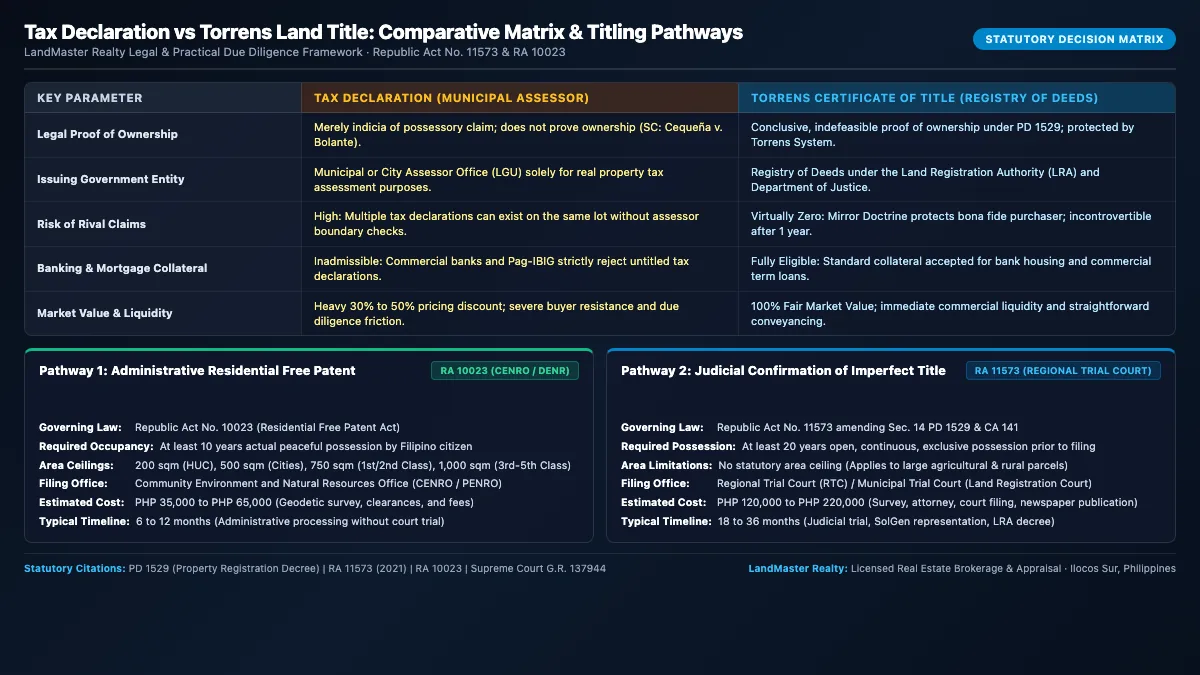
To clearly illustrate the structural differences between these two instruments, our brokerage team at LandMaster Realty has synthesized the legal, administrative, and economic attributes of both documents in the master comparison table below:
| Comparison Parameter | Tax Declaration of Real Property | Torrens Certificate of Title (OCT / TCT) |
|---|---|---|
| Governing Legislation | Local Government Code of 1991 (Republic Act No. 7160) | Property Registration Decree (Presidential Decree No. 1529) |
| Issuing Authority | Office of the Municipal or City Assessor (Local Government Unit) | Registry of Deeds (Land Registration Authority / Department of Justice) |
| Legal Purpose | Assessment and collection of Real Property Taxes (LGU revenue) | Definitive registration and judicial guarantee of land ownership |
| Evidentiary Value in Court | Prima facie indicia of possession; easily rebutted by superior proof | Conclusive, indefeasible proof of title against the entire world |
| Risk of Overlapping Claims | High: Assessors do not conduct boundary cross-matching; double declarations common | Virtually Zero: Rigorous LMB/LRA cadastral plotting prevents double registration |
| Bank Mortgage Eligibility | Ineligible: Commercial banks and Pag-IBIG strictly reject untitled land | 100% Eligible: Standard collateral for housing loans and credit lines |
| Market Value & Pricing | Sells at a 30% to 50% discount compared to titled market value | Commands 100% full Fair Market Value with high commercial liquidity |
| Conveyancing Instrument | Deed of Sale of Possessory Rights / Waiver of Rights | Deed of Absolute Sale conveying registered Torrens title |
| Cadastral Boundary Survey | Often relies on sketch plans or rough boundary descriptions | Strict technical description anchored on approved cadastral survey monuments |
The 30% to 50% Market Value Discount on Untitled Land
In our property valuation and appraisal practice across Ilocos Sur, we routinely observe that untitled land trades at a steep pricing discount of 30% to 50% relative to titled real estate in the same barangay. For instance, if titled residential lots along a national highway in Metro Vigan or Magsingal command 4,000 PHP per square meter, an adjacent tax-declared parcel with identical frontage and topography might struggle to fetch 2,200 PHP per square meter.
This valuation gap is not arbitrary. It represents the market rational pricing of four inherent risks:
- Capital Outlay for Titling: Converting untitled land into an Original Certificate of Title requires hiring a licensed geodetic engineer, paying filing fees, securing administrative clearances, and often retaining legal counsel for court proceedings.
- Duration of Conveyancing: Titling takes anywhere from six months for administrative residential patents to three years for judicial court confirmations. The buyer capital is tied up in an illiquid asset during this period.
- Total Loss Risk on Unalienable Land: If a geodetic surveyor or CENRO officer discovers that the parcel encroaches into a timberland zone, national park, river buffer easement, or government military reservation, the land cannot be titled under any circumstances. The buyer risks total forfeiture of their purchase price.
- Financing Friction: Because commercial banks cannot register a real estate mortgage on untitled property, the buyer pool is restricted entirely to cash purchasers, depressing overall demand.
The Statutory Titling Pathways: RA 11573 vs RA 10023
If you currently possess tax-declared real estate or are contemplating purchasing an untitled parcel with a clean possessory history, you must understand the statutory legal pathways available to convert that tax declaration into an official Torrens land title. Prior to 2021, land titling in the Philippines was trapped in archaic, near-impossible statutory requirements. The legislative landscape has since been fundamentally modernized.
Republic Act No. 11573: The 20-Year Judicial Confirmation Overhaul
For decades, the primary avenue for titling agricultural and rural lands through the courts was governed by Section 48(b) of Commonwealth Act No. 141 (The Public Land Act) and Section 14(1) of Presidential Decree No. 1529. These laws imposed a notorious, nearly impossible evidentiary burden: the applicant was required to prove open, continuous, exclusive, and notorious possession under a bona fide claim of ownership since June 12, 1945, or earlier.
As decades passed, proving possession prior to June 12, 1945 became virtually unattainable. Witnesses who were alive and conscious in 1945 have passed away, and municipal tax declarations dating back to the Second World War were widely destroyed during the conflict or lost to municipal fires. In response to this legal impasse, Congress enacted Republic Act No. 11573, which took effect in September 2021. RA 11573 fundamentally revolutionized Philippine land titling in three decisive ways:
- The New 20-Year Possession Rule: RA 11573 amended Section 14(1) of PD 1529 by eliminating the June 12, 1945 standard entirely. Today, an applicant for judicial confirmation of imperfect title must prove open, continuous, exclusive, and notorious possession and occupation of Alienable and Disposable (A&D) agricultural land for at least twenty (20) years immediately preceding the filing of the application.
- Streamlined Proof of A&D Status: Under old jurisprudence (such as Republic v. T.A.N. Properties), proving that land was Alienable and Disposable required presenting both a CENRO certification and a copy of the original classification approved by the DENR Secretary. RA 11573 simplified this by establishing that a certification issued by the designated DENR geodetic engineer, accompanied by an approved cadastral survey plan and certified land classification projection map, constitutes sufficient proof of A&D status.
- Unified Titling Periods: The law synchronized the requirements between administrative free patents and judicial court applications, removing confusing contradictions in public land administration.
The Residential Free Patent Act (RA 10023): Fast-Track CENRO Administrative Titling
For parcels located in residential zones, property owners do not need to go through an expensive and protracted trial court proceeding. Under the Residential Free Patent Act (Republic Act No. 10023), any Filipino citizen who has been in actual occupation of a residential parcel for at least ten (10) years can apply for an administrative patent directly through the Community Environment and Natural Resources Office (CENRO) of the DENR.
The beauty of RA 10023 is that it eliminates court filing fees, formal trial hearings, and the requirement to retain litigation counsel. However, RA 10023 imposes strict statutory ceilings on parcel sizes depending on the local government classification where the property is located:
| LGU Classification (City / Municipality) | Maximum Allowable Lot Area Under RA 10023 |
|---|---|
| Highly Urbanized Cities (HUCs, e.g., Metro Manila, Cebu, Davao) | Up to 200 square meters |
| All Other Component Cities (e.g., Vigan City, Candon City) | Up to 500 square meters |
| First-Class and Second-Class Municipalities | Up to 750 square meters |
| Third, Fourth, and Fifth-Class Municipalities (e.g., Magsingal, San Juan) | Up to 1,000 square meters |
If your residential parcel exceeds these statutory limits (for example, a 1,500 sqm residential compound in a 3rd class municipality), you cannot process the entire parcel under a single administrative Residential Free Patent. You must either subdivide the property among qualified family members or pursue judicial confirmation of title before the Regional Trial Court under RA 11573.
Due Diligence Protocol Before Buying Tax-Declared Land
Purchasing untitled real estate based solely on a Tax Declaration carries substantial commercial risk. However, for experienced investors, provincial families, and agricultural buyers, tax-declared properties represent exceptional value if subjected to rigorous due diligence. At LandMaster Realty, we enforce a strict 4-Step Due Diligence Protocol before allowing any client to commit funds or sign a deed of conveyance for untitled provincial land:
Verification 1: CENRO Land Classification and Alienable & Disposable (A&D) Status
The single most critical step in evaluating untitled land is verifying that the property is classified as Alienable and Disposable (A&D) public land. Under the Regalian Doctrine (codified in Section 2, Article XII of the 1987 Philippine Constitution), all lands of the public domain belong to the State. Agricultural lands classified as A&D are the only public domain lands that can be alienated and titled to private individuals.
If a property is classified as timberland, forest reserve, national park, mangrove swamp, watershed, or military reservation, no amount of possession or tax payments can ever ripen into private ownership. A Tax Declaration issued over forest land is completely void ab initio. To verify A&D status, you must visit the local Community Environment and Natural Resources Office (CENRO / PENRO) having jurisdiction over the municipality. Request a formal Certificate of Land Classification Status. The CENRO geodetic engineer will project the parcel coordinates onto Land Classification Map overlays (LC Maps) to certify that the land falls 100% inside an alienable and disposable block, referencing the specific Forestry Administrative Order and executive declaration date.
Verification 2: Historical Assessor Chain Tracing and Rival Declarations
In a standard titled transaction, the buyer traces the chain of title through transfer certificates at the Registry of Deeds. In an untitled transaction, you must conduct an exhaustive historical chain of tax declarations at the Municipal Assessor Office and Provincial Assessor Office:
- Trace the Chain Back at Least 20 to 30 Years: Request certified true copies of all previous tax declarations that preceded the current declaration. You must see an unbroken chain of cancelations: Tax Declaration A canceled by B, B canceled by C, and C canceled by the seller current declaration. Any unexplained gap in the assessment history indicates that the tax record may have been manufactured or revived improperly.
- Conduct an Assessor Cross-Match to Rule Out Rival Declarations: Ask the municipal assessor to search their tax rolls for adjacent lot declarations. Because assessors in provincial towns historically declared lands based on unverified affidavits of ownership without ground surveys, it is disturbingly common for two different families to hold separate tax declarations covering the exact same parcel of land. You must verify that no rival tax declaration exists over the property.
- Verify Real Property Tax Tax Clearances: Request an official Tax Clearance from the Municipal Treasurer certifying that all real property taxes (amilyar) are paid up to date, ensuring no delinquent tax auction warrants have been issued against the lot.
Verification 3: Approved Cadastral Survey Records and LMB Verification
Never rely on a rough sketch plan or a boundary description hand-drawn on the back of a tax declaration. You must confirm that the parcel is tied to an official Cadastral Survey approved by the Land Management Bureau (LMB) or the DENR Regional Technical Director for Lands:
- Request the approved Cadastral Map (CM), Boundary and Index Map (BIM), and certified Technical Description of the specific cadastral lot (e.g., Lot No. 1428, Cad. 314-D).
- Verify the Cadastral Lot Status with the Land Management Bureau records section. Confirm that no public land patent application, homestead patent, or prior judicial title decree has already been issued to someone else for that exact lot number.
Verification 4: Physical Boundary Relocation and On-Ground Inquiries
Desk research at government offices is useless if the reality on the ground tells a different story. You must hire a licensed Geodetic Engineer to conduct an actual Relocation and Boundary Survey:
- Locate Boundary Concrete Monuments (Mojones): The surveyor must locate existing cadastral monuments or plant new standard cylindrical concrete monuments at all corners. Verify that the fence lines or rice paddy dikes (tambak) match the mathematical technical description.
- Interview Adjacent Property Owners: The surveyor and buyer must interview the registered owners and occupants of all adjoining boundary parcels (north, south, east, and west). Secure written Affidavits of Boundary Conformity from adjacent neighbors confirming that the seller is the sole recognized occupant and that no boundary encroachment disputes exist.
- Confirm Zero Adverse Occupants: Walk the entire property to ensure no informal settlers, tenant farmers asserting agrarian reform tenancy under RA 6657, or rival relatives are living on or cultivating the land. In the Philippines, buying a property occupied by an adverse possessor requires filing an expensive ejectment lawsuit before the Municipal Trial Court.
Concrete Worked Financial Budget: Cost to Title a 1,000 sqm Parcel in Ilocos Sur
One of the most persistent complaints from property buyers and heirs is that real estate blogs never provide concrete financial figures for land titling. Below, we present an itemized, realistic financial budget model for converting an untitled 1,000 square meter parcel in Ilocos Sur into an official Torrens Original Certificate of Title (OCT). We directly compare the two primary statutory pathways: Administrative Free Patent via CENRO (RA 10023) versus Judicial Confirmation of Title via Regional Trial Court (RA 11573).
| Expense Item / Professional Service | Pathway 1: Administrative Free Patent (RA 10023 · CENRO) | Pathway 2: Judicial Confirmation (RA 11573 · Regional Trial Court) |
|---|---|---|
| Geodetic Relocation Survey & Approved Plan | PHP 18,000 to PHP 28,000 (Field survey, plotting, and DENR LMS approval) | PHP 20,000 to PHP 32,000 (Survey plan, technical description, and tracing cloth) |
| CENRO Land Classification Certification | PHP 600 to PHP 1,200 (Government fee and inspection charge) | PHP 600 to PHP 1,200 (Required trial evidence exhibit) |
| Barangay, Assessor & Municipal Clearances | PHP 1,500 to PHP 2,500 (Zoning certificate, tax clearance, certifications) | PHP 1,500 to PHP 2,500 (Annexes attached to judicial petition) |
| Legal Counsel Retention & Trial Appearances | PHP 0 (No attorney required; administrative application) | PHP 55,000 to PHP 95,000 (Acceptance fee, petition drafting, trial hearings) |
| Court Docket Fees & Sheriff Expenses | PHP 0 (Administrative application) | PHP 6,000 to PHP 12,000 (RTC filing fees based on assessed value) |
| Mandatory Newspaper Publication | PHP 0 (Notice posted on municipal/barangay bulletin boards) | PHP 22,000 to PHP 38,000 (Official Gazette and general circulation newspaper) |
| CENRO / Court Inspection & Ocular Fees | PHP 3,000 to PHP 5,000 (Land investigator travel and ocular inspection) | PHP 4,000 to PHP 8,000 (Court commissioner ocular and report) |
| Registry of Deeds OCT Registration & IT Fees | PHP 2,800 to PHP 4,500 (LRA graduated fees, entry fee, IT fees) | PHP 3,500 to PHP 5,500 (LRA decree registration, assurance fund, IT fees) |
| Documentary Stamp Taxes & Notarial Fees | PHP 2,000 to PHP 3,500 (Affidavits and application documents) | PHP 3,000 to PHP 5,000 (Affidavits of witnesses, petition verification) |
| ESTIMATED TOTAL OUT-OF-POCKET COST | PHP 29,400 to PHP 46,400 (Typically PHP 35,000 to PHP 50,000 avg) |
PHP 115,600 to PHP 199,200 (Typically PHP 135,000 to PHP 185,000 avg) |
Financial and Strategic Analysis
As the arithmetic demonstrates, an Administrative Residential Free Patent under RA 10023 is vastly more economical than judicial court confirmation. For an average residential parcel under 1,000 sqm in provincial municipalities, a family can secure a genuine Torrens Original Certificate of Title for approximately 35,000 PHP to 50,000 PHP in total expenses, with the primary expense being the licensed geodetic survey.
Conversely, Judicial Confirmation under RA 11573 requires a minimum budget of 135,000 PHP to 185,000 PHP. The steep increase is driven by mandatory legal representation, court filing fees, and statutory newspaper publication requirements. Under Presidential Decree No. 1529, notice of the initial hearing must be published in both the Official Gazette and a newspaper of general circulation in the province once a week for three consecutive weeks, which alone costs between 22,000 PHP and 38,000 PHP. However, judicial confirmation has no statutory area limits, making it the only legal path for large agricultural estates, ancestral family compounds, and commercial parcels.
Critical Risks and Red Flags in Tax-Declared Land Transactions
In our years of assisting property buyers, investors, and families across Ilocos Sur, we have identified recurring patterns that lead to severe financial losses. If you are evaluating a property supported only by a Tax Declaration, watch out for these four critical red flags:
1. Overlapping and Multiple Tax Declarations on the Same Parcel
The most dangerous trap in provincial real estate is the existence of multiple tax declarations issued to different persons for the exact same parcel of land. Because municipal assessors are tasked with revenue generation rather than title adjudication, historical assessors often created a new tax declaration whenever a claimant submitted an affidavit of ownership and paid nominal inspection fees. If two heirs dispute a grandfather estate, one heir might declare the western half while another heir declares the entire parcel. If you buy from one claimant, the rival claimant will immediately file a possessory lawsuit or physically block you from entering the land.
2. Encroachment on Inalienable Public Domain (Timberland & Easements)
A shocking percentage of untitled provincial land offered for sale in coastal and mountainous municipalities encroaches into non-alienable public domains. This is particularly prevalent in beachfront properties (violating the mandatory 20-meter or 40-meter salvage zone easements under the Philippine Water Code) and mountain view lots (falling inside classified timberland under Presidential Decree No. 705). No amount of money, political connections, or possession can title timberland. Under the law, timberland is imprescriptible and cannot be acquired through prescription or free patent.
3. Hidden Agrarian Reform Encumbrances (CARP / DAR Coverage)
If the tax-declared property is agricultural land, you must verify whether the parcel has been placed under the Comprehensive Agrarian Reform Program (CARP) under Republic Act No. 6657. If the land has been subjected to a Notice of Coverage by the Department of Agrarian Reform (DAR), or if tenant farmers have established recognized tenancy rights, the owner cannot freely sell the land to an outside commercial buyer. Any sale executed without a formal DAR Clearance is illegal and unenforceable.
4. Simulated Sales of Rights and Unregistered Possessory Transfers
When buying tax-declared land, sellers often present an informal document titled “Kasulatan ng Bilihan ng Karapatan” (Deed of Sale of Rights) or a waiver of rights executed on unnotarized notebook paper decades ago. If the chain of possessory sales is not supported by notarized instruments, death certificates of deceased ancestors, and BIR tax clearances, you will face insurmountable obstacles when applying for a patent at CENRO or presenting your case before the Regional Trial Court.
Step-by-Step Practical Titling Pipeline
Converting a tax-declared property into an indefeasible Torrens Original Certificate of Title requires following a rigorous, 5-stage sequential roadmap. Skipping stages or submitting incomplete records will result in rejected applications and wasted survey fees:
- Stage 1: Geodetic Relocation Survey and Cadastral Approval
- Engage a licensed Geodetic Engineer to conduct an on-ground relocation and boundary survey.
- Locate and verify all boundary monuments (mojones) alongside adjacent property owners.
- Prepare the survey return, boundary computation sheets, and cadastral plan.
- Submit the plan to the DENR Land Management Services (LMS) Regional Office for formal technical verification and approval.
- Stage 2: Documentary Compilation and Clearance Verification
- Secure a certified Land Classification Status Certificate from CENRO confirming that the property is 100% Alienable and Disposable.
- Secure certified true copies of the historical chain of Tax Declarations from the Municipal Assessor.
- Obtain an updated Tax Clearance from the Municipal Treasurer proving zero tax delinquency.
- Secure a Zoning Certification from the Municipal Planning and Development Coordinator (MPDC) confirming residential classification for RA 10023 applications.
- Secure Barangay Certifications of actual, peaceful, and continuous residency and possession.
- Stage 3: Application Filing (CENRO Administrative vs RTC Judicial)
- For RA 10023 (Administrative): File the Residential Free Patent application at the local CENRO office having jurisdiction. The CENRO land investigator conducts an ocular inspection, verifies neighbor boundaries, and posts public notices at the barangay and municipal halls for 15 days.
- For RA 11573 (Judicial): Legal counsel drafts a verified Petition for Original Registration of Title. File the petition before the Regional Trial Court (sitting as a designated Land Registration Court). The court issues an initial order setting the date for the initial hearing.
- Stage 4: Publication, Opposition Period, and Trial Adjudication
- Administrative Pathway: CENRO reviews investigator findings. If no third-party adverse claims or boundary protests are filed within the statutory notice period, the CENRO recommends approval to the Provincial Environment and Natural Resources Office (PENRO).
- Judicial Pathway: The court order is published in the Official Gazette and a newspaper of general circulation. Copies are served on the Office of the Solicitor General (OSG), CENRO, LRA, and adjacent lot owners. Counsel presents witness testimony proving 20 years of possession under RA 11573, A&D status, and cadastral survey evidence. The RTC judge issues a Decision granting original registration.
- Stage 5: Patent Approval, Decree Transmittal, and Registry of Deeds OCT Release
- Administrative: The PENRO officer signs the approved Free Patent. The patent is transmitted electronically to the local Registry of Deeds for transcription.
- Judicial: Upon finality of the court judgment, the RTC clerk of court issues a Certificate of Finality. The Land Registration Authority (LRA) in Quezon City reviews the record and issues a formal Decree of Registration.
- Final Issuance: The Registry of Deeds inscribes the decree in the registration book, collects the statutory entry and assurance fund fees, and releases the official Owner Duplicate Original Certificate of Title (OCT) to the landowner.
Frequently Asked Questions About Tax Declarations and Land Titles
Can a Tax Declaration be converted to a Land Title in the Philippines?
Yes. A Tax Declaration can be converted into a Torrens title through two primary statutory pathways. If the parcel is residential and under the statutory area limits (up to 1,000 sqm in provincial municipalities), you can apply for an administrative Residential Free Patent through CENRO under Republic Act No. 10023, requiring 10 years of actual occupancy. If the parcel is larger or agricultural, you can file a petition for judicial confirmation of imperfect title before the Regional Trial Court under Republic Act No. 11573, requiring at least 20 years of continuous possession of Alienable and Disposable land.
Is it safe to buy land with only a Tax Declaration in the Philippines?
Buying land with only a Tax Declaration carries significant legal and financial risks. You are not acquiring a government-guaranteed title; you are purchasing an imperfect possessory claim. However, it can be safe if you conduct thorough due diligence before paying: verify that the land is certified Alienable and Disposable by CENRO, confirm an unbroken 30-year historical chain of tax declarations with the assessor, rule out rival declarations, conduct a boundary survey to establish monuments, and confirm zero adverse occupants on the ground.
Does paying real property tax for 30 years make you the legal owner?
No. Settled Supreme Court doctrine (such as Cequeña v. Bolante and Director of Lands v. IAC) establishes that tax declarations and tax receipts do not prove ownership of real property. Paying taxes demonstrates a claim of possession and good faith, which supports an application for titling, but it does not confer legal title by itself. If a registered Torrens titleholder emerges, the Torrens title will almost always defeat the tax declaration.
Can commercial banks accept a Tax Declaration as loan collateral?
No. Philippine commercial banks, universal banking institutions, thrift banks, and government lending agencies such as the Pag-IBIG Fund strictly refuse to accept tax declarations as loan collateral. Only properties covered by an authentic Torrens Certificate of Title (OCT or TCT) with a clean title history can be mortgaged to secure institutional financing.
How did Republic Act No. 11573 change the rules for titling untitled land?
Enacted in September 2021, Republic Act No. 11573 completely eliminated the obsolete, practically impossible requirement under PD 1529 that applicants prove possession since June 12, 1945. Under RA 11573, applicants for judicial confirmation need only prove open, continuous, exclusive, and notorious possession for at least twenty (20) years immediately preceding the filing of the application, alongside certified Alienable and Disposable land classification.
How much does it cost to convert a tax-declared lot into a land title?
The total cost depends on the titling pathway. Administrative titling under the Residential Free Patent Act (RA 10023) through CENRO typically costs between PHP 35,000 and PHP 50,000 for a 1,000 sqm lot, with the primary expense being the licensed geodetic survey. Judicial confirmation before the Regional Trial Court under RA 11573 typically costs between PHP 135,000 and PHP 185,000 due to mandatory attorney acceptance fees, court filings, and newspaper publication requirements.
Professional Land Titling and Due Diligence Services in Northern Luzon
Purchasing or holding untitled provincial real estate does not have to be a blind gamble. When properly investigated and guided by experienced property professionals, tax-declared land can be secured, protected from rival claimants, and converted into an unassailable, high-value Torrens title that protects your family wealth for generations.
At LandMaster Realty, we provide comprehensive, end-to-end land titling, property appraisal, and transaction due diligence services across Ilocos Sur and Northern Luzon. Our team of PRC-licensed real estate brokers and appraisers coordinates with geodetic engineers, municipal assessors, CENRO officials, and the Registry of Deeds to verify land classifications, uncover hidden title defects, execute boundary surveys, and process title applications seamlessly from initial filing to new title release.
Need Expert Land Titling or Due Diligence Guidance in Ilocos Sur?
Whether you are evaluating a tax-declared provincial lot for acquisition, seeking to convert an ancestral tax declaration into a Torrens title, or needing on-ground boundary verification, LandMaster Realty provides authoritative, licensed brokerage and appraisal support tailored to Northern Luzon property owners and overseas Filipinos.