Finding the right residential subdivision in Metro Vigan requires navigating a unique mix of historical preservation rules, provincial land constraints, and varying developer standards. For returning Overseas Filipino Workers (OFWs), local families building a long-term home, and retirees moving to Ilocos Sur, buying a lot within a master-planned community promises security, paved roads, and organized neighborhood living. However, not all residential developments in the Metro Vigan area offer the same legal protections, infrastructure maturity, or title segregation readiness.
Practitioner Note and Legal Disclaimer: The guidance in this article reflects provincial real estate practice, regulatory compliance under the Department of Human Settlements and Urban Development (DHSUD), and property appraisal principles in Ilocos Sur. This guide provides general informational assistance for property buyers and does not constitute formal legal counsel. For specific contract disputes, court petitions, or complex title defects, always consult a qualified real estate attorney.
Quick Summary: Navigating Residential Subdivisions in Metro Vigan
When buyers search for residential subdivisions in Vigan City, they quickly encounter an important local reality: the historic core of Vigan proper has virtually zero vacant acreage available for modern residential subdivisions. As a result, master-planned communities have expanded outward into what we designate as suburban Metro Vigan, encompassing the adjacent municipalities of Bantay, Santo Domingo, San Ildefonso, and Caoayan.
Before committing your savings or signing a reservation agreement for a subdivision lot in this region, keep these four essential rules in mind:
- DHSUD Registration Is Mandatory: Never purchase a lot in a commercial subdivision unless the developer presents a valid Certificate of Registration (CR) and License to Sell (LS) issued under Presidential Decree No. 957 (PD 957) or Batas Pambansa Blg. 220 (BP 220). Buying into an unapproved “pocket” subdivision leaves you vulnerable to perpetual title delays and non-existent utilities.
- Demand an Individual Transfer Certificate of Title (TCT): Confirm whether the lot you are purchasing is already segregated with its own individual TCT at the Registry of Deeds, or whether the property still sits on an undivided “mother title.” Buying an undivided share means you cannot build, mortgage, or transfer ownership cleanly until the developer finishes costly geodetic and administrative segregation.
- Heritage Zoning Does Not Equal Subdivision Living: The UNESCO World Heritage Core and Buffer Zones in central Vigan enforce strict Spanish-colonial architectural guidelines and height limits under City Ordinance No. 04 (Series of 2000). Modern subdivisions are located outside these heritage zones, giving homeowners the creative freedom to construct modern, contemporary, or Mediterranean houses without needing special conservation permits.
- Audit Ground-Level Infrastructure: Do not rely solely on developer marketing brochures. Personally verify power supply continuity with the Ilocos Sur Electric Cooperative (ISECO), test water access from the Metro Vigan Water District (MVWD) or dedicated deep-well systems, inspect road drainage capacity, and check flood elevation relative to the Govantes and Mestizo river basins.
To explore current titled parcels and residential properties across the province, review our curated Metro Vigan property listings for verified ownership documentation.
The Metro Vigan Residential Expansion: Why Buyers Look Outside the City Proper
To understand the residential subdivision landscape, one must first examine the geographic and historical layout of Vigan City. Vigan is one of the few surviving historic Hispanic towns in Asia, recognized globally for its intact colonial street grid and Spanish-era architecture.
Land Scarcity and Preservation in Historic Vigan Proper
The urban center of Vigan is physically compact. Much of the land within the central barangays is occupied by heritage structures, institutional buildings, commercial establishments, and dense ancestral homes that have passed through multiple generations of heirs. Large contiguous land tracts suitable for 5-hectare or 10-hectare residential subdivisions simply do not exist in the Poblacion.
Furthermore, the land value within central commercial districts commands substantial commercial premiums. Constructing low-density or medium-density single-family housing on commercial land is economically impractical for developers and prospective homebuilders alike. Consequently, local families and returning OFWs seeking quiet, suburban, family-friendly neighborhoods must look beyond the immediate heritage district.
The Emergence of Suburban Metro Vigan
Over the past two decades, residential growth has organically radiated outward from Vigan into neighboring municipalities that form the Metro Vigan urban cluster. These suburban corridors provide open space, cooler rural air, wider access roads, and lower cost per square meter while remaining within a five to fifteen minute drive of Vigan Cathedral, provincial hospitals, universities, and commercial shopping centers:
- Bantay: Situated immediately north and east across the Govantes River, Bantay serves as the primary suburban residential extension of Vigan. Established master-planned communities, including Tierra Vista Subdivision, are located here, offering direct highway access, established homeowner associations, and proximity to regional commercial centers.
- Santo Domingo: Located roughly 10 kilometers north along the Manila North Road, Santo Domingo features gently rolling terrain, agricultural greenery, and emerging residential pockets attractive to buyers seeking larger lot cuts at competitive price points.
- San Ildefonso: Located just 6.58 kilometers (10 to 15 minutes) north of Vigan City and 5 kilometers from Bantay, San Ildefonso offers quiet residential retreats and expanding suburban homesteads favored by retirees and families who desire rural peace with quick city access. Master-planned developments here, including Alpha + Alpha Residences in Barangay Otol-Patac, provide DHSUD-licensed economic housing designed specifically for middle-income buyers and returning overseas workers.
- Caoayan: Located south of Vigan across the Mestizo River, Caoayan provides coastal and riverside living, though buyers here must conduct rigorous flood due diligence along river tributaries.
- Suburban Barangays of Vigan Proper: Outside the historic core, outlying barangays such as Tamag, Ayusan Norte, Ayusan Sur, Bulala, and Nagsangalan feature residential enclaves and smaller private subdivisions offering high connectivity to the city center.
DHSUD and HLURB Regulatory Checks: Avoiding Unlicensed Pocket Subdivisions
The most critical risk facing residential lot buyers in provincial Northern Luzon is purchasing land within an unaccredited or illegal “pocket” subdivision. In our practice at LandMaster Realty, we frequently meet buyers who paid substantial sums for a plot of land, only to discover years later that they cannot secure an individual title, cannot obtain a building permit from the municipal engineering office, and cannot get an electric meter installed by ISECO.
Certificate of Registration (CR) and License to Sell (LS) Under PD 957 and BP 220
Under Philippine law, specifically Presidential Decree No. 957 (The Subdivision and Condominium Buyer’s Protective Decree) and Batas Pambansa Blg. 220, no real estate developer, owner, or promoter may sell or offer for sale any subdivision lot or house and lot unit without securing two non-negotiable statutory documents from the Department of Human Settlements and Urban Development (DHSUD, formerly HLURB):
- Certificate of Registration (CR): This certificate proves that the developer has submitted the complete legal, technical, and environmental requirements for the project, including land titles, environmental compliance certificates (ECC), and approved master development plans.
- License to Sell (LS): This license authorizes the developer to publicly advertise, accept reservation fees, and execute contracts to sell for designated blocks and lots. To secure a License to Sell, the developer must post a mandatory performance bond ensuring that all committed amenities (roads, drainage, water lines, perimeter fences) will be completed according to the approved timetable.
Under Section 5 and Section 6 of PD 957, selling subdivision lots without a valid License to Sell is a criminal offense punishable by fines and imprisonment. Contracts entered into without an LS leave buyers completely unprotected if the developer runs out of funds or abandons the project.
The Legal Risks of Unapproved “Farm Lot” and “Pocket” Subdivisions
A prevalent scheme across provincial areas involves individuals or informal syndicates purchasing a one-hectare or two-hectare agricultural rice paddy or tobacco field, dividing the parcel on paper into 20 or 30 small cuts (often 150 to 200 square meters each), staking crude wooden stakes, and marketing them on social media as “Affordable Residential Farm Lots” or “Private Executive Compounds.”
These informal pocket subdivisions almost always suffer from severe legal defects:
- No Agrarian Reform Conversion: If the mother parcel is classified as agricultural land, dividing and selling it for residential purposes without formal Department of Agrarian Reform (DAR) conversion violates Republic Act No. 6657 (CARP). The Registry of Deeds cannot legally issue residential titles for unconverted agricultural lots.
- Substandard Road Widths: Government standards under PD 957 require main roads to be at least 10 to 12 meters wide, with secondary roads measuring at least 8 to 10 meters. Unlicensed pocket developments frequently carve out narrow 3-meter or 4-meter dirt alleys. Such narrow access roads prevent two vehicles from passing, block fire trucks and emergency ambulances, and violate municipal zoning laws.
- No Right-of-Way Donation: Because the road network in an informal subdivision has not been formally segregated and donated to the Local Government Unit (LGU) or turned over to an incorporated Homeowners Association (HOA), the road remains private property. If the developer defaults or passes away, the road parcel may be tied up in inheritance disputes or foreclosed by creditors, physically landlocking every homebuyer.
- Utility Rejection: Public utility companies, including the Ilocos Sur Electric Cooperative (ISECO) and the Metro Vigan Water District (MVWD), require approved subdivision plans, municipal permits, and legal easements before extending service lines. Without an approved subdivision plan, utility providers will refuse to install dedicated primary distribution poles or water mains.
How to Verify Developer Accreditation in Region 1
Before issuing any reservation deposit, verify the project’s credentials directly through these three verification steps:
- Request Copies of the CR and LS: Ask the developer or licensed broker for clear photocopies of the Certificate of Registration and License to Sell. Note the specific project name, location, and expiration or validity dates.
- Cross-Check with DHSUD Regional Office 1: Contact or visit the DHSUD Region 1 office (serving Ilocos Sur) or access the online DHSUD verification portal. Confirm that the License to Sell is active, that the specific block and lot you are eyeing are covered by the license, and that no cease-and-desist orders have been issued against the developer.
- Verify Broker and Salesperson PRC Licenses: Ensure that the person presenting the property is a Professional Regulation Commission (PRC) Licensed Real Estate Broker or an accredited salesperson registered with DHSUD under the Real Estate Service Act (Republic Act No. 9646). Unlicensed fly-by-night agents frequently push unapproved pocket developments because legitimate licensed brokers refuse to market illegal subdivisions.
For buyers needing comprehensive document verification before committing capital, our team provides complete land acquisition due diligence services across Ilocos Sur.
Title Due Diligence: Individual TCTs vs Undivided Mother Titles
Securing a valid license from DHSUD is only half the battle. The next critical checkpoint is examining the exact title structure of the subdivision.
The Mother Title Trap: Why You Must Demand an Individual TCT
When a developer begins developing raw land into a subdivision, the entire property is initially covered by a single, large land title known as the “mother title” (registered as either an Original Certificate of Title or a Transfer Certificate of Title). To deliver clean ownership to individual buyers, the developer must commission a licensed geodetic engineer to prepare a subdivision survey plan (Psd or Pcs plan), have it approved by the Land Management Bureau (DENR) or the Land Registration Authority (LRA), and submit the approved plan to the Registry of Deeds to cancel the mother title and generate individual TCTs for each specific lot.
In practice, developers operate under two distinct titling models:
| Feature | Individual Clean TCT Already Issued | Undivided Mother Title (Promise to Segregate) |
|---|---|---|
| Title Status | Each lot has its own distinct TCT number, technical description, and separate page in the registry vault. | The developer holds one mother title. Buyer purchases an abstract co-ownership share or future right. |
| Transfer Speed | Fast (2 to 4 weeks upon payment of taxes and issuance of BIR eCAR). | Protracted (often takes 1 to 3 years, sometimes indefinitely delayed if developer defaults). |
| Bank Financing | Fully bankable. Commercial banks and Pag-IBIG Fund readily accept individual TCTs as loan collateral. | Ineligible for bank mortgage. Banks will not release loan proceeds on an unsegregated mother title. |
| Building Permit | Straightforward approval with local building official upon presenting the individual TCT and tax declaration. | Delayed. Municipal building officials require certified true copies of individual titles before issuing permits. |
| Buyer Risk Level | Low Risk. Buyer gains immediate Torrens title protection. | High Risk. Subject to developer insolvency, mortgage liens, and survey disputes. |
As a rule of thumb, we strongly advise clients, particularly overseas buyers who cannot personally monitor administrative processing, to prioritize subdivisions where individual clean TCTs have already been issued. If you choose to buy into a pre-selling development where the mother title has not yet been cancelled, ensure the Contract to Sell includes strict milestone clauses and verify whether the mother title is mortgaged to a financing bank.
Road Lot and Open Space Donations to the Local Government Unit
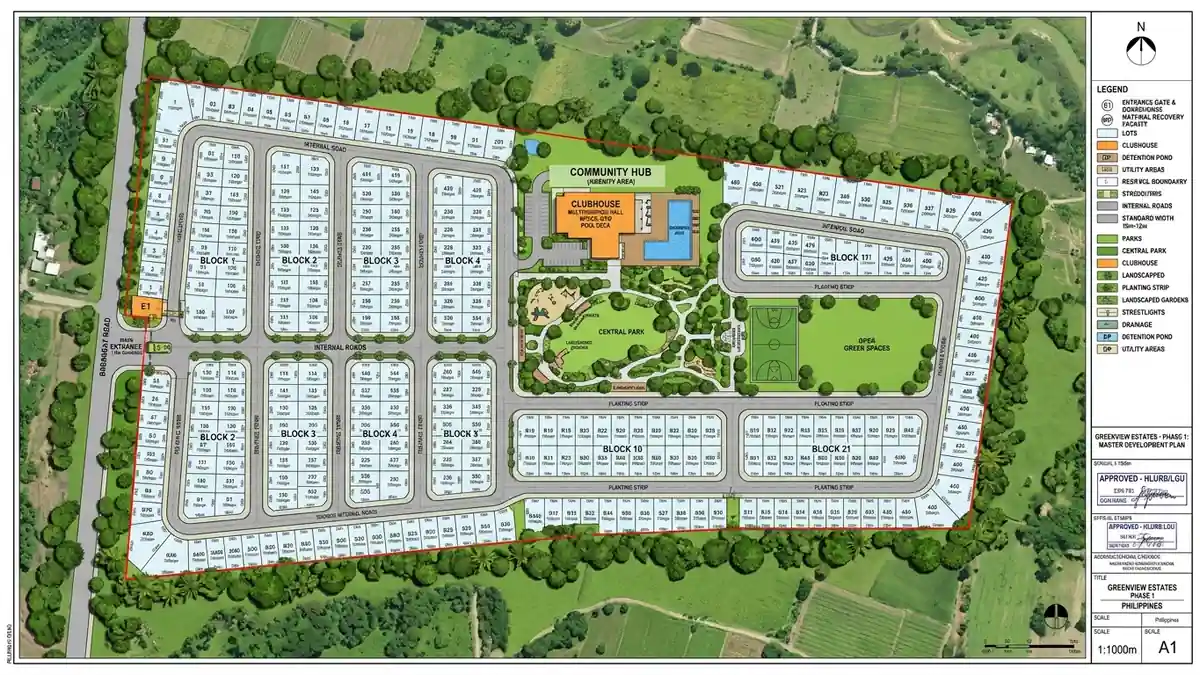
Under Section 31 of PD 957, as amended by Presidential Decree No. 1216, subdivision developers are legally required to allocate a mandatory percentage of the total gross area for roads, drainage, parks, playgrounds, and community facilities:
- For residential subdivisions with 1 hectare or larger, at least 30% of the total project area must be dedicated to open spaces and roads.
- Road lots and open spaces cannot be converted to residential sale lots, cannot be mortgaged, and must ultimately be donated to the city or municipality (in this case, Vigan City or the Municipality of Bantay), or conveyed directly to the duly registered Homeowners Association (HOA) with LGU consent.
During title due diligence, examine the developer’s mother title and master subdivision plan to confirm that road lots are designated as separate parcels and have not been pledged as collateral to creditors. For a step-by-step methodology on inspecting registry records, read our comprehensive guide on how to verify a land title at the Registry of Deeds.
In the subsequent stage of your purchase, understanding tax computation and registry fees is essential. Consult our guide on title transfer services and requirements to navigate Capital Gains Tax, Documentary Stamp Tax, and local transfer taxes seamlessly.
Architectural and Heritage Zoning: UNESCO Buffer Zone vs Suburban Freedom
One of the most frequent misconceptions among property buyers moving to the Vigan area is that every home built in or around Vigan must look like a 16th-century Spanish colonial mansion with clay tile roofs and wooden window grilles. Understanding the exact geographic boundaries of local heritage ordinances will save you significant architectural expense and design frustration.
Vigan City Ordinance No. 04 (Series of 2000) Heritage Core and Buffer Rules
Vigan City’s world-famous heritage status is protected by Vigan City Ordinance No. 04, Series of 2000 (The Preservation and Conservation of the Vigan World Heritage Site and Buffer Zones). This ordinance establishes two strictly regulated zones:
- The Historic Core Zone: Covering the ancient Spanish trading district (centered around Calle Crisologo, Plaza Burgos, and Plaza Salcedo), this zone enforces absolute architectural preservation. Existing ancestral houses cannot be demolished. New construction or renovations must strictly mirror 18th-century and 19th-century architecture, using clay tile roofing (tejas), brick or plastered stone ground floors (cal y canto), hardwood second floors, capiz or persiana windows, and muted pastel earth tones. Building heights are restricted to a maximum of two storeys or 10 meters.
- The Heritage Buffer Zone: Surrounding the core zone, the buffer zone serves as a visual transition corridor. While building designs here have slightly more flexibility, all plans must still be submitted to the Vigan Conservation Council (VCC) for architectural review, ensuring rooflines, exterior facades, and signage do not clash with the historic skyline.
Acquiring real estate inside the Core or Buffer Zone requires adherence to strict conservation guidelines, specialized building materials, and lengthy review cycles by the city conservation office.
Building Outside the Heritage Zone: Modern House Designs in Suburban Subdivisions
Here is the liberating reality for subdivision lot buyers: residential subdivisions in Metro Vigan are located outside the UNESCO Historic Core and Buffer Zones.
Whether you purchase a lot in Bantay (such as Tierra Vista), Santo Domingo, or the suburban barangays of Vigan (such as Tamag or Ayusan), you are entirely outside the jurisdiction of Vigan Conservation Ordinance No. 04. This means:
- You are free to build contemporary modern, minimalist, Scandinavian, Mediterranean, or tropical modern architectural homes.
- You can utilize modern building materials, including insulated metal standing-seam roofing, tempered glass curtain walls, composite wood panels, and reinforced concrete.
- Your building plans require standard municipal engineering permits under the National Building Code of the Philippines (Presidential Decree No. 1096), without having to undergo the Vigan Conservation Council aesthetic vetting process.
Understanding the Subdivision Deed of Restrictions (DOR) and HOA Guidelines
While municipal heritage restrictions do not apply in suburban subdivisions, private subdivision regulations do. Every well-managed gated community enforces a private Deed of Restrictions (DOR) annotated on the title or incorporated into the purchase contract:
- Building Setbacks: Standard DOR guidelines require minimum setbacks from property boundaries (typically 3 meters from the front road boundary and 2 meters from side and rear boundaries) to ensure adequate airflow, natural lighting, and fire prevention.
- Height Restrictions: Most suburban subdivisions cap residential height at 2 to 2.5 storeys (roughly 9 to 10 meters) to preserve neighborhood privacy and prevent multi-family high-rises from towering over adjacent single-family bungalows.
- Construction Cost Floors: Quality subdivisions often mandate a minimum construction value (for example, requiring homes to have a minimum building cost of ₱2,500,000 to ₱4,000,000) to maintain high community aesthetic standards and protect neighborhood property valuation.
- HOA Dues and Governance: Living in a gated subdivision entails recurring Homeowners Association (HOA) monthly assessments under Republic Act No. 9904 (The Magna Carta for Homeowners and Homeowners Associations). Dues typically range from ₱500 to ₱2,000 per month, funding 24/7 security guard personnel, street lighting maintenance, garbage collection, and clubhouse care.
Master Comparison Matrix: Established Subdivisions Across Metro Vigan
To assist prospective homebuilders and investors in evaluating their options, the following comparison matrix outlines established residential subdivisions across the Metro Vigan corridor based on location, developer classification, lot sizes, price benchmarks, and environmental parameters:
| Subdivision / Area | Municipality | Developer Classification | Average Lot Cuts | Price Range (₱/sqm) | Title Segregation Status | Amenities & Security | Zoning & Flood Profile |
|---|---|---|---|---|---|---|---|
| Tierra Vista Subdivision | Bantay (Adjacent to Vigan) | Established Master-Planned Developer | 150 to 350 sqm | ₱8,500 to ₱14,000 / sqm | Individual TCTs Released | Gated entrance, 24/7 security guardhouse, clubhouse, playground, perimeter fence, concrete curbs. | Outside UNESCO buffer zone; elevated terrain with excellent natural drainage; high flood immunity. |
| Mira Hills / Heights Area | Bantay / Boundary Corridor | Mid-Scale Residential Development | 180 to 400 sqm | ₱7,500 to ₱12,000 / sqm | Mixed (Verify on specific block) | Paved access roads, basic security checkpoints, peaceful suburban setting. | Ridge elevation; zero river flood risk; standard suburban residential zoning. |
| Tamag Residential Enclaves | Vigan City (Barangay Tamag) | Private Compound / Pocket Subdivisions | 120 to 250 sqm | ₱10,000 to ₱18,000 / sqm | Individual TCTs for titled pockets | Gated entries, streetlights, immediate proximity to universities and provincial capitol. | Suburban Vigan; outside historic core; requires verification of roadside ditch drainage. |
| Santo Domingo Highway Corridor | Santo Domingo (North Metro Vigan) | Emerging Residential Clusters | 200 to 500 sqm | ₱4,500 to ₱8,000 / sqm | Varies (Critical to check CR/LS) | Wide open spaces, larger garden yards, basic concrete roads, expanding commercial access. | Agricultural-to-residential transitions; elevated agricultural ground; safe from river overflow. |
| Alpha + Alpha Residences (AA Subdivision) | San Ildefonso (Barangay Otol-Patac) | Aljero A. Favis Realty and Development Inc. | 46 House and Lot Units (Economic Housing under BP 220) | Pre-Selling Packages (Cash, Bank, Pag-IBIG) | DHSUD-Licensed; Individual TCTs on Turn-Over | Gated entrance, concrete road networks, ISECO electricity, dedicated water provisions, community drainage. | BP 220 compliant outside UNESCO buffer zone; moderate to low flood risk; 10 to 15 minutes to Vigan City center. |
| Caoayan Riverfront Subdivisions | Caoayan (South of Vigan) | Small-Scale Residential Enclaves | 150 to 300 sqm | ₱4,000 to ₱7,500 / sqm | Individual TCTs on registered sites | Coastal air, peaceful environment, quick bridge connection to southern Vigan. | Flood Vulnerable: Must check seasonal river cresting and require elevated foundation filling. |
Note on price benchmarks: Figures reflect general prevailing market valuations in Ilocos Sur as of 2026. Actual asking prices vary depending on specific corner-lot positioning, road width frontage, immediate title readiness, and developer financing terms.
Featured Project Spotlight: Alpha + Alpha Residences (San Ildefonso, Ilocos Sur)
For buyers seeking an accredited, legally secure house and lot package in Metro Vigan, Alpha + Alpha Residences (also marketed as The Residences at Alpha Meadows) in Barangay Otol-Patac, San Ildefonso represents a prime example of master-planned economic housing executed with strict regulatory compliance.
Developed by Aljero A. Favis Realty and Development Inc. (AA Subdivision), the project provides a structured residential alternative for local families and overseas workers who want modern home construction without the inflated land acquisition costs of central Vigan.
Alpha + Alpha Residences Project Highlights
- Project Developer: Aljero A. Favis Realty and Development Inc.
- Location: Barangay Otol-Patac, San Ildefonso, Ilocos Sur (6.58 km or 10 to 15 minutes from Vigan City proper; 5 km from Bantay)
- Development Classification: DHSUD-Licensed Economic Housing Subdivision under Batas Pambansa Blg. 220
- Project Scope: 46 house and lot units in Phase 1 (targeted completion by February 2028)
- Utility Infrastructure: Direct power interconnection via the Ilocos Sur Electric Cooperative (ISECO), dedicated water distribution network, and engineered concrete storm drainage
- Flexible Financing: Accessible through Spot Cash, Commercial Bank Housing Loans, and Pag-IBIG Fund (HDMF) Mortgage Financing
Prospective homebuilders and investors can review complete architectural floor plans, pricing schedules, and availability through our official Alpha + Alpha Residences property listing on iRealtee, or contact our brokerage office directly to schedule an on-site property walkthrough.
Infrastructure and Utility Audit: Power, Water, Connectivity, and Drainage
A subdivision may look magnificent in an architectural rendering, but day-to-day comfort depends entirely on basic utilities. In provincial real estate, you must conduct your own physical infrastructure audit before signing a purchase agreement.
Power Grid Stability and ISECO Outage Mitigation
Electrical service throughout Ilocos Sur is distributed by the Ilocos Sur Electric Cooperative (ISECO). While the provincial grid has steadily modernized, Northern Luzon regularly experiences powerful monsoon storms and typhoons between July and October, frequently causing temporary grid outages due to fallen tree limbs along overhead transmission lines.
When inspecting a subdivision, evaluate:
- Subdivision Transformer Distribution: Check whether the developer has installed dedicated concrete utility poles and distribution transformers sized to handle full residential occupancy, or whether houses are relying on long, undersized drop-wires.
- Back-Up Power Provisions: Premier subdivisions maintain diesel generators for the main guardhouse, entrance boom gates, and streetlights. For your individual home, design your building plan with a manual transfer switch (MTS) or automatic transfer switch (ATS) to support a standby generator or rooftop solar photovoltaic system with lithium battery storage.
Water Security: Metro Vigan Water District (MVWD) vs Submersible Deep Wells
Potable water in Metro Vigan is supplied either through the Metro Vigan Water District (MVWD) piped network or private motorized deep-well systems:
- MVWD Piped Connection: Where available, an MVWD mainline connection provides pressurized treated water. However, in higher-elevation subdivisions or at the far ends of distribution lines, water pressure can dip during peak morning hours (6:00 AM to 8:30 AM).
- Centralized Subdivision Deep Wells: Many self-contained master-planned communities operate a private centralized deep well, pumping water into an overhead elevated storage tank that gravity-feeds all residential lots.
- Homeowner Best Practice: Regardless of the subdivision water source, standard building practice in Ilocos Sur involves installing an on-site ground storage cistern or overhead stainless steel tank paired with a 1-horsepower booster pressure pump to ensure continuous water supply during utility maintenance.
Telecom and Fiber Readiness for Work-from-Home Professionals
Many returning OFWs and remote professionals choose Metro Vigan for its relaxed pace while continuing to work for multinational employers. Never assume fiber internet is installed just because a national highway is nearby:
- Confirm whether major internet service providers (PLDT Home Fiber, Converge ICT, or Globe At Home) have physical fiber-optic distribution boxes (NAP boxes) mounted inside the subdivision.
- Inspect cellular reception on site across multiple network carriers (Smart and Globe) to verify indoor mobile coverage.
Topography, Elevation, and Floodplain Safety (Govantes and Mestizo River Basins)
Vigan City is historically an island municipality, bounded by the Abra River delta, the Govantes River to the north and east, and the Mestizo River to the south. During major typhoon systems, river swelling combined with high ocean tides can cause low-lying coastal and riverside barangays to experience backwater flooding.
When evaluating a subdivision:
- Examine Topographical Elevation: Communities built on elevated ridges, such as the rolling hills of Bantay or naturally high plateaus, possess superior drainage and are immune to river cresting.
- Inspect Drainage Engineering: Look inside the roadside storm drains. Quality subdivisions feature wide, reinforced concrete box culverts or deep open drainage channels that rapidly channel torrential monsoon rainwater into natural outfalls. Avoid developments with shallow, silted dirt ditches that overflow onto lot frontages during heavy rains.
- Interview Adjoining Neighbors: The most reliable flood due diligence is asking nearby long-term residents and local tricycle drivers: “Agtudo unay, lumlumlom kadi ditoy?” (When it rains heavily, does water accumulate here?). Real local testimony reveals seasonal watermarks that developer marketing brochures never disclose.
5-Stage Due Diligence Roadmap for Subdivision Buyers
To ensure a seamless, legally bulletproof property acquisition, follow this sequential 5-stage due diligence roadmap when purchasing a residential subdivision lot in Metro Vigan:
| Stage | Key Actions & Documents | Responsible Authority | Red Flag to Avoid |
|---|---|---|---|
| Stage 1: Credential Verification | Verify Certificate of Registration (CR) and License to Sell (LS). Verify broker PRC ID and DHSUD accreditation. | DHSUD Region 1 / PRC | Developer offering lots for sale under “pre-selling” without an approved License to Sell. |
| Stage 2: On-Site Ocular Inspection | Conduct physical site inspection. Locate concrete boundary markers (mojons). Check road widths, ISECO poles, MVWD water pipes, and drainage culverts. | Licensed Broker / Geodetic Engineer | Missing boundary monuments, narrow dirt access roads, standing water after brief rains, or high-tension power lines directly overhead. |
| Stage 3: Registry Title Audit | Secure a Certified True Copy (CTC) of the specific lot’s TCT from the Registry of Deeds (Vigan or Candon). Inspect the Memorandum of Encumbrances for bank mortgages or adverse claims. | Registry of Deeds / LRA PhilRIS | Uncanceled real estate mortgage (REM) in favor of a commercial bank without a partial release agreement. |
| Stage 4: Contract Review | Thoroughly read the Reservation Agreement, Contract to Sell (CTS), and Deed of Restrictions (DOR). Scrutinize payment schedules, forfeiture clauses, and Macedonian Law protections under RA 6552. | Real Estate Counsel / Broker | Clauses requiring buyer to shoulder developer taxes (such as VAT or unpaid developer corporate income taxes) or omitting completion deadlines. |
| Stage 5: Conveyance and Titling | Upon full payment, execute notarized Deed of Absolute Sale (DOAS). Pay Capital Gains Tax and DST at BIR RDO 12 (Ilocos Sur). Secure barcoded BIR eCAR. Pay local transfer tax and register individual TCT in buyer’s name. | BIR RDO 12 / Municipal Treasurer / Registry of Deeds | Prolonged developer delays in releasing the DOAS or failing to remit taxes, preventing issuance of the BIR eCAR. |
For a complete breakdown of legal risks across all provincial property purchases, review our foundational guide on real estate due diligence in the Philippines.
Frequently Asked Questions About Subdivisions in Vigan City
1. Are there gated residential subdivisions located inside historic downtown Vigan?
No. The historic downtown district of Vigan (the UNESCO World Heritage Core and Buffer Zones) consists of established ancestral homes, institutional buildings, and commercial establishments. There are no large tracts of vacant land to accommodate modern master-planned subdivisions in the historic center. Residential subdivisions are located in suburban barangays (such as Tamag and Ayusan) and in neighboring municipalities forming Metro Vigan, particularly Bantay, San Ildefonso, and Santo Domingo.
2. Can I build a modern contemporary house in a Metro Vigan subdivision?
Yes. Because suburban residential subdivisions in Metro Vigan (including Bantay, Santo Domingo, San Ildefonso, and suburban Vigan barangays) sit outside the UNESCO World Heritage conservation zones, homeowners are not bound by Vigan City Ordinance No. 04 (Series of 2000). You are not required to build Spanish colonial architecture or use clay tile roofs. You can construct modern, contemporary, or Mediterranean homes, subject only to the National Building Code and your subdivision’s private Deed of Restrictions.
3. What is the legal danger of buying an unapproved “pocket” subdivision lot?
Unapproved pocket subdivisions lack a Certificate of Registration (CR) and License to Sell (LS) from DHSUD. These developments typically involve unsegregated agricultural land that has not undergone Department of Agrarian Reform (DAR) conversion. If you purchase an unapproved lot, you will not receive an individual Transfer Certificate of Title (TCT), will be unable to secure a municipal building permit, and public utility companies like ISECO and MVWD will refuse to install dedicated electric and water service connections.
4. How can I confirm whether a subdivision lot has its own individual TCT?
Request a photocopy of the specific lot’s title from the developer or seller and obtain a fresh Certified True Copy (CTC) directly from the Registry of Deeds via the Land Registration Authority (LRA) PhilRIS system or eSerbisyo portal. If the title is an individual TCT, it will bear a unique title number and the technical description will specifically describe that single lot (for example, “Lot 14, Block 3, Psd-…”). If the developer presents a title covering several hectares, the property is still an undivided mother title.
5. What recurring monthly costs should I budget for in a gated subdivision?
Homeowners in gated subdivisions pay monthly Homeowners Association (HOA) dues under Republic Act No. 9904. In Metro Vigan, HOA dues generally range from ₱500 to ₱2,000 per month, depending on community amenities. These fees cover 24/7 security guard personnel, perimeter gate operation, street lighting electricity, common area landscaping, and garbage collection. In addition, you must pay annual Real Property Tax (RPT) on both your titled land and your house improvements to the municipal treasurer.
6. What are the typical lot price ranges in Metro Vigan subdivisions?
As of 2026, prices in established, fully titled master-planned communities with complete amenities (such as Tierra Vista in Bantay) typically range from ₱8,500 to ₱14,000 per square meter. Suburban residential clusters in Tamag and Bantay range from ₱7,500 to ₱18,000 per square meter depending on commercial proximity. In emerging suburban enclaves like San Ildefonso and Santo Domingo, lot-only and economic house-and-lot packages (such as Alpha + Alpha Residences by AA Subdivision) offer highly competitive entry prices with pre-selling terms through Cash, Bank, or Pag-IBIG financing.
What I Would Check Next Before Reserving a Subdivision Lot
Before transferring a reservation fee or signing any paperwork for a subdivision lot in the Metro Vigan area, I always advise my clients to take these three immediate steps:
- Examine the Master Development Plan on the Ground: Take the approved subdivision lot layout to the physical property. Match the surveyed lot on paper with the physical concrete monuments (mojons) in the ground. Ensure the lot does not sit directly above a major storm drainage outfall, that it has adequate road frontage, and that no neighboring structures encroach across the boundary.
- Demand Written Timelines for Title Release: If buying into a pre-selling or newly expanded phase, demand a formal written undertaking from the developer specifying the exact date when the individual TCT will be released into your name, along with clear penalties if the developer fails to deliver.
- Verify Local Property Tax Assessment: Check with the municipal assessor’s office to confirm that the developer has settled all annual Real Property Taxes on the mother parcel. An outstanding tax delinquency on the developer’s mother title can stall your individual title transfer at the Registry of Deeds for months.
Professional Due Diligence and Land Acquisition Services
Purchasing a home or residential lot is one of the largest financial investments you will ever make. Whether you are an Overseas Filipino Worker planning your retirement home, an investor seeking capital appreciation, or a family looking for a secure neighborhood, navigating developer credentials, title audits, and provincial zoning requires local expertise.
At LandMaster Realty, we have guided clients through secure provincial real estate transactions since 2023. We provide comprehensive due diligence, independent title verification at the Registry of Deeds, geodetic boundary reviews, and complete title transfer representation across Ilocos Sur.
To discuss your property goals or request an independent due diligence audit on a subdivision lot in Metro Vigan, explore our Metro Vigan residential listings, inquire about Alpha + Alpha Residences in San Ildefonso, or reach out directly through our contact page for professional consultation.